Critic takes aim at ruling on minimum wage and poverty
A Truth-O-Meter item published today on New Jersey’s minimum wage and poverty sparked some criticism from one reader.
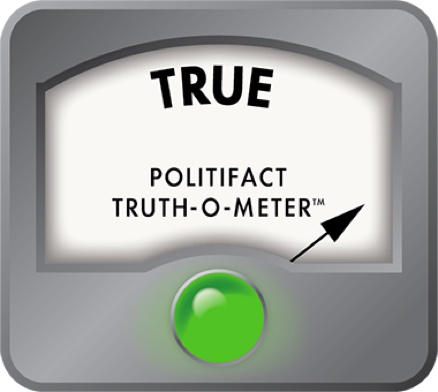
Assemblyman Wayne DeAngelo, a Democrat representing parts of Middlesex and Mercer counties, wrote a letter to the editor published in The Times of Trenton on Feb. 27 that said: “At the current New Jersey minimum wage, a full-time employee earns only $15,080. In comparison, the federal poverty level for a two-person household is $15,130. If we keep the minimum wage at the current level, then single-parent families earning the minimum wage at a full-time job will live in poverty in New Jersey. ” We rated that claim True.
DeAngelo based his statement on the U.S. Department of Health and Human Services’ poverty guidelines, a measure used primarily for administrative reasons such as determining eligibility for government assistance programs. Agencies may apply different income measures to the guidelines. The U.S. Census Bureau issues another measure of poverty called the poverty threshold, which is used for statistical purposes, such as determining the number of people living in poverty.
In DeAngelo’s scenario, the earnings from a minimum wage job don’t exceed either poverty measure.
But Michael Saltsman, a research fellow with Employment Policies Institute, a business-backed Washington, D.C.-based group, said our ruling was inaccurate for two reasons.
First, he said, “it ignores the Earned Income Tax Credit and other benefits available to these families” such as government assistance with food and energy costs.
“Let’s take the case above, of a two-person household with a single parent supporting a child. If they’re earning $15,080 a year, they’ll also be receiving an EITC payment of approximately $3,094. Additionally, New Jersey offers a state supplement to that federal payment of 20%. The NJ credit adds approximately $619 to the EITC payment, for a total payment of $3,713. So, in the example above, the full time minimum wage employee with a child would actually earn $18,793 a year, above the federal poverty line cited,” Saltsman wrote. He said he wasn’t criticizing the earned income tax credit and other programs, “the point is just that a single earner with a child in New Jersey is not living on $15,080 a year—with the other benefits available, they’re actually above the federal poverty level cited.”
However, the Census Bureau does not include the earned income tax credit as income for its poverty threshold. That’s been identified as one of the weaknesses in the poverty measure. But other weaknesses have also been identified, including: transportation and medical costs and geographic differences in prices that aren’t reflected in the current poverty measure.
The federal government is developing a supplemental poverty measure to address some of these issues.
So, there are concerns about the official poverty measure, but they fall on both ends of the spectrum.
By the measurement the federal government uses to determine who lives in poverty, DeAngelo’s statement is correct. So, we don’t fault the assemblyman for making the comparison using that measurement.
Saltsman’s second contention was that our ruling “ignores the distribution of minimum wage earners in the state of New Jersey.” He highlighted his institution’s analysis of Census data that found about 24 percent of the people who benefited from New Jersey’s last increase in the minimum wage were “single earners supporting kids on their own.” While “45% were people (such as young adults) living with a parent or relative, and 18% were second-earners with a spouse that also worked,” he said.
That’s worth noting, but it doesn’t impact our ruling. DeAngelo highlighted one scenario — and by Saltsman’s own analysis, that scenario applied to 24 percent of people who benefited from the state’s last minimum wage increase.
PolitiFact New Jersey’s ruling of True stands.
Our Sources
PolitiFact New Jersey, Assemblyman says a single-parent earning current minimum wage falls below federal poverty line, March 9, 2012
Emails from Michael Saltsman, a research fellow with the Employment Policies Institute, March 9, 2012
Email from Deborah Johnson, public information officer and senior editor for the Institute for Research on Poverty at the University of Wisconsin–Madison, March 7, 2012
U.S. Census Bureau, The Research Supplemental Poverty Measure: 2010, accessed March 9, 2012
Institute for Research on Poverty, Poverty Measurement: Federal Supplemental Poverty Measure (SPM), accessed March 9, 2012
Institute for Research on Poverty, How is poverty measured in the United States?, accessed March 9, 2012
Email from Adria Thomas of the U.S. Census Bureau’s public information office, March 9, 2012