“The average time someone used to hold a share of stock back in the ’60s was eight years. Now, the average time is four months.”

Mark Warner says average holding time for stocks has fallen to four months
U.S. Sen. Mark Warner joined the ranks of Wall Street critics during a recent radio interview, by complaining that investors increasingly are focused on reaping quick profits from companies at the expense of long-term value.
“The average time someone used to hold a share of stock back in the ’60s was eight years. Now, the average time is four months,” he said during an interview on “Cat’s Roundtable,” a New York City radio talk show hosted by John Catsimatidis, a billionaire businessman.
We wondered whether Warner, D-Va., is right about the plunge in share-holding time.
Warner’s office sent us a variety of articles by academics, investment strategists, newspapers and magazines that contained similar statistics to the ones cited by the senator.
The source of the historic data is the New York Stock Exchange which, for most of the 20th century, was the dominant U.S. stock-trading venue.
Here’s the NYSE’s average holding period for stocks at the start of each new decade, beginning at Warner’s mark in 1960:
•1960, eight years, four months;
•1970, five years, three months;
•1980, two years, nine months;
•1990, two years, two months; and
•2000, one year, two months.
But many new trading venues have opened and expanded in recent decades – E*Trade and NASDAQ, for example – and the New York Stock Exchange’s dominance has diminished.
About 25 percent of all U.S. trading now occurs on the NYSE, which has high financial requirements for the companies it lists and generally deals with large, stable stocks.
In 2004, the NYSE changed its formula for calculating average share-holding periods to focus on its own listings. Credit Suisse that year began computing share-holding data that reflect the broader U.S. stock market.
Credit Suisse figures show that in 2008 and 2009, when the nation was mired in the Great Recession, shares turned over an average almost five times a year. That’s slowed to about three times a year since 2013 or, as Warner put it, once every four months.
The World Bank offers more conservative figures, saying U.S. shares, on average, turned over four times a year during the Great Recession and that slowed to 1.65 times a year in 2015 – or about once every eight months.
Stock market analysts and academics note a variety of reasons for the quickening turnover of shares. Many say the days of small ma-and-pa investors have given way to an era of mutual funds and hedge funds that exert strong pressure of companies to produce short-term profits.
The growth of e-trading also is cited; so are federal laws passed in 1993 that tied the bonuses of executives to their achievement of measurable performance goals in order for the bonuses to be tax-deductible for their companies.
Warner said the consequence of “activist investors” is that corporations pay less attention to training workers and to research and development. He said Congress should explore offering tax incentives to companies that embrace those long-range goals.
Many activist investors, to the contrary, say their actions have been beneficial and note that the stock market has continued to rise over the decades.
Our ruling
Warner said, “The average time someone used to hold a share of stock back in the ’60s was eight years. Now, the average time is four months.”
The gist of Warner’s statement is undeniable: The average holding period for stocks has eroded greatly during the past 56 years.
The specifics of Warner’s statement, however, need a little elaboration. Estimates by Credit Suisse jibe with Warner’s claim that shares, on average, now are held for four months. The World Bank estimates the holding period now is about eight months.
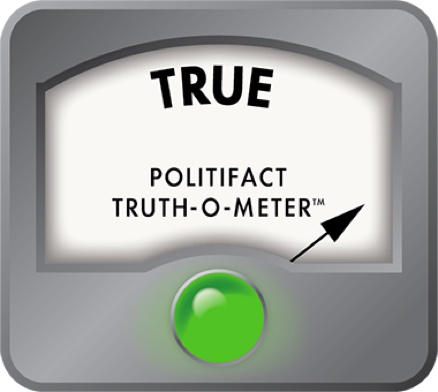
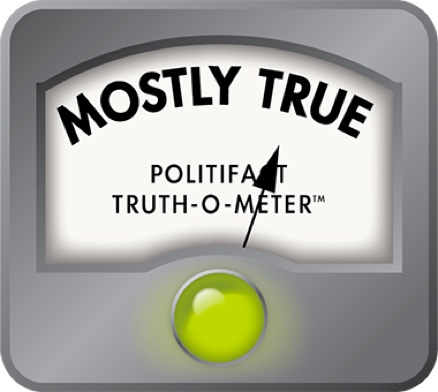
So we rate Warner’s statement Mostly True.
https://www.sharethefacts.co/share/2825f4d2-7663-4da5-8b09-70db1503d5e3
Our Sources
Mark Warner, Radio interview on "The Cat’s Roundtable," June 19, 2016 (20-minute mark on audio).
Email from Kevin Hall, communications director for Mark Warner, June 21, 2016.
Forbes, "Stock market becomes short attention theater of trading," Jan. 21, 2011.
LPL Financial, "Weekly Market Commentary," Aug. 6, 2012.
Yale School of Management, "Does focusing on shareholder value hurt shareholder value?" Nov. 13, 2012.
The Wall Street Journal, "Why hair-trigger traders lose the race," April 10, 2015.
New York Stock Exchange, "NYSE Group turnover, 2010-2016," accessed June 28, 2016.
New York Stock Exchange, "Annual reported volume, turnover rate, reported trades," 1900-2003.
Emails from Azar Boehm, communications manager for Credit Suisse, June 29-30, 2016.
Bloomberg, "Where has all the stock trading gone?" May 10, 2012.
The World Bank, "Stocks traded, turnover ratio of domestic shares," 1975-2015.