
Do U.S. families have more money in their pockets now, despite inflation?
If your time is short
• The standard metric used for this purpose — per capita, inflation-adjusted personal disposable income — has risen steadily since before the pandemic hit, even when some anomalous quarters during the pandemic are factored out.
• Not all of the increase in inflation-adjusted disposable income has to do with organic economic growth. Some was because of the emergency fiscal measures that were passed during the pandemic under both the Trump and Biden administrations.
Despite overseeing strong showings in employment and economic growth, President Joe Biden’s public standing has been weakened by inflation levels not seen in decades. During Dec. 3 remarks on the most recent jobs report, Biden said that some of the economic achievements on his watch have allowed Americans to keep a step ahead of inflation.
“Even after accounting for rising prices, the typical American family has more money in their pockets than they did last year,” Biden said.
When we took a closer look, we found that Biden has a point.
To zero in on how much Americans have “in their pockets” despite inflation, we turned to a statistic calculated by the federal Bureau of Economic Analysis: Per capita, inflation-adjusted disposable personal income. When we inquired, the White House confirmed to PolitiFact that this was the statistic Biden had in mind.
Disposable personal income refers to wage and salary income, plus government transfer payments like Social Security and unemployment insurance, minus taxes. It’s the net of what Americans have left over to pay for all of their needs after they’ve paid their taxes. The figure we used is adjusted for inflation and calculated on a per capita — that is, a per person — basis.
During the coronavirus pandemic, this metric has been unusually volatile. That’s because the federal government enacted several massive bills that provided cash payments, expanded unemployment insurance, business loans, and liberalized child tax credits to help the nation cope with an unprecedentedly sudden economic shutdown after the virus emerged.
In the second quarter of 2020 and the first quarter of 2021 — the quarters that included some of the most intensive federal relief efforts, including the cash payments — personal disposable income rose significantly higher than usual. Smaller but tangible bumps were also evident in the third quarter of 2020 and the second quarter of 2021.
Beyond these anomalous quarters, though, the data shows that personal disposable income has risen fairly steadily since the first quarter of 2016.
This means that, even setting aside the unusually high quarters, per-capita, inflation-adjusted personal disposable income was higher in the third quarter of 2021 — at $47,188 — than it was in the fourth quarter of 2020, when it was $46,682, as well as every month prior to the pandemic. (These are “annualized” rates, which means that the amount of disposable income for a quarter is multiplied by four, to show what it would look like over the course of a whole year.)
One way to look at this is that we’re simply following the gentle upswing in personal disposable income that’s been underway for years. But economists say that would be misleading, since staying on that trend line was no foregone conclusion once the pandemic hit.
“It’s honestly quite surprising to look at the personal income data and not see a deep gash in income,” George Washington University economist Tara Sinclair said. “To continue a long-term trend of growing personal income when the economy was getting hammered is a pretty impressive feat of policy.”
To see a decline in gross domestic product of more than 30% between the first and second quarters of 2020 is akin to “a Great Depression in one quarter,” said Douglas Holtz-Eakin, president of the American Action Forum, a center-right think tank. “But there was enough cash coming out of the government that you don’t see it in the personal disposable income data. It’s stunning.”
Part of the reason for larger disposable incomes is government payments, but another part is that Americans were unable to spend what they would have on many services, including restaurants and tourism during the pandemic.
One clear sign of that is the personal saving rate. For four years prior to the pandemic, personal saving as a percentage of disposable income usually hovered between 7% and 9%. But after the pandemic struck, it initially spiked to 26% and has remained higher than the pre-pandemic average ever since.
This has been echoed in a different metric, as well. JPMorgan Chase research found that median cash balances — the amounts of money Americans have in the bank — were more than 50% higher at the end of July 2021 than they were at the end of July 2019.
Biden and his policies deserve a share of credit, experts say, but not all of it.
The CARES Act, passed early in the pandemic, was a broadly bipartisan bill that was signed by then-President Donald Trump. Trump also signed a series of smaller bipartisan relief bills. Biden’s biggest contribution, the American Rescue Plan, was passed with only Democratic support.
“You can argue how much credit Biden and the American Rescue Plan deserve, as opposed to Trump and the CARES Act,” said Dean Baker, co-founder of the liberal Center for Economic and Policy Research. But both efforts, he said, were a “big deal.”
Our ruling
Biden said, “Even after accounting for rising prices, the typical American family has more money in their pockets than they did last year.”
Since the pandemic’s onset, there has been unusual volatility in the metric used for this purpose — per capita, inflation-adjusted personal disposable income. But even setting those quarters aside, the country has seen steady growth in disposable income since before the pandemic hit.
Not all of this has to do with organic economic growth. The expansion of disposable income is partly because of changes in Americans’ spending behaviors during the pandemic, but it has a lot to do with the emergency fiscal measures that were passed under the Trump and Biden administrations.
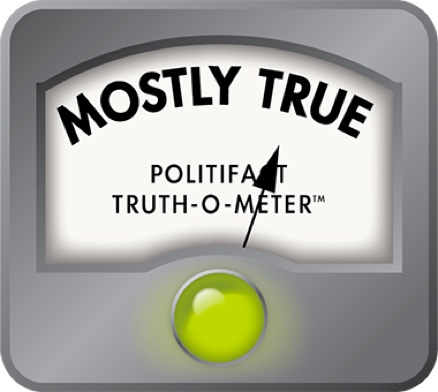
We rate the statement Mostly True.
Our Sources
Joe Biden, remarks on the economy, Dec. 3, 2021
Bureau of Economic Analysis, Table 2.1. Personal Income and Its Disposition, accessed Dec. 6, 2021
JPMorgan Chase, "Household Finances Pulse: Cash Balances during COVID-19," September 2021
Email interview with Tara Sinclair, George Washington University economist, Dec. 6, 2021
Email interview with Dean Baker, co-founder of the Center for Economic and Policy Research, Dec. 6, 2021
Email interview with Gary Burtless, senior fellow at the Brookings Institution, Dec. 6, 2021
Interview with Douglas Holtz-Eakin, president of the American Action Forum, Dec. 6, 2021