“Apple has just announced it plans to invest a total of $350 billion in America, and hire another 20,000 workers.”

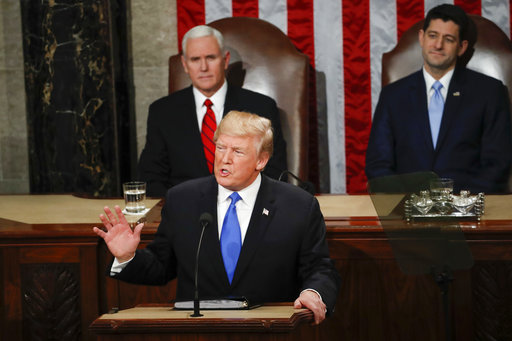

Donald Trump inflates Apple investment
In his State of the Union address, President Donald Trump led off with the economy, and he drew particular attention to the recently passed tax law.
“Since we passed tax cuts, roughly 3 million workers have already gotten tax cut bonuses,” Trump said. “And it’s getting more every month, every week. Apple has just announced it plans to invest a total of $350 billion in America, and hire another 20,000 workers.”
A number of readers asked us to take a closer look at his claim about Apple, so we did.
Apple’s press release
We can see where Trump got his number. Under the headline “Apple accelerates US investment and job creation,” Apple announced on Jan. 17 a series of initiatives to bolster its position in the United States.
“Combining new investments and Apple’s current pace of spending with domestic suppliers and manufacturers — an estimated $55 billion for 2018 — Apple’s direct contribution to the U.S. economy will be more than $350 billion over the next five years,” the statement said.
Notice that Apple did not say it plans to invest $350 billion. It described its “direct contribution to the U.S. economy.”
Charles Lee, accounting professor at Stanford University’s Graduate School of Business, told us the distinction is huge.
“Apple certainly did not just announce it plans to invest a total of $350 billion in America,” Lee said. “This is a statement about its importance to the U.S. economy, not a statement about its new investments due to the tax law change.”
So what did Apple’s press release actually say?
It said its purchases from other companies will be large — about $55 billion in 2018. Lee said if that number didn’t grow, Apple would spend about $275 billion over five years. But that’s “pre-planned,” Lee said. It’s the cost of doing business and doesn’t represent new investment.
If it isn’t an investment in expansion, such as building new facilities, buildings and data centers, that brings the investment total down to $75 billion.
But even that figure is too high.
Apple wrote the $75 billion includes expected “repatriation tax payments of approximately $38 billion.” The new tax law offers a lower tax rate for companies that move profits off the books of their overseas subsidiaries and put them on their domestic balance sheets.
Not only is paying Uncle Sam not an investment, Lee cautioned that it doesn’t even mean that Apple is doing anything with those overseas profits immediately.
“It simply means they are pre-paying the taxes on that cash right now to take advantage of the lower rates,” Lee said. “This ensures Apple will not need to pay any more taxes when, if ever, they decide to bring the cash back.”
After subtracting the taxes, Lee said “My best estimate of the change in Apple’s U.S. investments attributable to the new laws is at most $37 billion.”
It could be a few billion less.
In a section called “Growing Apple’s U.S. operations,” the company wrote that it “expects to invest over $30 billion in capital expenditures in the U.S. over the next five years and create over 20,000 new jobs through hiring at existing campuses and opening a new one.”
In addition, it will add $4 billion to an Advanced Manufacturing Fund, an Apple program that helps finance American and foreign companies to expand in America.
That adds up to $34 billion over five years.
Our ruling
Trump said that Apple said it will invest $350 billion in America and hire another 20,000 workers.
Trump got the new hires figure right, but Apple’s own announcement doesn’t back him up on the investment dollars.
After deducting the costs of paying suppliers and paying taxes, an accounting professor estimated the investment at no more than $37 billion. And based on the press release, it could be $34 billion.
That’s still a lot of money, but it’s less than 10 percent of what Trump said.
We rate this claim Half True.

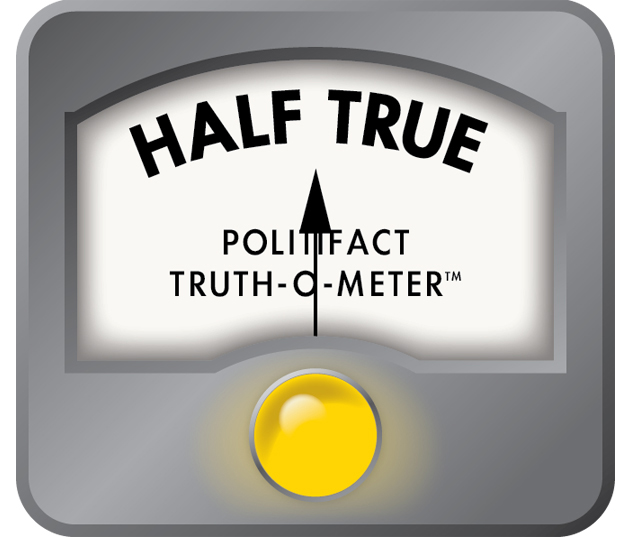 PolitiFact Rating:
Our Sources
White House, Remarks by President Trump in State of the Union Address, Jan. 30, 2018