The GOP health care plan gives “$275 billion in tax breaks for the top 2 percent, people earning $250,000 a year or more.”

Sanders: GOP health care plan gives wealthiest a $275 billion tax break
Sen Bernie Sanders, I-Vt., put a different spin on the Republican House’s plan to overhaul the health care system. Speaking on MSNBC, Sanders said the House plan isn’t really a health care plan at all.
It’s a tax cut package, he says, that overwhelmingly helps the wealthy.
“Look at it as a tax plan with $275 billion in tax breaks for the top 2 percent, people earning $250,000 a year or more,” Sanders said on All In With Chris Hayes March 8. He said the change amounted to a transfer of wealth from working families to the wealthiest.
Is that true?
Sanders’ office told us they got their tax numbers from the Joint Committee on Taxation, a congressional committee that lawmakers rely on for core fiscal data. The committee estimated the impact of repealing two taxes on the wealthy in the Affordable Care Act.
One is a 0.9 percent payroll tax on earnings and the other is a 3.8 percent tax on net investment income for individuals with incomes over $200,000 and couples with incomes over $250,000.
In the decade between 2017 and 2026, the committee said dropping both measures would cut taxes by $274.9 billion.
The Tax Policy Center, a joint fiscal analysis project of the Brookings Institution and the Urban Institute, confirmed Sanders’ number for the total tax cut.
Two caveats
First, Sanders’ fixation on the top 2 percent is not quite right.
According to the latest survey from the U.S. Census Bureau, households making $250,000 and above accounted for the top 4.4 percent. Sanders’ office cited an op-ed from two advocacy groups that asserted that those making that much fell into the top 2 percent.
Second, Gordon Mermin, a senior research associate at the Tax Policy Center, said Sanders left out a couple of “nuances.”
The House Republican plan includes other forms of tax relief that will benefit a broader swath of Americans.
“Repealing ACA taxes delivers small tax cuts to most people throughout the income distribution,” Mermin said. Plus, he added, removing the tax penalty for failing to buy insurance would benefit people regardless of income, though for low and moderate income families, “the overall average impact is small,” Mermin said.
Our ruling
Sanders said that the Republican House health care plan would cut taxes on the wealthiest 2 percent by $275 billion. While Sanders didn’t specify the time frame, that is a 10-year estimate from a neutral congressional committee. Estimates that look a decade ahead are typical in budgeting circles.
The one point where Sanders erred most was in labeling the affected taxpayers as the “top 2 percent.” According to government data, a more accurate number is 4.4 percent. But that’s still a small sliver of the population.
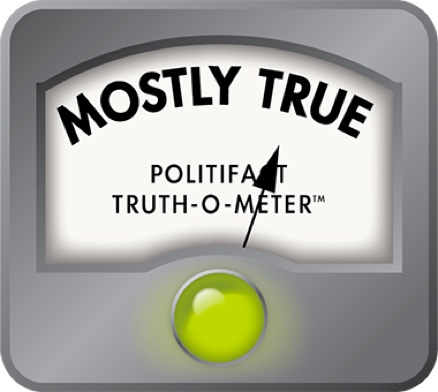
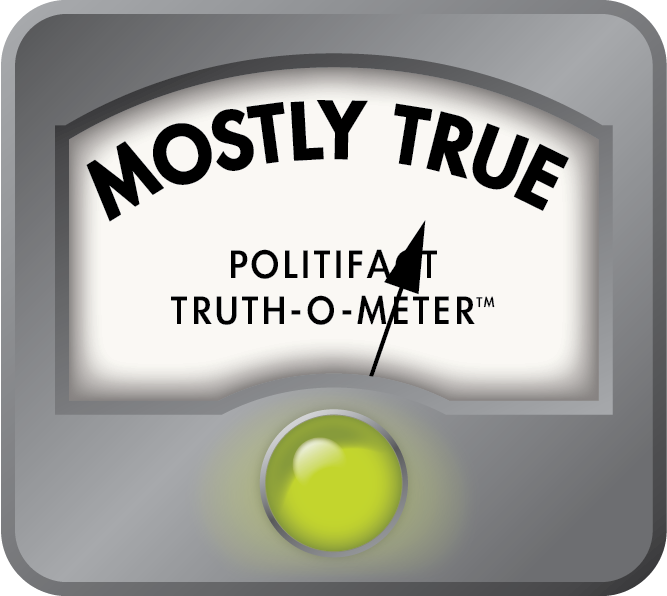
We rate this claim Mostly True.

 Politifact Rating:
Our Sources
MSNBC, All In With Chris Hayes, March 8, 2017
House Republican Leadership, Introducing the American Health Care Act, accessed March 9, 2017
Joint Committee on Taxation, Description of budget reconciliation legislative recommendation relating to repeal of the net investment income tax, March 7, 2017
Joint Committee on Taxation, Estimated revenue effects of budget reconciliation legislative recommendations relating to repeal and replace of certain health-related tax policy provisions contained in the Affordable Care Act, March 7, 2017
Tax Policy Center, The big tax changes in the House GOP health plan, March 8, 2017
U.S. Census Bureau, Family Income in 2015, accessed March 9, 2017
Congressional Budget Office, The Distribution of Household Income and Federal Taxes, 2013, June 8, 2016
CNN, How close are you to the top 1%?, 2014
USA Today, How Obamacare repeal helps rich, hurts poor: Column, Jan. 11, 2017
Email interview, Gordon Mermin, senior research associate, Tax Policy Center, March 9, 2017
Email interview, Michael Briggs, communications director, Office of Sen. Bernie Sanders, March 9, 2017