In the United States, we’ve had “12 years in a row of wages declining.”

Martin O’Malley says U.S. has seen falling wages for 12 straight years
Assuming she runs, former Secretary of State Hillary Clinton has assembled a formidable lead in the race for the 2016 Democratic presidential nomination. But there’s still a chance she’ll get some competition before the primaries and caucuses start next year.
One of those potential candidates is Martin O’Malley, who served two terms as governor of Maryland. O’Malley, like Clinton, hasn’t officially announced a bid yet, but he recently traveled to New Hampshire, home of the first-in-the-nation primary, and he sat for an interview with George Stephanopoulos on ABC’s This Week.
During the interview, O’Malley decried the long-term economic fraying of the American dream, saying the United States has had “12 years in a row of wages declining.” A reader suggested we check out this claim, so we did.
We turned to data from the federal Bureau of Labor Statistics, zeroing in on the annual averages for median, inflation-adjusted, usual, weekly earnings for full-time wage and salary workers. That sounds like a mouthful — but when we ran it by two economists, Tara Sinclair of George Washington University and Gary Burtless of the Brookings Institution, both said it was the same metric they would have used.
Here’s a summary of the data between 2002 and 2014:
Year
Median, inflation-adjusted, usual, weekly earnings for full-time wage and salary workers (annual average)
Change from previous year
2002
$ 338
—
2003
337
$ -1
2004
338
+1
2005
333
-5
2006
333
0
2007
335
+2
2008
335
0
2009
345
+10
2010
342
-3
2011
336
-6
2012
335
-1
2013
333
-2
2014
334
+1
Whole period (2002-2014)
—
-4
Here’s where O’Malley has a point: Wages were indeed lower in 2014 than they were 12 years earlier.
But here’s where his phrasing is misleading: It’s not accurate to say the United States has had “12 years in a row of wages declining.”
This makes it sound like wages dropped, in lockstep, in each of those 12 years. That’s not the case — as the chart above shows, wages fell in six of the 12 years, rose in four years, and remained steady in two years.
Indeed, over the 12-year period in question, weekly earnings remained in a fairly narrow band — sometimes rising, sometimes falling, but only deviating by $4 a week over 12 years, a decline of just over 1 percent from where they started in 2002. That’s more accurately described as a sideways trend line than as a steady decline.
“Gov. O’Malley misspoke or simply was in error,” Burtless said.
O’Malley’s office did not dispute the data we found. Spokeswoman Lis Smith said O’Malley has previously used a different formulation — that “over the last 12 years, wages have been going down, not up.” He used that phrasing in Iowa recently, for instance. And that wording would have been more accurate than what he said on This Week.
Our ruling
O’Malley said that in the United States, we’ve had “12 years in a row of wages declining.”
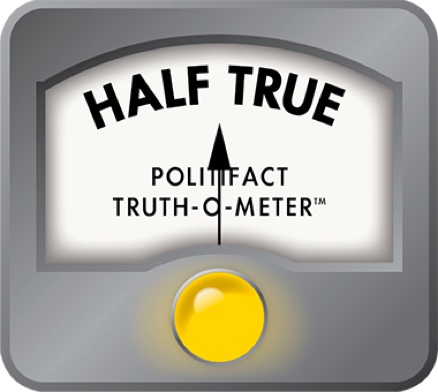
He has a point that, using the most appropriate measure of compensation, weekly wages adjusted for inflation are lower now than they were 12 years ago. But they have not fallen consistently and inexorably, as the phrasing of his claim on This Week suggests. We rate the claim Half True.
Our Sources
Martin O’Malley, interview with ABC’s This Week, March 29, 2015
Bureau of Labor Statistics, "Weekly and hourly earnings data from the Current Population Survey" (main index page, series ID LEU0252881600), accessed March 30, 2015
New Hampshire Union Leader, "Democrat O'Malley back to NH," March 28, 2015
Associated Press, "O'Malley works to position himself as Clinton alternative," March 21, 2015
Email interview with Tara Sinclair, economist with George Washington University, March 30, 2015
Email interview with Gary Burtless, senior fellow at the Brookings Institution, March 30, 2015
Email interview with Lis Smith, spokeswoman for Martin O'Malley, March 30, 2015