As governor, Maggie Hassan first proposed a $1 billion spending increase.
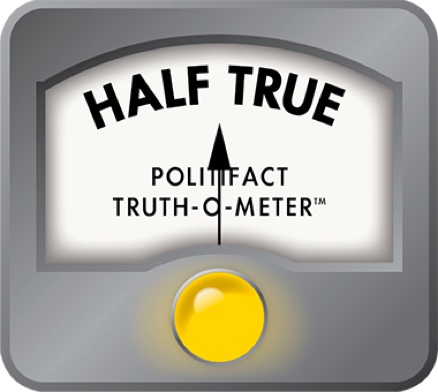
Ad says NH Governor Hassan proposed $1 billion spending increase
As budget season threatens to go into overtime and Democratic Gov. Maggie Hassan ponders her political future, ads are already attacking her management of the state budget. One spot in particular, funded by the “pro-growth” group Impact America Action, is called “Hassan Spending Problem” and cites a particularly noteworthy number.
“Maggie Hassan has a spending problem,” the spot’s narrator says, in a web ad viewed more than 27,000 times. “As governor, Hassan first proposed a $1 billion spending increase.”
The number also appears in an ad titled “The Hassan Plan,” as well as on the group’s website.
But is the claim true? Did Hassan actually propose such an increase with her first budget, for 2014-2015? We decided to check it out.
Hassan came into office inheriting a $10.1 billion total budget approved by a Republican-controlled legislature. Her first budget proposal weighed in at $11.1 billion — a roughly 10 percent increase — and it restored many cuts, including a halving of aid to the university system.
Here’s how that $1 billion increase broke down, according to Hassan’s executive summary.
— $184 million more from the general fund
— $493 million more from the federal government
— $348 million more from “other funds,” which includes the education trust fund; fees and assessments to fund the banking and insurance departments and the Public Utilities Commission; county and local funding; and transfers among state agencies:
It’s worth noting that nearly half of that $1 billion increase comes from federal funds — not New Hampshire state taxes. And that $493 million was meant mostly for the expansion of Medicaid under the Affordable Care Act.
When politicians debate the budget, though, they generally talk about general fund spending, because that’s the pot of money most directly controlled by the state. Looking at that fund alone, Hassan’s budget proposed an increase of about $184 million. That’s up “7.1 percent, from more than $2.6 billion to nearly $2.8 billion,” according to Concord Monitor reporting.
The ad cherry-picked the most all-encompassing number — total spending, including federal grants. (It also was careful enough not to claim claim that Hassan proposed hiking taxes by $1 billion or raising spending $1 billion more from the general fund. Both claims would have been entirely untrue.)
Impact America Action is a 501(c)(4) nonprofit group that isn’t required to report its donors publicly, according to the Sunlight Foundation. But the ad does cite a source for its $1 billion claim. That would be an article from the New Hampshire Union-Leader, dated Feb. 14, 2013.
But even that article clarified that Hassan’s total budget request included “federal money and other state revenue such as highway funds and court fines.”
It’s also worth noting, the two-year budget cycle closes on June 30, and the state is expected to ultimately spend about $10.5 billion during the period the ad cites.
New Hampshire Democrats panned the ads, saying the claims had already been debunked by PolitiFact. It’s true when Hassan was running for election in 2012 we checked claims about Hassan’s votes to increase taxes and budget increases when she was Senate Majority Leader. But this recent claim was a new one to us.
Our ruling
Multiple ads from Impact America Action state that “As governor, Hassan first proposed a $1 billion spending increase.” The reality is more complicated. There was a spending increase of $1 billion in her proposal, but nearly half of that amount came from the federal government, and much of the rest came from other sources of revenue. Only about $184 million — one fifth of the total increased spending — came from the general fund.
We rate the claim Half True
Our Sources
"Hassan Spending Problem," Impact Action America, June 8, 2015
"The Hassan Plan," Impact Action America, June 18, 2015
Governor Hassan’s Plan, Impact Action America
Governor’s Executive Budget Summary, State of New Hampshire Department of Administrative Services, 2013
"Hassan’s budget: A casino, more money for mental health and higher education, a new women’s prison," Concord Monitor, Feb. 14, 2013
Hassan calls for increased state services, spending ‘to choose our own path forward,’ Concord Monitor, Feb. 15, 2013
"Hassan budget proposes tax hike, gambling revenue to offset increased spending," The Union Leader, Feb. 14, 2013
Correspondence with Jeffry Pattison, Legislative Budget Office, June 24, 2015
Impact America hits New Hampshire Gov. Hassan on budget, Sunlight Foundation, June 8, 2015
"Shady Dark Money Group Launches Misleading Attacks Against Governor Hassan to Distract from Unbalanced Senate Republican Budget, NH Democratic Party," New Hampshire Democratic Party, June 8, 2015