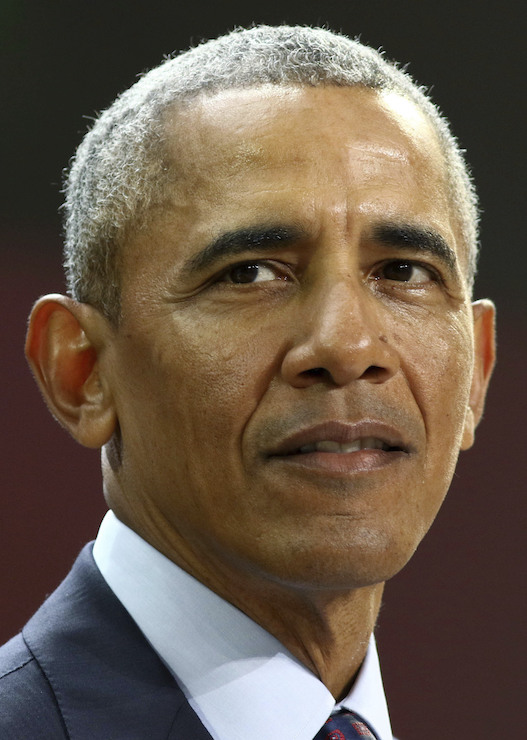
“Our unemployment rate is now lower than it was before the financial crisis.”

Barack Obama says unemployment rate now lower than before the financial crisis of 2008
A significant theme of President Barack Obama’s 2015 State of the Union address was that the United States economy has come back from the brink. One of the metrics he used to make this claim was unemployment rate.
During his address, Obama said that “our unemployment rate is now lower than it was before the financial crisis.”
We decided to check whether that’s correct.
The most recent reported monthly unemployment rate was 5.6 percent for December 2014. The last time it was that low was in June 2008, when it was also 5.6 percent.
The financial crisis occurred after June 2008 — it’s generally dated to the implosion of the Wall Street firm Lehman Brothers in September 2008. So Obama clearly has a point.
That said, there are a few caveats.
First, while we have no quarrel with Obama using the most basic version of the unemployment rate, it’s worth mentioning that there’s another version of the unemployment rate, known as U-6, that isn’t as favorable to the president’s case.
The U-6 statistic tries to capture a broader picture of labor-market weakness than the more familiar unemployment rate. It takes into account not just people who are unemployed but also people working part-time who would rather have full-time work, as well as people who have stopped looking for work but would begin to look again if labor-market conditions improved. Because it includes these additional factors, the U-6 rate tends to track the official unemployment rate but is usually a few points higher.
As it happens, the U-6 rate — unlike the more basic unemployment rate — hasn’t returned to its pre-financial-crisis level. The December 2014 U-6 rate was 11.2 percent, which is higher than the 11 percent rate in September 2008 and the 10.8 percent rate one month earlier in August 2008.
Second, while economists cheer the clear improvement in the basic unemployment rate, they also fret that a portion of that improvement stems from Americans leaving the labor market rather than finding jobs after experiencing joblessness. (The unemployment rate can improve either if someone goes back to work, or if they leave the labor market entirely.)
A way to measure this is by looking at a statistic called the labor force participation rate, which measures the number of people in the labor force divided by the civilian, noninstitutionalized population. The labor force shrinks whenever someone retires, voluntarily gives up working (such as when they become a full-time parent or go back to school full-time) or because they simply give up hope of finding a job.
The labor force participation rate has decreased markedly since 2008. In September 2008, it stood at 66.0 percent, but that fell to 62.7 percent by December 2014, the most recent month available. It’s now at its lowest point since the late 1970s, a time when fewer women were working.
Part of this is explained by the retirement of the large Baby Boom generation, but not all — and the trendline worries many economists. So Obama has justification for celebrating the unemployment rate’s decline, but it’s worth remembering that that’s not the only important labor-market statistic out there.
Our ruling
Obama said “our unemployment rate is now lower than it was before the financial crisis.” He’s correct when using the basic unemployment rate — the most commonly cited figure — but it’s worth noting that other measures of the labor market are not quite so rosy. The unemployment rate may be dropping, if only in part, because people have stopped looking for work.
The statement is accurate but needs clarification or additional information, so we rate it Mostly True.
Our Sources
Barack Obama, State of the Union address, Jan. 20, 2015
Bureau of Labor Statistics, Labor Force Statistics from the Current Population Survey (main index page), accessed Jan. 20, 2015