
Jeb Bush says ‘millions’ have given up looking for work
During a major policy address intended to increase his profile as a 2016 presidential hopeful, former Florida Republican Gov. Jeb Bush criticized the economic performance of President Barack Obama.
“Six years after the recession ended, median incomes are down, households are, on average, poorer, and millions of people have given up looking for work altogether,” Bush told the Detroit Economic Club on Feb. 4, 2015.
We’ve already fact checked a similar claim about median incomes being down ( we rated it True), but we wondered whether Bush is correct that “millions of people have given up looking for work altogether.”
When we checked with Bush’s staff, they pointed us to two Bureau of Labor Statistics data points — persons who are “marginally attached to the labor force” and “discouraged workers.”
These two measurements are similar, but slightly different.
“Marginally attached workers” are those who “want and are available for work, and who have looked for a job sometime in the prior 12 months,” but were not counted as unemployed because they had not searched for work in the four weeks prior to being interviewed by federal survey takers.
The “discouraged workers” category is a subset of marginally attached workers, but they have specifically told survey-takers that they aren’t looking for work because they’re discouraged — specifically, that they “believe there are no jobs available or there are none for which they would qualify.”
In December 2014, there were 2.26 million marginally attached workers, of which 740,000 were considered discouraged workers. So if you use the definition for “marginally attached workers,” then Bush is right that “millions of people have given up looking for work altogether.” If you use the more specific “discouraged workers” definition, the number doesn’t reach into the “millions.”
We can see an argument for preferring the discouraged workers figures. The four-week period without searching for a job certainly suggests that a person has “given up” (as Bush put it) but it’s not proof positive. The criteria for discouraged workers is somewhat stronger for the purposes of checking Bush’s claim, because survey takers have confirmed that workers are indeed “discouraged.”
Still, the definition of marginally attached workers isn’t far off from what Bush said, and using that yardstick, the figure is greater than 2 million people, so it qualifies as “millions.”
We asked economists how close Bush was to the mark, and they agreed that he was largely accurate.
“If they want work and are available and have previously looked but haven’t looked recently, that sounds to me like they have given up,” said Tara Sinclair, a George Washington University economist.
University of Chicago economist Robert Shimer agreed. “No data allows us to answer this with certainty, but the quote seems reasonably likely to be accurate,” he said.
Gary Burtless, a Brookings Institution economist, observed that some young workers might not technically fall under the “given up” category because the weak labor market since the Great Recession may have convinced them not to begin seeking work at all, perhaps deciding instead to remain in school or become a stay-at-home parent.
Still, Burtless said, “from the perspective of labor-force growth, it amounts to the same thing: A weak job market has kept them from finding work or even looking for work.” Burtless said he’s “fairly confident” that roughly 3 million adults between the ages of 25 and 54 who are currently not working or looking for work would have been in the labor force if they had faced the same labor market conditions that existed in December 2007.
Our ruling
Bush said that “millions of people have given up looking for work altogether.” There are two statistics that shed some light on this question; one meets Bush’s “millions” threshold at 2.26 million and one does not. But despite some uncertainty over the definitions and the scope of the data, economists told PolitiFact that Bush is on reasonably safe ground in making this claim.
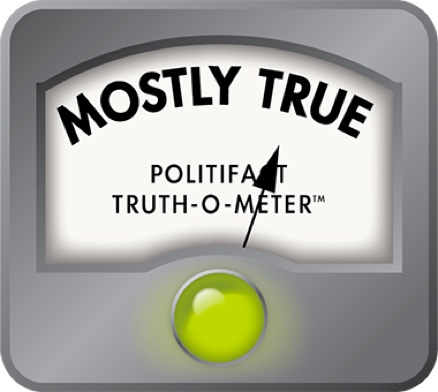
The statement is accurate but needs clarification, so we rate it Mostly True.
Our Sources
Jeb Bush, speech to the Detroit Economic Club, Feb. 4, 2015
Bureau of Labor Statistics, "Employment Situation Summary Table A. Household data, seasonally adjusted," accessed Feb. 5, 2015
Bureau of Labor Statistics, glossary, accessed Feb. 5, 2015
Email interview with Tara Sinclair, George Washington University economist, Feb. 5, 2015
Email interview with Gary Burtless, senior fellow at the Brookings Institution, Feb. 5, 2015
Email interview with Robert Shimer, University of Chicago economist, Feb. 5, 2015