“If you have a union job, you’re making on average $950 a week. If you have a non-union job, you’re making $750 a week.”

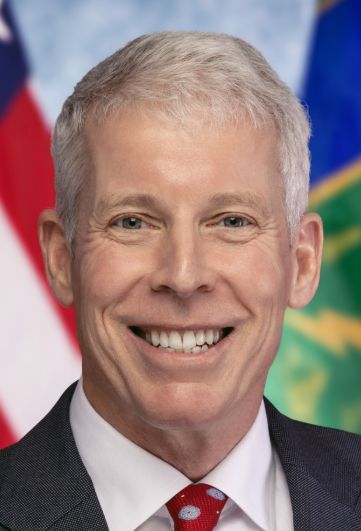
Labor Secretary Thomas Perez says union members earn $200 more a week than those not in unions
Do union members really make $200 a week more than people who aren’t in unions? Secretary of Labor Thomas Perez said so during the Feb. 4, 2014, edition of MSNBC’s Morning Joe.
The Bureau of Labor Statistics, Perez said, “just came out with their data on union membership. … If you have a union job, you’re making on average $950 a week. If you have a non-union job, you’re making $750 a week. So collective bargaining is a big part of how this middle class grew in America and it continues to be an important part of who we are as Americans.”
We located the report Perez was talking about. In this table, BLS summarizes median weekly earnings of full-time wage and salary workers in 2012 and 2013 by whether they are in a union or not.
The table shows that the median weekly earnings for union members in 2013 was $950, compared to $750 for non-union workers.
So Perez is basically right, with one exception. He should have referred to median earnings, rather than average earnings. A median takes the exact middle value from a list that’s ordered from biggest to smallest, rather than taking the sum of all earnings and dividing it by the number of people. The two calculations usually aren’t the same; a median is less likely to be skewed by very small or very large values.
Meanwhile, it’s worth pointing out a few other bits of context, none of which make Perez’s claim less accurate.
• This is an overall median; the ratios by occupation differ. In some sectors, being a union member doesn’t matter much, BLS found. In several sectors — including “management, professional, and related occupations,” “financial activities,” “professional and technical services,” “sales and related occupations,” “mining, quarrying, and oil and gas extraction,” and the federal government — non-union workers actually earn modestly more than union members do. And union members earn only marginally more than non-union workers in such fields as “telecommunications” and “arts, entertainment, and recreation.”
By contrast, the biggest gaps come in fields such as “protective service occupations” (a difference of $459 a week) and “construction” (a difference of $383 a week). Protective service occupations includes correctional officers, police, firefighters, animal control workers, lifeguards, and security guards.
“Unions do more to raise the wages of workers with less-than-average education than they do to boost the wages of those with better-than-average education,” said Gary Burtless, an economist with the Brookings Institution. “Unionized Ph.D.s do not gain as much from being in a union as high school dropouts, though even unionized Ph.D.s may enjoy a bit better job security and receive bigger helpings of health and retirement benefits than their non-union counterparts.”
• If you include fringe benefits, the difference between union members and non-union workers grows.
According to BLS data from 2011, workers’ pay plus benefts for a 40-hour week was $1,508 for a union employee and $1,083 for a non-union worker. That’s a gap of $425 — more than double the gap in the figures cited by Perez.
“Unions are typically more successful in getting good fringe benefits – especially health benefits, sickness pay, and retirement benefits – than in raising workers’ money wages,” Burtless said.
Our ruling
Perez said. “If you have a union job, you’re making on average $950 a week. If you have a non-union job, you’re making $750 a week.”
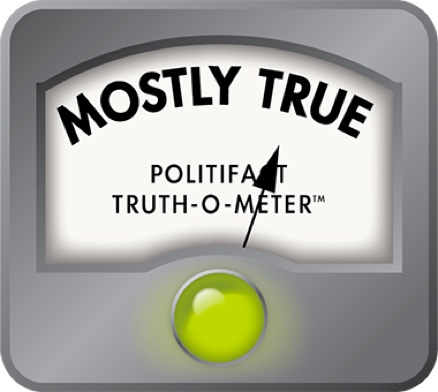
His figures are correct, but with an asterisk — Perez should have specified “median” when he said “average.” In general, though, his overall point is backed up by the data. We rate his claim Mostly True.
Our Sources
Tom Perez, interview with MSNBC’s Morning Joe, Feb. 4, 2014
Bureau of Labor Statistics, "Table 4. Median weekly earnings of full-time wage and salary workers by union affiliation, occupation, and industry," accessed Feb 7, 2014
Bureau of Labor Statistics, "Table 2. Median weekly earnings of full-time wage and salary workers by union affiliation and selected characteristics," accessed Feb 7, 2014
Bureau of Labor Statistics, "Union and nonunion wages, December 2011," May 13, 2013
Email interview with Gary Burtless, economist with the Brookings Institution, Feb. 6, 2014
Email interview with Tara Sinclair, George Washington University economist, Feb. 6, 2014
Email interview with Jason Kuruvilla, spokesman for the U.S. Department of Labor, Feb. 6, 2014