
Bill O’Reilly says unemployment is lower in ‘right-to-work’ states
On the Feb. 24, 2011, edition of Fox News’ The O’Reilly Factor, host Bill O’Reilly said that the jobs picture is better in “right to work” states — that is, states in which workers can refuse to pay dues or fees to the union that represents them in bargaining.
“The right-to-work states have much lower level of unemployment than the union states do,” O’Reilly said while interviewing Caroline Heldman, a political scientist at Occidental College.
We thought we’d check to see whether O’Reilly is correct.
First, some background. According to the National Right to Work Legal Defense Foundation, 22 states have passed some form of right-to-work law (the exact provisions can vary) — Alabama, Arizona, Arkansas, Florida, Georgia, Idaho, Iowa, Kansas, Louisiana, Mississippi, Nebraska, Nevada, North Carolina, North Dakota, Oklahoma, South Carolina, South Dakota, Tennessee, Texas, Utah, Virginia and Wyoming. The other 28 states do not have such laws.
To test O’Reilly’s claim, we turned to Bureau of Labor Statistics data, which is the official source for unemployment statistics in the United States. BLS’ most recent state-by state data is for December 2010.
We consulted with Gary Burtless, a labor economist with the centrist-to-liberal Brookings Institution, about the fairest way to look at the data. We agreed that it was best to compare right-to-work and non-right-to-work states through data weighted according to state population. That way, California’s unemployment rate would be given more weight than, say, Wyoming’s.
When we did the math, we found that the unemployment rate in the 22 right-to-work states was 9.17 percent, compared to 9.65 in the 28 non-right-to-work states. (The national unemployment rate that month was 9.4 percent that month — right in the middle.) So O’Reilly is basically correct.
His only shortcoming was his use of the phrase “much lower level of unemployment.” The difference for December 2010 was only about half a percentage point, which is fairly modest, given that the range of state unemployment figures stretched from 3.8 in North Dakota to 14.5 in Nevada.
As always, there’s a question about causation — that is, whether right-to-work status actually produces low unemployment. Of the 11 states with the lowest unemployment (there was a tie for 10th place) eight were right-to-work states. Of those, seven states — North Dakota, Nebraska, South Dakota, Iowa, Wyoming, Kansas and Oklahoma — are from the Great Plains and the Mountain West, which have in general been less hard-hit during the recent recession.
To see whether today is an unusual situation, we asked the National Right to Work Legal Defense Foundation whether they had historical data on the unemployment gap. They said they did not. James Sherk, a senior policy analyst in labor economics at the conservative Heritage Foundation, said that numbers he’s run suggest that in 2008, before the worst of the recession set in, the gap was slightly larger — about eight-tenths of a percentage point — but was in the same general ballpark.
In any case, none of the economists we spoke to thought the gap was especially surprising, either now or historically.
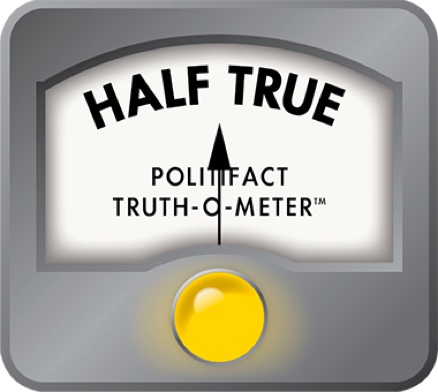
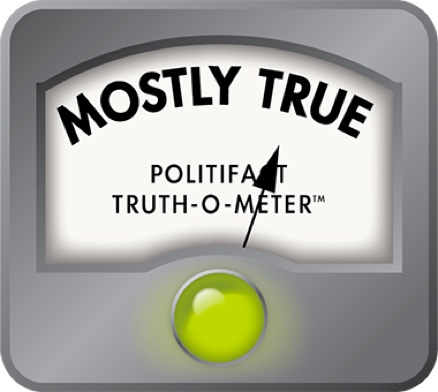
So where does that leave us in terms of O’Reilly’s claim? He said that “right-to-work states have much lower level of unemployment than the union states do.” To say it’s “much lower” is a stretch, but he’s right that it is lower. On balance, we rate his statement Mostly True.
Our Sources
Bill O’Reilly, transcript of The O’Reilly Factor, Feb. 24, 2011 (accessed via Lexis-Nexis)
National Right to Work Legal Defense Foundation, list of right-to-work states, accessed Feb. 28, 2011
Bureau of Labor Statistics, "Unemployment Rates for States, Monthly Rankings, Seasonally Adjusted," December 2010
Bureau of Labor Statistics, main search page or national unemployment statistics, accessed Feb. 28, 2011
U.S. Census Bureau, resident population of the 50 states, April 1, 2010
Economic Policy Institute, "The Compensation Penalty of Right to Work Laws," Feb. 17, 2011
E-mail interview with Gary Burtless, senior fellow at the Brookings Institution, Feb. 25, 2011
E-mail interview with James Sherk, a senior policy analyst in labor economics at the Heritage Foundation, Feb. 28, 2011
E-mail interview with Heidi Shierholz, economist with the Economic Policy Institute, Feb. 28, 2011
E-mail interview with Stanley Greer, senior research associate at the National Right to Work Legal Defense Foundation, Feb. 28, 2011