After Fahrenheit 9/11 came out, “Bush’s approval rating never was better, it only got worse.”

Michael Moore said Bush’s approval rating dropped, but it rose first
Michael Moore talked about his new movie,
Capitalism: A Love Story
, at a Washington news conference a few days before the movie’s nationwide release.
A reporter asked him why his movies didn’t have more of an impact, citing
Roger and Me
as not doing much to change the auto industry and
Sicko
as not changing public opinion about health care.
Moore disputed the premise of the question, saying
Roger and Me
postponed layoffs in his hometown of Flint, Mich., and that
Sicko
spurred advocacy for health care reform.
He then said that his film
Fahrenheit 9/11
kicked off criticism of President George W. Bush during his second term.
“It’s funny how that movie gets judged as, ‘Well, Bush got re-elected.’ That movie comes out four or five months before the election, and somehow a movie was going to change the election. I’ll tell you what it did do.
“At that point, people were afraid to speak out about the war, and about Bush. He had a high approval rating. Someone had to fire the first salvo. And that’s what I did, and I took a lot of abuse for it.”
Moore said that many liberals had supported the Iraq war and were afraid to criticize it, but that changed after his movie came out.
“From
Fahrenheit
on, Bush’s approval rating never was better, it only got worse,” Moore said. “Within a couple of years, after more and more millions of Americans saw the truth in that film, he could never recover.”
We wanted to check Moore’s statement about Bush poll numbers to see if they declined like Moore said they did.
To do this, we turned to the Gallup Poll, which has tracked presidential approval ratings since 1940s.
Fahrenheit 9/11
came out at the end of June 2004, when Bush’s approval rating was at 48 percent. But his approval rating climbed through the rest of the summer and hit 53 percent around Election Day in early November.
After the election, Bush’s approval peaked at 57 percent during the first week of February 2005. A year after
Fahrenheit
, Bush’s approval rating was about the same as when the movie came out, hovering around 47 percent.
Bush’s approval ratings started to noticeably decline about a year after his election, sliding into the low 40s and high 30s in the fall of 2005 and staying in that range for most of 2006 and 2007.
Bush’s ratings hit their all-time low in October 2008, during the financial crisis, when he had an approval rating of 25 percent.
So Moore was incorrect when he said that “Bush’s approval rating never was better, it only got worse” after the movie came out. The ratings actually increased and were pretty much the same a year after
Fahrenheit
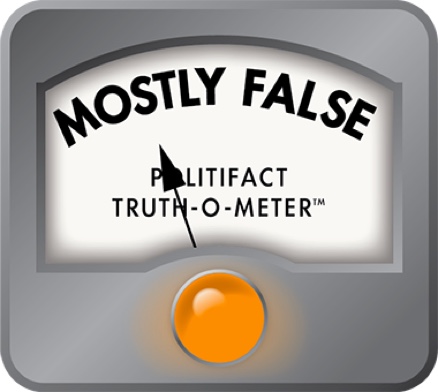
. On the other hand, Moore qualifies his statement by suggesting that it took years for the film to have an impact, and indeed, Bush’s ratings did decline overall for much of his second term. So we rate Moore’s statement Barely True.
Editor’s note: This statement was rated Barely True when it was published. On July 27, 2011, we changed the name for the rating to Mostly False.
Our Sources
Michael Moore news conference, Sept. 28, 2009
Gallup Poll, President George W. Bush approval ratings