What would state laws look like in a post-Roe world?


If your time is short
• If the Supreme Court overturns Roe v. Wade, as a leaked draft ruling suggests it might, then the rules governing abortion would revert to the states.
• Some states, largely Democratic-led, have protected access to abortion by passing laws to do so. Other states, many but not all Republican-led, either have pre-Roe laws against abortion that would snap back into effect, or have passed “trigger” laws to block abortion access if Roe is overturned. Other states have no directly relevant law, which means that abortion should remain legal, at least to start.
• With states empowered to address abortion in a post-Roe world, battles over abortion policy will be hard-fought in the states.
The leak of an early draft ruling on a hotly contested Supreme Court abortion case has focused attention on what might happen if Roe v. Wade — the five-decade-old precedent requiring national access to abortion — is overturned.
Prior to the Roe decision in 1973, abortion was illegal in many states, but states were gradually choosing to legalize it. Roe recognized a right to abortion based on the 14th Amendment. In a 7-2 ruling, the court found that the due process clause of the 14th Amendment protects the right to privacy from state action, including a woman’s right to choose to have an abortion. While subsequent rulings allowed states to impose some restrictions on abortion, they could not outlaw it entirely.
Overturning Roe, as the leaked draft would do, would get rid of the national right to an abortion and leave it up to each state to decide on what its policy should be.
If Roe is overturned, “what seems clear is there will be a checkerboard effect,” with some states allowing abortion and others preventing it, said Carl Tobias, a University of Richmond law professor.
What would happen in the states if Roe v. Wade is struck down?
In the absence of Roe v. Wade, each state would be able to decide whether, and how, it wanted to permit abortions.
Sixteen states plus the District of Columbia have passed laws directly allowing access to abortions: California, Colorado, Connecticut, Delaware, Hawaii, Illinois, Maine, Maryland, Massachusetts, Nevada, New Jersey, New York, Oregon, Rhode Island, Vermont, Washington state, and D.C. (These states vary on whether abortion would be allowed through fetal viability or through an entire pregnancy.)
Many other states, however, would see abortion become illegal if Roe falls.
At least nine states have pre-Roe laws restricting abortion would snap back into effect if Roe is overturned: Alabama, Arizona, Arkansas, Michigan, Mississippi, North Carolina, Oklahoma, West Virginia, and Wisconsin.
Meanwhile, at least 10 states have passed more recent “trigger” laws that are written to take effect if Roe were to disappear. They are Idaho, Kentucky, Louisiana, Missouri, North Dakota, South Dakota, Tennessee, Texas, Utah, and Wyoming.
In Georgia, Iowa, and Ohio, courts have blocked laws that would restrict access to abortion with Roe still intact. If Roe was overturned, these restrictions would likely go back into effect.
If Roe falls, legal battles will move to state courts.
“If the court holds that there is no federal constitutional right to an abortion, there will doubtless be fights in many states that have abortion restrictions, both as to whether the state constitution protects the right to abortion, and as to how the state laws should be interpreted,” said Eugene Volokh, a law professor at UCLA.
Older, pre-Roe laws may be more open to legal attack on grounds such as vagueness, but “lots of new laws in all sorts of areas are also badly drafted” and could give abortion-rights advocates room for legal challenges, Volokh said.
Meanwhile, there are 12 states that have no relevant law ready to spring into effect. They are: Alaska, Florida, Indiana, Kansas, Minnesota, Montana, Nebraska, New Hampshire, New Mexico, Pennsylvania, South Carolina, and Virginia.
In these 12 states, abortion would likely remain legal unless and until it’s restricted under a new law, Volokh said. “Everything not forbidden is permitted, generally speaking,” he said.
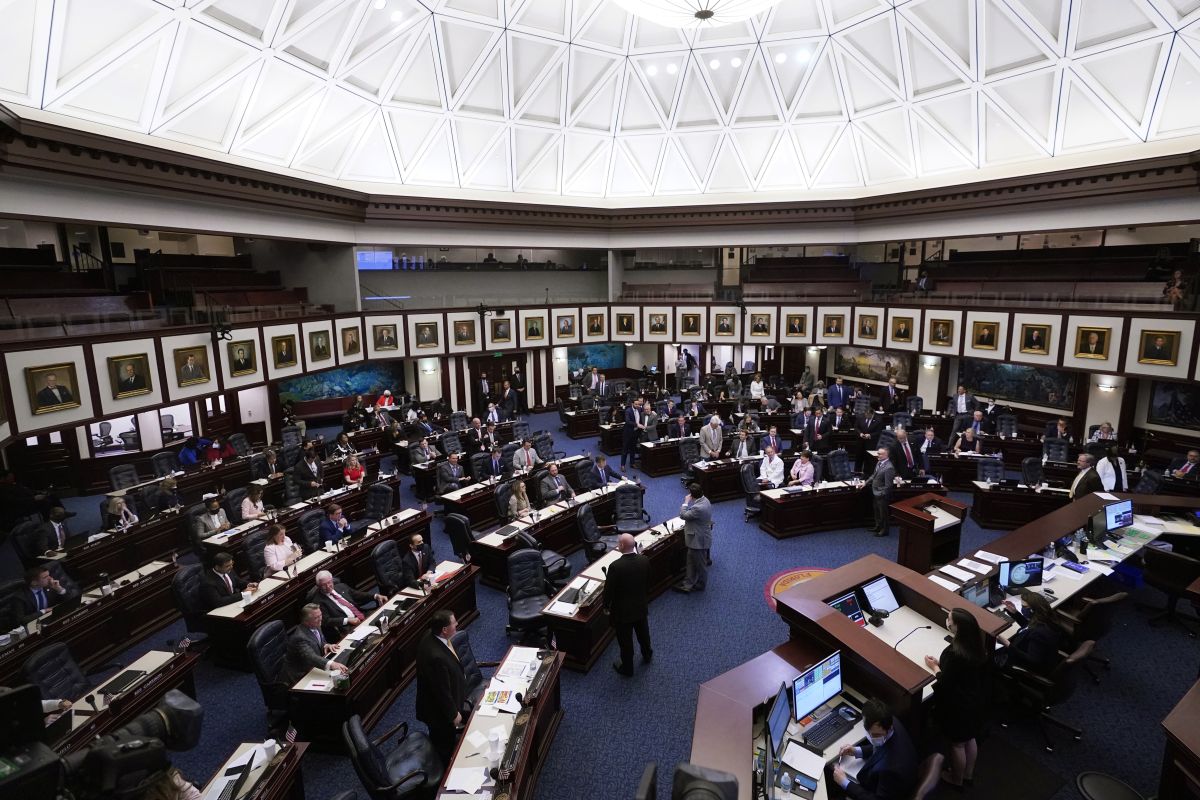
It’s also expected that passing laws on abortion, either for or against, will become a major topic of attention among state legislators and governors in the years ahead.
In March, Sabato’s Crystal Ball at the University of Virginia Center for Politics identified at least seven and possibly up to 10 states where polling shows majority or plurality support among voters for abortion access, yet the possibility that abortion might be severly restricted.
In some of these states, a pre-Roe law banning the procedure can spring-back into effect if Roe is overturned, which could put pressure on elected officials to craft new laws allowing some abortion access. In other states, Republicans control the legislature, the governorship or both, and these elected officials may be tempted to pass stringent abortion restrictions.
The seven most likely states to be cross-pressured this way are: Arizona, Georgia, Michigan, New Hampshire, North Carolina, Pennsylvania, and Wisconsin.
There will almost certainly be “huge fights in legislatures over these issues,” Tobias said.
Our Sources
Oyez, Roe v. Wade, accessed May 3, 2022
Guttmacher Institute, "Abortion Policy in the Absence of Roe," April 4, 2022
Sabato’s Crystal Ball, "Abortion Battlefields in a Potentially Post-Roe Political World," March 10, 2022
Email interview with the National Right to Life Committee, May 3, 2022
Email interview with Carl Tobias, University of Richmond law professor, May 3, 2022
Email interview with Eugene Volokh, law professor at UCLA, May 3, 2022