The COVID-19 relief package: Where the money goes

If your time is short
-
The Democratic bill has $410 billion in stimulus checks and $360 billion in aid to state and local governments.
-
Expanded unemployment benefits cost $242 billion.
-
School spending is nearly $170 billion spread out over 10 years.
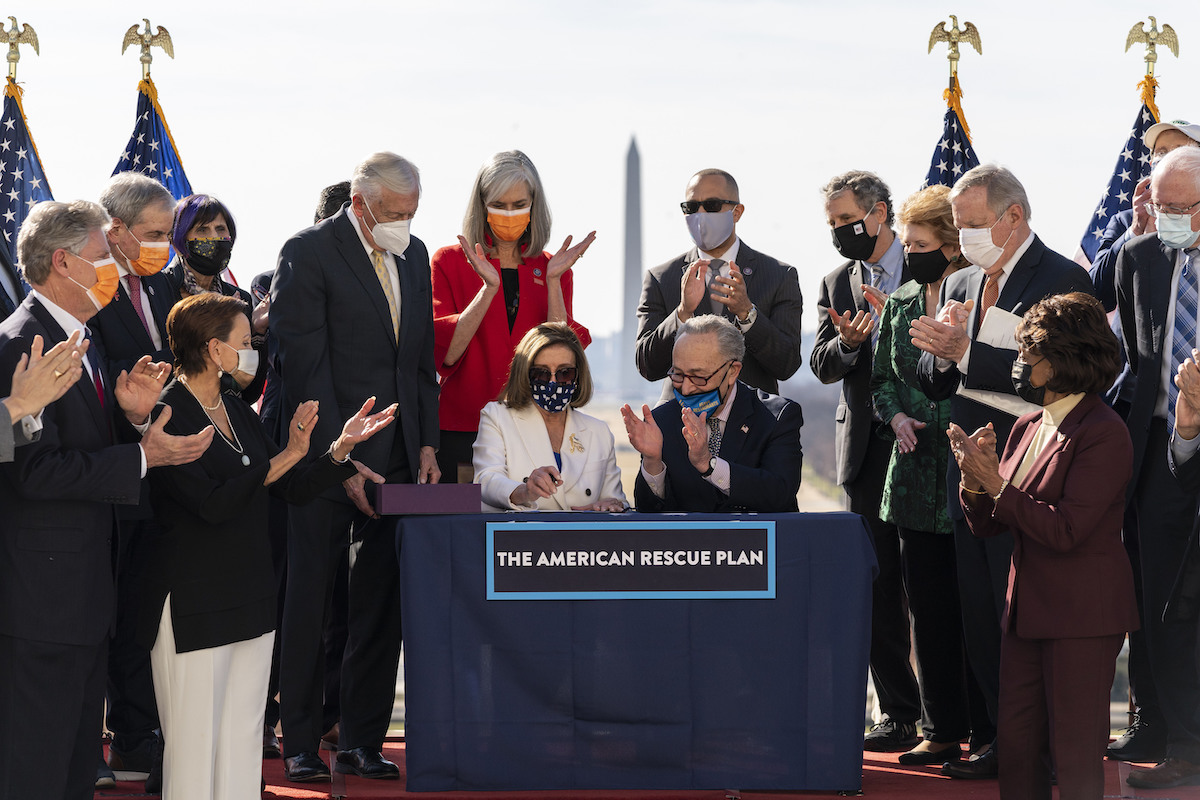
There are a few big chunks of money in the American Rescue Plan Act that have generated a lot of news coverage and are pretty well known. In response to a reader’s request, we present the whopping $1.86 trillion spending plan in pie chart form.
There are the $1,400 checks (or more likely deposits) to many citizens or permanent legal residents and their dependents. That comes to about $410 billion.
Aid to state, local, territorial and tribal governments costs about $360 billion.
The bill boosts and extends unemployment benefits. Add another $242 billion.
Over the next 10 years, the law spends nearly $170 billion on education. That includes $129 billion for K-12 schools — both public and private — and about $40 billion for higher education.
The money for vaccines and corralling the coronavirus became a political talking point. Democrats touted the $20-25 billion they included for vaccine supplies and research. Republicans argued that the bill spent less than 10% of its total cost on COVID-19.
People will parse the numbers in different ways. Some only count money spent directly on vaccine production. Some look more broadly at the economic damage wrought by the virus. We looked for money that went towards health care, whether that meant improving treatment on tribal lands, adding health care workers at clinics, or anything that reduced the health impacts of the pandemic.
We put the bill’s total public health spending at $143 billion.
Within that, the single biggest line item is $47.8 billion for mitigating the disease, a broad description that includes testing and surveillance. There is also $15 billion for COVID-related health care for veterans, $7.6 billion to help community health centers distribute vaccines, and about the same amount to the Centers for Disease Control and Prevention for roughly the same purpose.
This chart lays out how the money breaks down.
All of the amounts so far come to $1.3 trillion over 10 years. The bill’s total cost is $1.86 trillion, which leaves about $500 billion dollars to flesh out.
The law has over $40 billion for child care. Money to keep people in their homes and to house the homeless comes to about $44 billion. There is $10 billion to put food on people’s tables. The expected cost of temporarily boosting the child tax credit is $109 billion.
In our chart, we fold all of that, plus subsidies for pensions and health insurance premiums, into the category of support for families. Our total is $352 billion.
Our last distinct category is transportation. Under that umbrella, we put $30 billion for mass transit, $15 billion for the airline industry, $8 billion for airports, and other related activities. That came to $58 billion.
The catch-all bucket of other spending includes items such as $66 billion for businesses, $50 billion for disaster relief at the Federal Emergency Management Agency, and $7 billion to expand broadband internet.
Our Sources
U.S. Congress, H.R.1319 - American Rescue Plan Act , March 11, 2021
Congressional Budget Office, Estimated Budgetary Effects of the Amendment in the Nature of a Substitute to the American Rescue Plan Act, March 4, 2021
Joint Committee on Taxation, Estimated Revenue Effects Of An Amendment In The Nature Of A Substitute To H.R. 1319, March 4, 2021
Senate Republican Policy Committee, Summary of final text H.R. 1319, March 10, 2021
PolitiFact, Budd says 9% of stimulus targets COVID, the rest is 'not even' related, March 1, 2021
PolitiFact, How much goes to COVID-19 vaccines in the stimulus bill?, Feb. 26, 2021