Fact-checking the Feb. 14 Sunday shows


Republicans say President Barack Obama should let his successor pick the replacement for Supreme Court Justice Antonin Scalia.
To do so, they say, follows convention.
In an interview on Meet the Press, Texas Sen. Ted Cruz said it’s a “long tradition” that a president in his final year in office lets his successor fill a spot on the nation’s highest court. And Florida Sen. Marco Rubio said presidents of both parties have followed a “precedent” of not nominating judges to the bench near the end of their terms.
Neither claim is totally accurate, PolitiFact found.
Cruz’s ‘long tradition’
Meet the Press Host Chuck Todd asked Cruz if the Senate had an obligation to at least consider a nominee from Obama. Cruz said “not remotely.”
“It has been 80 years since a Supreme Court vacancy was nominated and confirmed in an election year,” Cruz said. “There is a long tradition that you don’t do this in an election year.”
Cruz is correct in that it’s rare for a president to nominate and have confirmed a Supreme Court justice in an election year. But that’s more because of the rarity of filling Supreme Court slots than some “long tradition.”
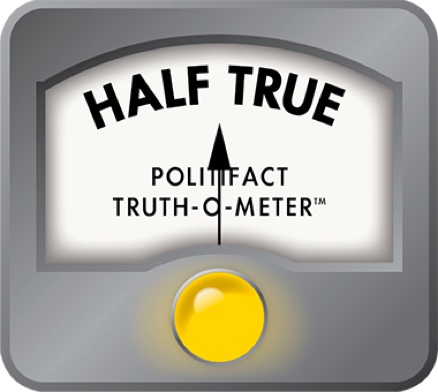
His claim rates Half True.
Here’s how Amy Howe, editor of SCOTUS Blog put it. “The historical record does not reveal any instances since at least 1900 of the president failing to nominate and/or the Senate failing to confirm a nominee in a presidential election year because of the impending election,” Howe wrote.
We found only five instances in the past 115 years, besides today, when a vacancy coincided with a presidential election year — in 1968, 1940, 1932, 1916 and 1912.
President Lyndon B. Johnson nominated two people in 1968, his final year in office. One would have elevated sitting Justice Abe Fortas to the Chief Justice position vacated by Earl Warren. Fortas hit strong opposition in the Senate Judiciary Committee and in the face of a filibuster, and he asked that his name be withdrawn.
Johnson also nominated Homer Thornberry in 1968 and was forced to withdraw that nomination, too.
So neither Thornberry nor Fortas was nominated and confirmed in the same year.
The next election-year nomination was in 1940, when President Franklin D. Roosevelt put forward Frank Murphy on Jan. 4, 1940. The Senate confirmed Murphy 12 days later on Jan. 16, 1940.
That took place 76 years ago, not 80 as Cruz said, but it’s pretty close.
What does it all mean? Practically speaking, Supreme Court vacancies occurred in an election year only twice in the past 80 years. In both cases, the president nominated a replacement. That hardly makes a “long tradition.”
“This is entirely a matter of circumstance,” said Sarah Binder, a political scientist at George Washington University. “Certainly not a norm or tradition by presidents refraining from nominating in a presidential election year or by senators refusing to consider such nominations.”
Rubio’s ‘precedent’
Rubio went down a similar path while talking to NBC, saying there’s no need for Obama to even try making a nomination.
“But why not go through this process?” host NBC’s Todd asked.
“Because actually, it’s not just for the Supreme Court, even for appellate courts, both parties have followed this precedent,” Rubio responded. “There comes a point in the last year of the president, especially in their second term, where you stop nominating, or you stop the advice and consent process.”
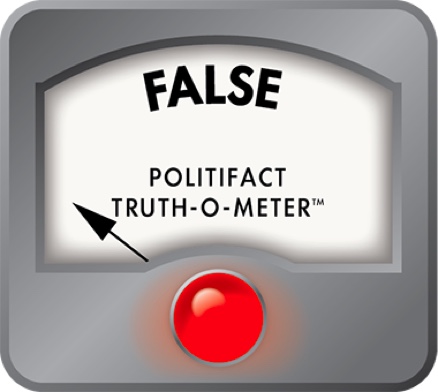
That rates False.
As we’ve already noted, nominations to the Supreme Court are rare, and even rarer in election years.
But the situation isn’t the same in the lower courts
“He’s clearly wrong,” said Russell Wheeler, a judicial expert with the Brookings Institute. Wheeler provided PolitiFact a list of lower court nominations by the last four two-term presidents (Obama, George W. Bush, Bill Clinton and Ronald Reagan).
All made nominations in their final year. Reagan, for instance, made 33 District Court of Court of Appeals nominations. Bush made 32.
Bush forwarded nominees to the Court of Appeals “as late as September of his last year in office,” said Lisa Holmes, a University of Vermont professor who specializes in judicial politics.
And that month, the Democratic Senate Judiciary Committee “shepherded through” many of Bush’s nominations even though “it did look very promising for President Obama” at the time, said Sheldon Goldman, a University of Massachusetts at Amherst professor who specializes in the politics of judicial selection.
The evidence against Rubio’s claim also multiplies if we expand the criteria to beyond lame-duck presidents. From 1947 to 2014, there have been 79 appellate court nominations and 416 District Court nominations in presidential election years, according to Sarah Binder, a George Washington University professor who studies the federal judiciary.
In fact, there’s an example sitting on the Supreme Court right now that contradicts Rubio, pointed out Goldman. Justice Stephen Breyer was nominated by Jimmy Carter to the Court of Appeals in November 1980, after Reagan won the White House.
Our Sources
Listed in the individual fact-checks.