Democrats to take debate stage

The five candidates for the Democratic presidential nomination will appear in their first debate Tuesday, a month after the much larger GOP field finished its second such contest.
Former Secretary of State Hillary Clinton is the party’s frontrunner, though Vermont Senator Bernie Sanders, an independent who calls himself a democratic socialist, has been gaining ground in polls of Iowa and New Hampshire voters.
Three long shots round out the field: former governors Lincoln Chafee of Rhode Island and Martin O’Malley of Maryland and Jim Webb, a former U.S. senator from Virginia.
PolitiFact has checked statements from all of the candidates, with a sample from each below. You can review all of the candidates at www.politifact.com/personalities.
“Under Republicans, recessions happen four times as frequently as under Democrats.”
Hillary Clinton on Sept. 19, 2015 in remarks at the 2015 New Hampshire Democratic Party State Convention
Clinton is expected to go after potential GOP rivals more than her Democratic opponents, especially Sanders (whose supporters she will need if she captures the party nomination).
At a recent event in New Hampshire, she made an economic argument for her party: When there’s a Democrat in the White House, she says, the economy does better.
“Under Republicans, recessions happen four times as frequently as under Democrats,” she said.
The numbers back up Clinton’s claim since World War II: Of the 49 quarters in recession since 1947, eight occurred under Democrats, while 41 occurred under Republicans.
It’s important to note, however, that many factors contribute to general well-being of the economy, so one shouldn’t treat Clinton’s implication — that Democratic presidencies are better for the economy — with irrational exuberance.
Clinton is right on the numbers, but her claim needs additional information to put its implication into the proper context.
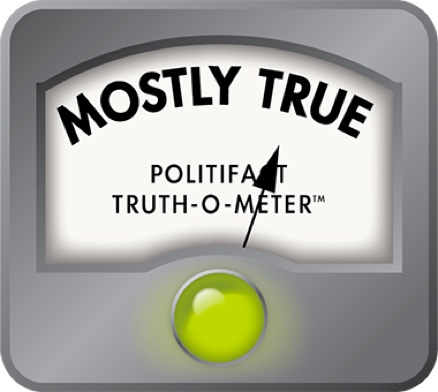
We rated her claim Mostly True.
“Unlike virtually every other campaign, we don’t have a super PAC.”
Bernie Sanders, Sept. 28, 2015 in comments on Twitter.
Sanders has long been a political outsider who has pledged to flush big money out of campaigns.
Speaking at the University of Chicago on Sept. 28, Sanders vowed to nominate Supreme Court justices who will overturn Citizens United, the landmark 2010 decision that opened the floodgates for unlimited donations to political fundraising organizations known as super PACs.
Later that day, Sanders took to Twitter to demonstrate his consistency.
“Unlike virtually every other campaign, we don’t have a super PAC which collects money from billionaires and corporations,” he tweeted.
Out of the 21 presidential candidates, Sanders is one of five who doesn’t have an affiliated super PAC. Sanders’ qualifier — “virtually” — makes his claim more accurate.
If we narrow the count to major candidates, only Sanders and Trump can claim that, but both have two unaffiliated super PACs backing their candidacy. Trump has appeared at a fundraiser for one super PAC that’s also received donations from his in-laws. Sanders, meanwhile, has disassociated himself with these groups, through statements and legal action.
We rated his claim Mostly True.
Says Ronald Reagan “talked about” converting the United States to the metric system.
Lincoln Chafee on June 7, 2015 in comments on CNN’s “State of the Union”
Chafee has made the most news in his presidential campaign for a goal of switching the U.S. to the metric system.
When asked by CNN about the unusual pledge, the Republican-turned-Democrat cited the Gipper when noting that the discussion has been going on for a while in the United States.
“I know many in the scientific community, the health care community that deal internationally, the business community, are saying this is way overdue,” he said. “(Former President) Ronald Reagan talked about it. Others have talked about it.”
The issue of metrication rose at the very beginning and at the very end of Reagan’s presidency. However, Chafee’s statement implies that Reagan had more than a passing interest in the issue, but that doesn’t seem to be the case.
The metrication process started before Reagan took office. He slowed the process to a standstill by taking away funding. He was silent on the issue for the next six years until he signed a law that directed federal agencies to make a more concerted effort to transition to metric units when practical — though it’s unclear how much influence Reagan’s White House had on that tiny aspect of a 1,000-page omnibus bill.
Without this additional context, Chafee’s claim is off by a few yards. Or meters.
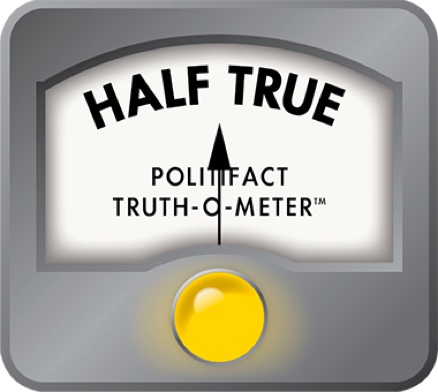
We rated the claim Half True.
“The CEO of Goldman Sachs let his employees know that he’d be just fine with either Bush or Clinton.”
Martin O’Malley on May 30, 2015 in his presidential announcement speech
O’Malley has struggled to gain coverage and polls at just 1 percent support in recent polls.
He kept on message since his announcement, arguing Wall Street viewed Clinton and Jeb Bush, who was thought to be the GOP’s most likely nominee, as the same.
“Recently, the CEO of Goldman Sachs let his employees know that he’d be just fine with either Bush or Clinton,” O’Malley said. “Well, I’ve got news for the bullies of Wall Street: The presidency is not a crown to be passed back and forth by you between two royal families.”
We had no trouble finding Goldman CEO Lloyd Blankfein’s support for Hillary Clinton.
The self-described Democrat, personally contributed $4,600 to Clinton’s last presidential campaign (and thousands to past Democratic presidential candidates).
But did Blankfein sign off on the presumed Republican frontrunner, especially in front of the firm’s 34,400 employees?
In a March 2015 Politico article, economic reporter Ben White detailed Blankfein’s close relationship with the Clintons and wrote,” Blankfein has indicated he would be fine with either a Bush or Clinton presidency.”
White told us in an email that to his knowledge, Blankfein has never stated this publicly, though he’s suggested it privately, according to anonymous sources close to the CEO.
It wouldn’t be unusual for business leaders to play close to both parties. But in this case, Blankfein has thrown his money behind only one candidate in question, not the other.
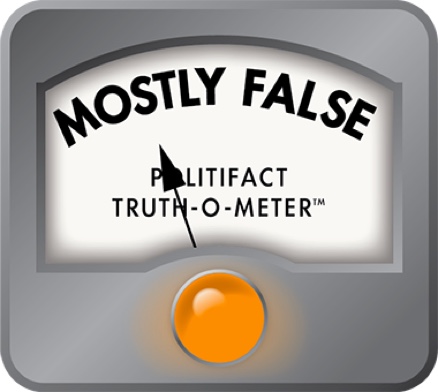
We rated O’Malley’s statement Mostly False.
“We did not even have a federal income tax in this country until 1913.”
Jim Webb on Aug. 12, 2015 in a web post
Webb had made an overhaul of the U.S. tax code one of the main issues of his campaign.
He has called for lowering tax rates in exchange for eliminating “loopholes and exceptions” that he says “have made a mockery out of true economic fairness.”
He wants investment income to be taxed at the same rate as wages. And he would like to see the U.S. shift some of its burden away from income taxes and toward consumption.
Big changes, but Webb writes on his campaign website that “We did not even have a federal income tax in this country until 1913.”
The modern income tax structure, complete with Form 1040, was indeed born in 1913 when the U.S. government began to tax individual incomes.
But in the interest of history, it should be noted that Lincoln ushered in an income tax in 1862 and it lasted 10 years.
Congress passed a new income tax in 1894 but it never went into effect after the U.S. Supreme Court ruled it unconstitutional because it was a direct tax that was not apportioned on the basis of each state’s population.
That constitutional hurdle was cleared by the 16th Amendment, proposed by President William Howard Taft in 1909 and ratified by the states in 1913.
So we rated the statement of Webb — a historian himself — Mostly True.
Our Sources
See individual reports.