
Claim overstates film industry’s impact on Georgia economy
Superheroes and zombies apparently bring serious coin into the Peach State.
The “Ant-Man” movie, and “The Walking Dead” TV series were among 248 productions shot in Georgia in the fiscal year that ended June 30, according to the state Department of Economic Development.
The direct spending in Georgia was $1.7 billion, but the headline had an even more eye-popping number.
The productions “generated an economic impact of more than $6 billion,” the department said.
For political junkies, that’s about the cost of the national 2012 election according to our friends at the Center for Responsive Politics.
So do productions really have as much impact in Georgia as all the spending in a contested presidential year nationwide? PolitiFact Georgia couldn’t resist looking further.
Georgia’s Red Carpet
Georgia has heavily incentivized the entertainment industry since 2008 to lure projects.
Production companies can earn a 20 percent income tax credit on in-state costs of projects worth at least $500,000. Another 10 percent credit is given for using a Georgia logo in production credits.
One unique element of the credit: if a production company doesn’t need to use it against its Georgia tax liability, it can sell the credit to another Georgia company to help finance a project.
Those breaks have become even more attractive as other states, such as North Carolina, have cut back on their incentives.
The result: a 553 percent increase in spending from 2008’s tally of $260.4 million spent on production in Georgia, according to Stefanie Paupeck Harper, spokeswoman for the state Department of Economic Development.
The impact
As head of the Georgia Film, Music and Digital Entertainment Office, Lee Thomas is responsible for certifying what productions can claim the state’s tax credit.
But the way the state estimates the overall impact of that direct spending predates her 19-year tenure.
For at least 30 years, the state economic development department has multiplied direct spending by 3.57 to estimate impact.
In economic terms, that is a multiplier, or how many times each dollar of direct spending cycles through direct spending.
In the film industry’s case, that means the state calculates that every dollar of direct spending has generated total spending of $3.57 in Georgia.
Looking back to 2008, the state used the multiplier to calculate the film industry’s impact at $465 million. That is an astonishing 1,190 percent jump on impact.
Thomas acknowledged that the state doesn’t know what sorts of spending that multiplier originally counted, or why the 3.57 estimate was used.
But keeping the same multiplier allows to track progress over time, comparing apples to apples, she said.
And it’s clear the more productions mean more local spending on gear, costumes, heating and air conditioning on set and location fees.
“If they spend on a caterer, that goes into the 3.57,” Thomas said. “Another thing we look at is film tourism, which is very hard to quantify but we know that those visitors are a direct result of the industry filming here. We certainly know that Georgia has seen significant growth in this industry.”
Economics 101
Bruce Seaman is sympathetic to the growth argument.
But as an economist at the Andrew Young School of Public Policy at Georgia State University, he knows the multiplier the state is using is way too high.
The common IMPLAN model gives the industry a 1.83 multiplier. Using the state’s method, that would translate into a far lower impact of $3.1 billion.
It’s significant, to be sure. But even that high number is likely overstated, because the state has not determined its capture rate.
That is, for every $1 million a production company pays a big star – or $100,000 spent on hotel rooms – how much is captured in Georgia before the money goes back to the celebrity’s L.A. home or the hotel’s out-of-state headquarters?
“I want to know what it means to say, ‘that money was spent in the state,’” Seaman said.
And, a more detailed analysis would also benefit the state’s case of impact.
That’s because the state doesn’t capture the long-term money invested from the boom, such as the erection of the new Pinewood Studios facility in Fayette County (where “Ant-Man” was shot last year) and the redevelopment of a Midtown facility for a new film and television master’s degree program at the Savannah College of Art and Design (SCAD).
It also fails to account for how many of the 43 productions in Georgia today, including a popular “Guardians of the Galaxy” sequel, would have selected the state without its growing ability to handle production.
“The good news, really, is the tax credits are spurring an indigenous film industry taking shape in Georgia,” Seaman said. “It’s incredibly complicated and you would have to look at all of the details on a project-by-project basis to seriously know what’s going on.”
“The irony is, without that study, you are clearly overstating the short-term impacts but we appear to be understating the longer-term impacts. We wouldn’t know without more careful study.”
Our ruling
The booming film industry in Georgia generated $6 billion in economic impact in the state in the most recent fiscal year, according to the state department of economic development.
The calculation is based on formula the state has used for at least 30 years, multiplied against direct spending.
There is no dispute that direct spending on productions has mushroomed, but the state can’t explain why it uses a multiplier that is almost double the standard economic model for that calculation.
The state’s formula likely also fails to capture long-term spending and investment that have taken hold in Georgia.
There is accuracy in the claim, especially in the carefully tracked direct spending from film and TV production in the state. But it leaves out important information that could better prove, or disprove, the statement.
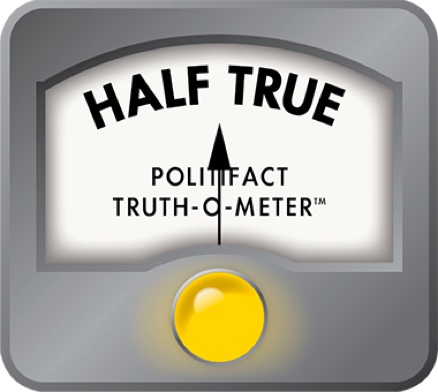
We rate the claim Half True.
Our Sources
Office of Gov. Nathan Deal, press releases, "Film industry generates $6 billion for Georgia’s economy," July 9, 2015
Center for Responsive Politics, "2012 Election Spending Will Reach $6 Billion," Oct. 31, 2012
Georgia Department of Economic Development, Film Tax Credit Brochure, accessed Aug. 3, 2015
PolitiFact Georgia, "Federal data mostly back claim about movie and TV jobs," June 12, 2015
Interview, Bruce Seaman, professor of economics, Andrew Young School of Policy Studies of at Georgia State University, Aug. 3, 2015
Interview, Lee Thomas, head of the Georgia Film, Music and Digital Entertainment Office, Georgia Department of Economic Development, Aug. 4, 2015
Interview with Stefanie Paupeck Harper, spokeswoman, Georgia Department of Economic Development, Aug. 3 and Aug. 4, 2014