Fact-checking the May 17 news shows



Microsoft co-founder and philanthropist Bill Gates discussed the state of the American economy Sunday, arguing that business leaders don’t need lower tax rates in the way Republicans have claimed.
The “highest economic growth decade was the 1960s. Income tax rates were 90 percent,” Gates told CNN’s Fareed Zakaria. “I mean, the idea that there’s some direct connection that all these innovators are on strike because tax rates are at 35 percent on corporations, that’s just such nonsense.”
Gates went on to say that corporations are paying a lower share of taxes today than they have been in the past. But we at PunditFact were struck by his look back at the federal tax rates of the 1960s.
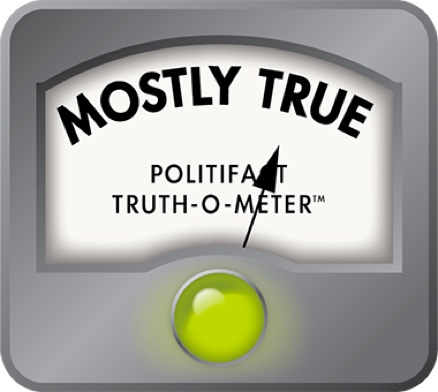
That claim rates Mostly True.
Using inflation-corrected rates of growth in the Gross Domestic Product, the 1960s indeed has the highest yearly average growth, 4.36 percent, since World War II
But that growth didn’t line up with a top tax rate of 90 percent in every year. For the first four years of the 1960s, individuals faced a top tax rate of 91 percent on each dollar over the $400,000 mark.
In 1964, the top rate dropped to 77 percent, followed by another decline to 70 percent (this time on every dollar over $200,000.) By the end of the decade, it inched back up to 77 percent. Like today, there were tax breaks and deductions that would lower someone’s effective tax rate — or what they actually pay.
Gates’ point was that lowering tax rates does not, by itself, create a more prosperous economy. But the reverse also must be said: Higher tax rates don’t mean a booming economy, either. In fact, many factors drive the economy, from energy prices and global competition, to interest rates and government spending.
Politicians and pundits meanwhile continued to debate whether President Barack Obama should receive trade promotion authority to negotiate trade agreements, including a pending trade agreement with a group of Asian economies.
Obama is being met with resistance from many within his own party. In this case, it’s Republicans who are coming to Obama’s defense.
“Every president since Franklin Delano Roosevelt has had this ability,” U.S. Rep. Paul Ryan, R-Wis., said on CNN’s State of the Union.
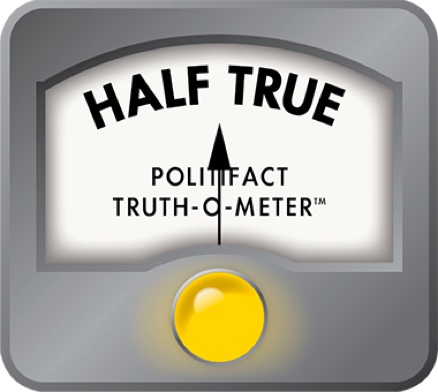
That rates Half True.
Trade promotion authority would allow trade agreements to move through Congress under special rules intended to speed up the process, thus it is known colloquially as “fast-track.” Congress would not be able to amend or filibuster a trade agreement, and the deal would only need 51 votes in the Senate to pass, as opposed to the 60 votes otherwise necessary.
There are two issues with Ryan’s statement. First, President Richard Nixon never had trade promotion authority.
“Technically, Nixon never had the authority, but the process was well advanced when he resigned,” said Mac Destler, an expert in American trade politics at the University of Maryland.
Second, the trade promotion authority of today doesn’t precisely match the authorities given to Roosevelt up until Nixon. The original version of fast-track authority was narrower in scope, but also placed more restrictions on Congress.
Our Sources
See individual fact-checks.