How close is today’s economy to the Great Depression?

Times are bad. But does today’s economy approach the depths of the Great Depression?
Recently, a number of Republicans have invoked the Great Depression when criticizing the economic record of the Obama Administration. PolitiFact national has checked two of them.
• During a June 12, 2011, face-off between party chairs on NBC’s Meet the Press, Republican National Committee chairman Reince Priebus compared the unemployment situation since the start of the past recent recession to what the nation faced during the Great Depression.
During a joint interview with his Democratic counterpart, Rep. Debbie Wasserman Schultz of Florida, Priebus said that we “have unemployment that rivals the Great Depression.” Later, he added, “we have lost as–two and a half million jobs since Barack Obama’s been president. And of that two and a half million jobs, almost 45 percent of those people have been out of work for six months. That number, that number rivals the Great Depression.”
Comparisons are complicated by a change in how employment statistics were calculated, but experts we spoke to said that comparisons are appropriate as long as the differences are disclosed.
Today’s unemployment rate is 9.1 percent. From 1931 to 1941, the annual rates ranged from 9.9 percent to 24.9 percent. So peak unemployment since the start of the most recent recession, as bad as it has been, remains well under half of the peak it reached during the Great Depression.
Meanwhile, we also looked at Priebus’ claim that “almost 45 percent of (the unemployed) have been out of work for six months,” a number that “rivals the Great Depression”?
Priebus was correct on the current figure. But his comparison had a problem: We couldn’t find any equivalent data from the Great Depression, and the economists we spoke to weren’t aware of any either. It turns out the claim came from an inaccurate CBS News story.
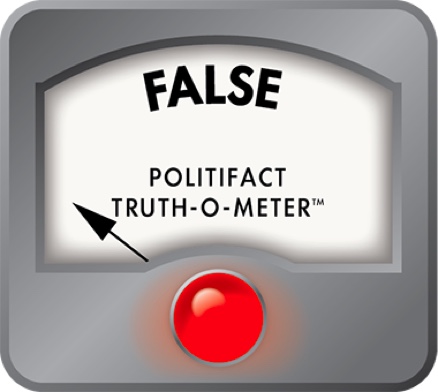
Since neither claim held up, we rated the statement False.
• During a visit to the Buddy Brew Coffee shop in Tampa on June 16, 2011, presidential candidate Mitt Romney said, “It’s been a failure in the last several years to get America back on track again. It’s taken longer to get Americans back to work than it took during the Great Depression. This is the slowest job recovery since Hoover. It breaks my heart. I want to get us back to work.” (By Hoover, Romney meant President Herbert Hoover, who held office from 1929 to early 1933 and presided over the early years of the Great Depression.)
We looked at two statistics — the number of jobs created or and the fall of the unemployment rate — during the first 23 months after a given recession officially ended, since that’s how long it’s been since the most recent recession ended.
For job creation, we compared the number of employed Americans at the start of the recovery to the number employed at the end of the 23-month period. Then we calculated the percentage increase (or decrease) in employment over that time period.
By this measure, there were two recoveries weaker than the one we’re currently experiencing — the one from November 2001 to October 2003, under President George W. Bush, and the one from July 1980 to June 1982, under presidents Jimmy Carter and Ronald Reagan. The George W. Bush recovery is especially striking, since the economy actually lost more than 700,000 jobs during the first 23 months after the recession ended.
For the unemployment rate, we compared the rate at the end of the 23-month period to what it was at the beginning of the period.
By this measure, too, the current recovery is not the weakest. Three recoveries actually saw an increase in the unemployment rate after 23 months (ones under George W. Bush, George H.W. Bush and Carter/Reagan), while another (under President Richard Nixon) produced a smaller decline in the unemployment rate than the current recovery has. (Because a budding recovery can entice discouraged workers back into the labor force, it’s not unusual for the unemployment rate to rise in a recovery.)
So, depending on the measure you use, there are either two or four recoveries since Hoover that were weaker than the current one. So we rated the claim False.
None of this is to suggest that the current recovery is robust. It isn’t. In fact, most economists agree that this is the worst economy since the Great Depression. But making direct comparisons with the nation’s worst economic disaster is a tricky business. In both of these cases, we concluded that the comparisons went too far.
Our Sources
See original Truth-O-Meter articles.