How useful are CPAP machines during a ventilator shortage?

If your time is short
• CPAP machines, which are used by people with sleep apnea, have some superficial similarities with ventilators, raising the question of whether they could be adapted to ease the coronavirus-driven ventilator shortage.
• Experts say that to be used on coronavirus patients, CPAPs would have to be retrofitted with filtering systems so they don’t discharge large amounts of virus into the surrounding air.
• Medical professionals say people who use a CPAP to treat sleep apnea need to consult with a doctor if they contract coronavirus, because the risks of continuing to use the device may outweigh the benefits.
As hospitals worry about their dwindling reserves of ventilators to battle coronavirus infections, interest has turned to another kind of device that aids in breathing: continuous positive airway pressure machines, or CPAPs.
Entrepreneur Elon Musk has donated some, and some hospital groups have welcomed the machines, which are typically used to treat sleep apnea. A group of engineers, physicians, and industry officials have set up a website, VentilatorSOS.com, to coordinate donations of the devices with faculty and students from two California universities.
Interest in CPAPs as a ventilator alternative stems from the way they aid breathing through the use of pressurized air. Several readers asked PolitiFact questions about how CPAPs might be used during the coronavirus epidemic, so we asked experts. They expressed reservations about how helpful CPAPs can be.
What are CPAPs?
CPAPs are widely used to treat sleep apnea, a condition in which muscles at the rear of the throat are unable to keep the airway open during sleep. This harms normal breathing, forcing the patient to wake up repeatedly and leaving them excessively tired. Another problem with sleep apnea is loud snoring.
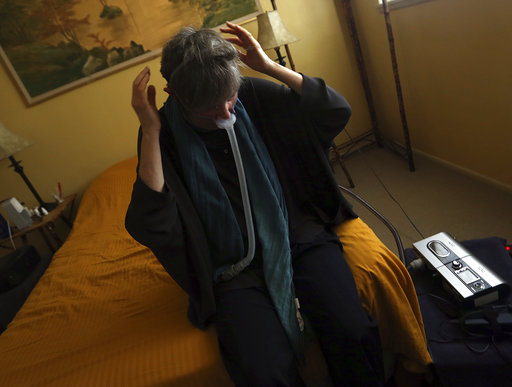
A CPAP addresses sleep apnea by producing a consistent, calibrated flow of air through the airways, routed through tubes and a mask attached to the face. The CPAP enables regular breathing and a better night’s sleep.
Generally speaking, CPAPs are simpler devices than ventilators. They produce a constant pressure, not the breath-to-breath changes in pressure needed to push air into the lungs. While CPAPs may be used in a hospital setting, their widest use is among sleep apnea sufferers in their own home.
Ventilators are connected to tubes that go into the patient’s breathing passage itself, rather than just to the mask. Ventilators also supply oxygen, which CPAPs ordinarily don’t. And generally, ventilators have much more sophisticated electronics for monitoring than CPAPs do.
Given the current ventilator shortage, can CPAPs be helpful to hospitalized coronavirus patients?
Yes, but not without modifications, experts say.
One problem is that CPAPs typically don’t have audible warning alarms. “If the power goes out, or if the patient stops breathing, it doesn’t tell the medical staff,” said Meir Kryger, a professor of pulmonary medicine and a clinical professor of nursing at the Yale School of Medicine.
But the bigger problem is that, unless they have been retrofitted, CPAPs send out the user’s exhaled breaths into the air. If a CPAP user is infected, that releases the coronavirus widely.
“The air leaving the patient actually goes into the environment without being filtered,” Kryger said. “That would be a hazard to people around the patient.”
In fact, this phenomenon may have turned a Washington state nursing home into one of the earliest coronavirus outbreak sites. According to PolitiFact partner Kaiser Health News, first responders who were called to the Life Care Center of Kirkland, Wash., initially used CPAPs to treat elderly patients before they realized that the patients had been infected with coronavirus.
The American Society of Anesthesiologists released guidance on Feb. 23 discouraging CPAP use for coronavirus patients, saying that intubation was preferable to avoid risks of spreading infection to other patients and health care workers.
The Food and Drug Administration subsequently issued guidance allowing the use of CPAPs, but only if they are modified.
What kind of modifications are needed?
The most important step is to retrofit CPAPs so that they filter out viruses before they exit the machine. The necessary filters can cost as little as $3 or $4. “It’s not a big piece of equipment,” Kryger said, but the fixes need to be done by a respiratory therapist or doctor. “Someone should not fool around with their CPAP,” he said.
A potentially promising option is to modify a more complex device known as a bilevel positive airway pressure machine, or BIPAP, which works more like a real ventilator in some ways.
While CPAP has the same pressure level for inhalation and expiration, a BIPAP has higher pressure for inhalation and lower pressure for exhalation, said Dr. Stuart F. Quan, senior physician and clinical director in the division of sleep and circadian disorders at Brigham and Women’s Hospital and a professor of sleep medicine at Harvard Medical School.
A BIPAP is a bit “more like a real ventilator, but they are less common than CPAPs,” Quan said.
If a BIPAP machine is modified to filter out viruses, it can hold a patient who isn’t facing a severe case, at least for a couple of days — possibly enough for a ventilator to become available, if needed, James Finigan, a pulmonology and critical-care specialist at National Jewish Health in Denver, told Kaiser Health News.
If someone already uses a CPAP for sleep apnea, should they continue doing so if they experience early coronavirus symptoms?
Obviously, you should first consult a doctor. But there are reasons to stop using a CPAP if you suspect you’re infected with coronavirus, experts say.
First, as we’ve noted, using a CPAP machine risks spreading the virus to other people living in the same house.
Beyond that, a CPAP itself could cause problems for the user with sleep apnea if they also have coronavirus.
“One of the early symptoms of coronavirus is shortness of breath and coughing,” Kryger said. “It might be difficult for someone to wear the mask and be on the machine when they are coughing.”
Then, when the illness progresses further, the lungs fill with fluid. At that point, more aggressive measures in a hospital are needed, rather than using a home CPAP.
Ultimately, for a patient with mild sleep apnea and coronavirus symptoms, Kryger said, it might be better not to be on the CPAP until they’ve recovered. “You will have trouble sleeping anyway, and the CPAP may not help,” he said.
Patients with more severe sleep apnea may need to start using oxygen. And if they have both severe apnea and shortness of breath from coronavirus, it’s recommended that they check into a hospital.
Our Sources
Venessa L. Pinto and Sandeep Sharma, "Continuous Positive Airway Pressure (CPAP)," May 11, 2019
American Society of Anesthesiologists, guidance, Feb. 23, 2020
Food and Drug Administration subsequently, guidance, March 22, 2020
Kaiser Health News, "Not So Fast Using CPAPs In Place Of Ventilators. They Could Spread The Coronavirus," March 27, 2020
Interview with Stuart F. Quan, senior physician and clinical director in the division of sleep and circadian disorders at Brigham and Women’s Hospital and a professor of sleep medicine at Harvard Medical School, April 6, 2020
Interview with Meir Kryger, professor of pulmonary medicine and a clinical professor of nursing at the Yale School of Medicine, April 6, 2020