Michael Moore vs. the Gipper

In his new film,
Capitalism: A Love Story
, Michael Moore contends the economic policies of President Ronald Reagan marked the turning point when the the gap widened between the rich and everyone else. We put a few of Moore’s claims about the Reagan era to the Truth-O-Meter.
Once Reagan was elected, Moore said, the government was run like a business, and the president’s tough stance on unions and his theory of “trickle-down” economics ended up hurting working Americans.
We found Moore’s claims made selective use of statistics and — while sometimes technically true — distorted the fuller picture of the Reagan era.
The first was that during the Reagan era, “Millions of people were thrown out of work.” We checked the statistics from the Bureau of Labor Statistics and found that while millions of people did, in fact, lose their jobs during a recession in the early years of Reagan’s first term — particularly in the manufacturing sector — if you look at the numbers from the beginning of Reagan’s term to the very end, some 17 million more people were added to the employment ranks, and unemployment rates decreased. And so we gave this one a
Barely True
.
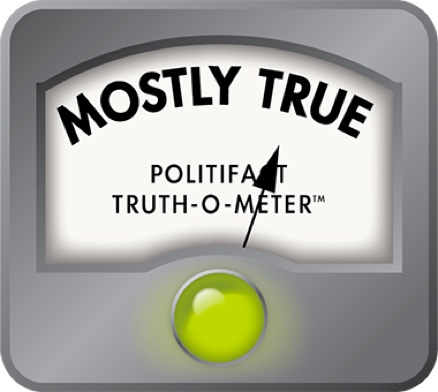
We also looked at Moore’s claim in the movie that as productivity rose during the Reagan years, “wages for working people remained frozen.” We found there were some defensible figures to back this statement up, but that Moore was awfully selective in choosing his data. Productivity definitely increased, and wages froze … if you factor for inflation, don’t include other types of worker compensation like health care, and use Moore’s definition of “working people.” And so we rated this one
Mostly True
.
Lastly, we looked at the claim that during the Reagan era, “the richest Americans had their top income tax rate cut in half.” Moore here is referring to the top marginal tax rate — the rate of income tax charged to an individual on their last dollar of earnings — which decreased from 70 percent in 1980 to 28 percent in 1989. But when you look at the effective tax rate, the actual percentage of income that people paid in income taxes, factoring in not only the graduated percentages along the marginal tax rate scale, but also the deductions and tax credits that people were entitled to, the richest Americans saw their taxes cut by about just 10 or 11 percent. That might have confused some people, but Moore worded things right. We ruled this one
Mostly True
.
You can find all of our Moore items collected in our article,
The Michael Moore movie gets a fact-check
.
Our Sources
See individual items.