At the start of the COVID-19 pandemic, Judge Ketanji Brown Jackson advocated that “each and every criminal defendant in D.C. Corrections custody should be released.”

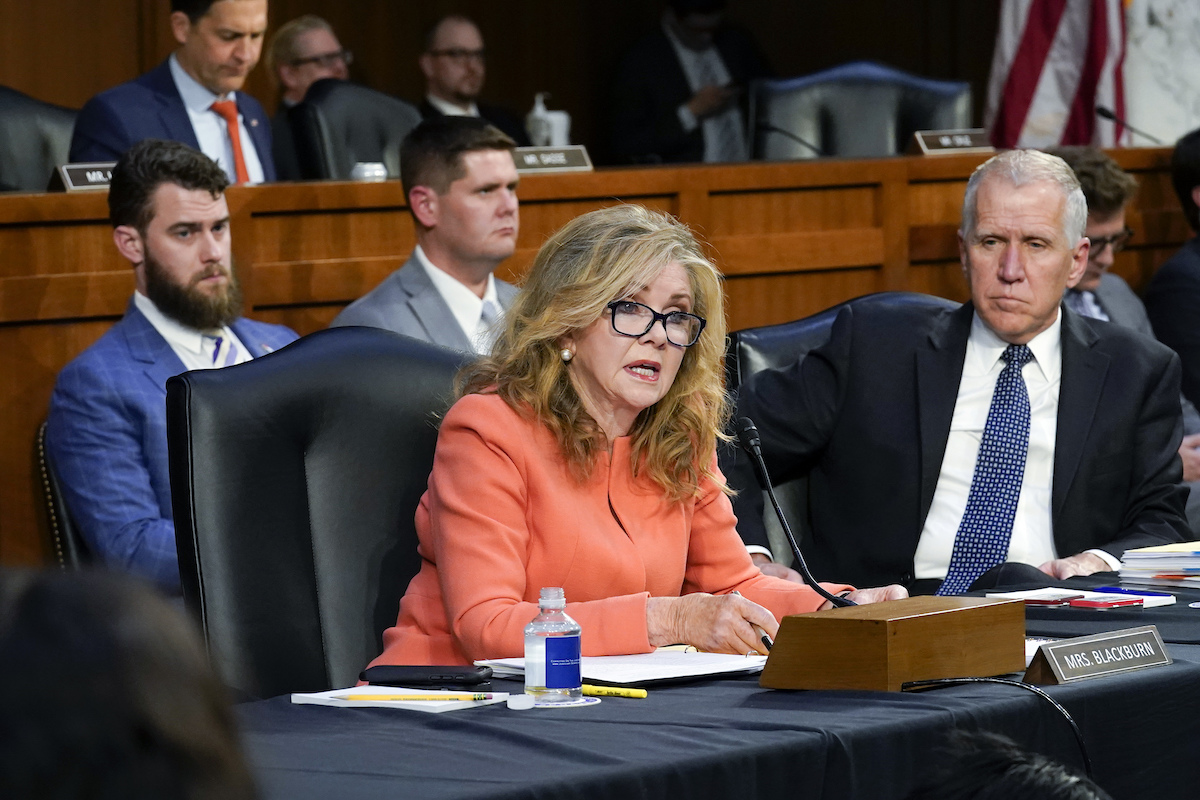

Marsha Blackburn misleads about Jackson’s record on releasing criminals during the pandemic
If your time is short
-
In April 2020, early in the pandemic, Judge Ketanji Brown Jackson wrote that the increased risk of harm from COVID-19 suggests every criminal defendant in D.C. DOC custody "and who thus cannot take independent measures to control their own hygiene and distance themselves from others — should be released."
-
But in the same ruling she denied the request of an inmate to be released, citing other factors. Those factors included whether they were at risk of reoffending or not complying with release conditions.
Republicans have portrayed Judge Ketanji Brown Jackson as soft on criminals. Sen. Marsha Blackburn, R-Tenn., suggested the federal judge “consistently called for greater freedom for hardened criminals.”
During the Senate Judiciary Committee hearing March 21, Blackburn said to Jackson, “At the start of the COVID-19 pandemic, you advocated and again I quote for ‘each and every criminal defendant in D.C. Corrections custody should be released.’ That would have been 1,500 criminals back on the street if you had had your way.”
Blackburn’s statement creates an impression that Jackson advocated for releasing incarcerated defendants en masse, and that’s wrong. The senator also cherry-picks part of Jackson’s April 10, 2020, ruling in one case in which she actually denied an inmate’s request for release.
We contacted Blackburn’s office to ask for her evidence about President Joe Biden’s Supreme Court nominee and did not get a response by our deadline.
Jackson’s record on releasing defendants
The case at hand was a motion by a defendant, Sean Ray Wiggins, who sought to be released from the D.C. jail to home confinement due to the COVID-19 pandemic. At the time of Jackson’s ruling in April 2020, 41 inmates had tested positive for COVID-19 in the jail. Jackson was a U.S. District Court judge in Washington, D.C.
Prosecutors opposed Wiggins’ request for release, arguing he was a danger to the community. Wiggins had pleaded guilty to participating in a large heroin trafficking conspiracy, and law enforcement found a significant amount of ammunition at his home when they arrested him.
Jackson did make the statement that Blackburn quotes about releasing defendants:
“The obvious increased risk of harm that the COVID-19 pandemic poses to individuals who have been detained in the District’s correctional facilities reasonably suggests that each and every criminal defendant who is currently in D.C. DOC custody — and who thus cannot take independent measures to control their own hygiene and distance themselves from others — should be released,” Jackson wrote.
But Blackburn omits that Jackson also wrote that there are constraints on judicial authority and that statutes mandate an assessment of an inmate’s flight risk and dangerousness and that releasing dangerous defendants “poses substantial risks to probation officers, law enforcement, and the public at large.” She concluded that Wiggins had not met the conditions for release and denied his motions.
The Congressional Research Service wrote that many of Jackson’s decisions about releasing defendants during the pandemic “did not rely on it to grant release automatically” and that her decisions reflect “attention to case-specific circumstances.”
The report cites multiple examples of when Jackson denied motions for release:
-
Hartley James Lee, who was charged with possession of firearms. Jackson wrote that she agreed with recent precedents that “rejected emergency motions for release of otherwise healthy and potentially violent defendants based solely on the generalized risks that COVID-19 admittedly creates for all members of our society.” Jackson cited a ruling by a magistrate judge who concluded that Lee was not likely to comply with release conditions and that he may act violently if released.
-
Robert Leake, a defendant charged with drug and gun offenses, which Jackson described as “serious and dangerous.” Jackson said that while Leake had mild asthma, he had a history of noncompliance with conditions of release, so there wasn’t a compelling reason for his release.
-
Jeremy Sears, pleaded guilty to distribution of child pornography. He sought release due to conditions including diabetes and asthma. Jackson wrote that Sears was at high risk of reoffending without treatment and had not had any sex offender treatment while in custody.
In at least two decisions in 2020, the Congressional Research Service found, Jackson granted release to federal offenders based in part on the pandemic after examining factors specific to each offender:
-
D’Angelo Dunlap, an inmate who had serious underlying medical conditions including a heart abnormality. Dunlap, a heroin addict, pleaded guilty to two counts of bank robbery. Jackson wrote that Dunlap “did not have a weapon and did not specifically threaten violence” and that he didn’t pose a danger to anyone but himself. She ordered him released, with the first six months of his 36-month term of supervised release under home incarceration.
-
Morris Gemal Johnson, who was convicted of weapons-related offenses. Johnson was an honorably discharged veteran with no prior criminal history who completed two tours in Afghanistan and had since been diagnosed with post-traumatic stress disorder. Johnson had generally complied with release conditions for the 3.5 years it took to bring his case to trial.
In a case unrelated to the pandemic, Jackson granted release to a 72-year-old prisoner who had served 49 years in prison and had medical conditions. LaVance Greene in 1971 fatally shot a marshal as Greene assisted his half brother from escaping custody during a funeral furlough. Greene, 23 at the time, was found guilty of felony murder and armed robbery. Prison officers supported his request for release and said he was a model inmate.
Our ruling
Blackburn said that at the start of the COVID-19 pandemic, Jackson advocated that “each and every criminal defendant in D.C. Corrections custody should be released.”
Blackburn plucked out part of a statement by Jackson in an April 2020 ruling while omitting that the judge also wrote that statutes mandate assessment of an inmate’s flight risk and the danger they pose. Jackson concluded that the inmate had not met the conditions for release and denied his motion.
Blackburn’s statement suggests that Jackson released all inmates who came before her en masse, and that’s wrong.
Jackson denied some inmates’ requests for release and granted other ones, taking into account factors such as the likelihood they would reoffend and whether they would comply with conditions of release.
We rate this statement Mostly False.
RELATED: Joe Biden keeps promise to name first Black woman to Supreme Court
Our Sources
Sen. Marsha Blackburn, Blackburn Raises Concerns Over Judge Ketanji Brown Jackson’s Judicial Record, March 21, 2022
Congressional Research Service, The Nomination of Judge Ketanji Brown Jackson to the Supreme Court, March 14, 2022
United States v. Wiggins, April 10, 2020
United States v. Lee, March 30, 2020
United States v. Leake, May 10, 2020
United States v Sears, June 16, 2020
United States V Dunlap, Sept. 2, 2020
United States v. Johnson, May 18, 2020
United States V Greene, Feb. 2, 2021
New York Times, Echoing Conservative Grievances, Blackburn Miscasts Jackson’s Views, March 21, 2022
AP, AP FACT CHECK: Republicans skew Jackson’s record on crime, March 22, 2022
Email interview, Andrew Bates, White House spokesperson, March 22, 2022