The $1,200 coronavirus relief checks this year are “just an advance on your next tax return. … Next year, you’re automatically going to owe $1,200…

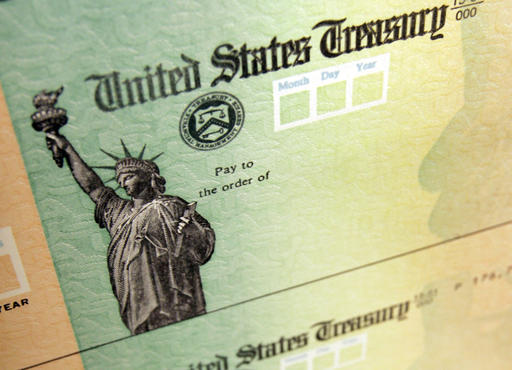

No, you don’t have to pay back your stimulus check
If your time is short
• The posts misread the law. Even if someone receives a bigger stimulus payment in 2020 than their next tax return says they should have received, they will not owe back the difference, much less the entire amount.
• The easiest way to think about it is that the government is implementing a tax cut for 2020 and giving people an advance on what they would have saved next year.
Are those $1,200 payments that are meant to cushion the financial blow of the coronavirus just a loan that Americans will have to pay back next year? That’s what a variety of social media posts are saying.
A reader sent us a link to a YouTube video titled, “Truth About Those Stimulus Checks.” In turn, this YouTube video showed a TikTok created by user @hunnerj9797. (This TikTok has also been shared via Facebook.)
Here’s the transcript of the TikTok:
“This is something I found out today about those $1,200 stimulus checks that you may be receiving with the new coronavirus stimulus package bill. Where am I getting my information? Literally, directly from the bill itself. If you go to ‘Subtitle B: Rebates and Other Individual Provisions,’ it outlines exactly what you’re going to get: the $1,200, $2,400 for the joint, for equal and qualified persons.
“See, what they don’t tell you is this is just an advance on your next tax return. ‘There shall be allowed as a credit against the tax imposed by Subtitle A for the first taxable year beginning in 2020.’ It even further outlines it is literally ‘an advance refund amount.’ So that means next year, you’re automatically going to owe $1,200 come tax season. Guys, stay safe out there. Media and public is not telling you exactly what this bill is.”
At issue are checks being cut by the federal government for essentially every American who doesn’t exceed the income cutoff.
The amount of these checks (or direct deposits) will be $1,200 per adult and $500 per child under age 17, as long as you don’t have income exceeding $75,000 per individual or $150,000 per couple. This means a family of four would get $3,400. (Above those income cutoffs, you’ll still get a check, but it will phase out by $5 for every $100 in additional income.)
In our analysis of the bill shortly before it passed, we wrote that Americans won’t have to pay taxes on the stimulus checks. Analysts told us that the government is effectively implementing a tax cut for 2020 and giving people an advance on what they would have saved.
Is that still the plan? When we checked in with tax experts, they told us the TikTok offers a misreading of the coronavirus relief bill. (Admittedly, the legislative language is tough to parse.)
Janet Holtzblatt, a senior fellow at the Urban Institute-Brookings Institution Tax Policy Center, said the rebate in the law is a refundable tax credit, meaning that people are entitled to the full amount they qualify for, even if they do not owe any income taxes.
The law also says the credit is based on the taxpayer’s circumstances in 2020. But for now, neither the IRS nor the taxpayer knows how much income they will receive in 2020.
“So the act specifies that the rebate paid now, in advance, will be based on the information from the most recent tax return filed with the IRS,” Holtzblatt told PolitiFact. That would be either the 2019 return, if it’s filed already, or else the 2018 return.
Now, flash-forward to early 2021, when a 2020 tax return will be filed. At that time, the amount of the rebate will be recomputed based on the actual 2020 income. “If the taxpayer should have gotten more than the advance credit paid this year, then he or she will get the additional amount next year,” Holtzblatt said.
However, if it turns out that the taxpayer got a larger advance rebate based on their 2019 or 2018 return, the law says that they do not have to pay back the excess, she said.
To make this more concrete, Holtzblatt offered a few scenarios for a taxpayer who ended up receiving $1,000 this year rather than the maximum of $1,200:
• If the 2020 tax return shows that they should have received $1,200, the taxpayer will get the additional $200 next year.
• If the 2020 tax return shows that they should have received $1,000, they get nothing additional and they owe nothing back.
• If the 2020 tax return shows that they should have received $800, the taxpayer does not owe back the excess $200 they received the year before.
Our ruling
The posts say that the $1,200 coronavirus relief checks being issued this year are “just an advance on your next tax return. … Next year, you’re automatically going to owe $1,200 come tax season.”
That’s not what the law says. Even if someone receives more in 2020 than their next tax return said they should have received, they will not owe back the difference, much less the entire amount. We rate the statement False.
Our Sources
YouTube, "Truth About Those Stimulus Checks," April 12, 2020
Text of H.R. 748 (CARES Act)
PolitiFact, "The Senate stimulus bill: What’s in it for you," March 26, 2020
Email interview with Janet Holtzblatt, senior fellow at the Urban Institute-Brookings Institution Tax Policy Center, April 15, 2020