A recent study found “that cities where Uber operates have 3.6%-5.6% fewer drunk driving deaths than cities without access to ridesharing.”
Uber cherry picks data from study about drunken driving
More than 43,000 people in upstate New York opened the app for the Uber ride-sharing service the night before Thanksgiving. Their attempts to catch a ride failed.
New York State does not allow the ride-hailing service north of New York City.
Uber hopes to persuade state lawmakers to change that during next year’s legislative session. It has collected more than 100,000 signatures on an online petition asking lawmakers to allow the service upstate.
“Uber can also make New York a safer place to live by reducing drunk driving throughout the State,” the petition reads. “A recent, independent study conducted by Temple University found that cities where Uber operates have 3.6%-5.6% fewer drunk driving deaths than cities without access to ridesharing.”
The company repeated that claim in a press release last month.
So is Uber right? Does ride-sharing reduce drunken-driving deaths?
What Temple University found
Since Uber’s launch in 2010, the service has expanded from San Francisco to more than 100 U.S. cities.
Temple University released its study in early 2015, and by then the ride-hailing service had already expanded to New York City and several other U.S. cities. The study attempted to find whether the Uber service changed the rate of drunken driving deaths.
Uber got half of the study’s findings correct. Researchers Brad Greenwood and Sunil Wattal found a 3.6 percent to 5.6 percent reduction in drunken driving deaths in cities where Uber was introduced between 2009 and 2014. But the study looked at only cities in California. The study did not include comparable data from the other cities where Uber operated in the same time period.
Greenwood says he’s working on an analysis for all of the cities, but the conclusion of that study won’t come soon.
National studies
A pair of researchers from Providence College and Stonehill College released a similar study earlier this year with a national perspective.
Sean Mulholland and Angela Dills looked at 150 cities and counties where Uber operated between 2010 and 2013. They found a 6 percent decline in fatal crashes in cities after Uber becomes available. But they concluded the effect on drunken-driving deaths is insignificant.
“When we look specifically at fatal crashes where alcohol is involved we find a negative relationship, but the estimated coefficient is not statistically significant,” Mulholland said. “Therefore we are unable to say whether there is an increase or decrease in alcohol-related fatal crashes when Uber enters a location.”
Mulholland said they found a 9 percent to 18 percent decrease in drunken-driving arrests in Uber locations.
Another study, published in the American Journal of Epidemiology from researchers at the University of Oxford and the University of Southern California, also found no effect on drunken driving deaths after Uber became available in 100 metropolitan areas in the United States.
“Findings reveal that the deployment of Uber services in a given metropolitan
county has no association with the number of subsequent traffic fatalities,” the study found.
Our ruling
Uber claims a Temple University study “found that cities where Uber operates have 3.6%-5.6% fewer drunk driving deaths than cities without access to ridesharing.”
But the study looked only at California cities. Two national studies found the service had no effect on drunken-driving deaths.
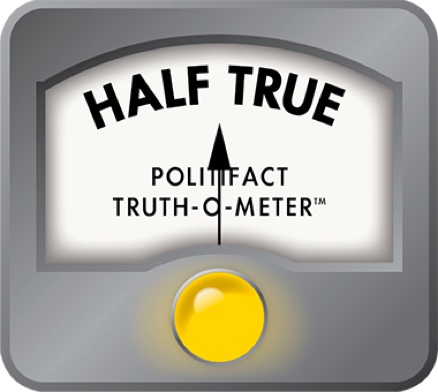
We rate this claim as Half True.
https://www.sharethefacts.co/share/8a8eac1c-9506-4ee8-b3a1-a931bff1791e
Our Sources
Uber petition to expand Uber to upstate New York
Press release: "MISSING FROM NEW YORKERS’ THANKSGIVING FEAST: UBER", Nov. 28, 2016, Received Dec. 6, 2016 from Uber via email
Email conversation with Alix Anfang from Uber
Uber Growth Timeline Infographic from NBC Los Angeles, Apr. 24, 2014, Accessed Dec. 7, 2016
"Show Me the Way to Go Home: An Empirical Investigation of Ride Sharing and Alcohol Related Motor Vehicle Homicide" Temple University, Jan. 29, 2015, Accessed Dec. 2, 2016
Email conversation with Brad Greenwood from Temple University
"Ride-Sharing, Fatal Crashes, and Crime" Western Carolina University (Researchers from Providence College and Stonehill College), May 31, 2016, Accessed Dec. 6, 2016
Email conversation with Sean Mulholland from Western Carolina University
"Uber and Metropolitan Traffic Fatalities in the United States" University of South Carolina and University of Oxford, May 24, 2016, Accessed Dec. 6, 2016