
Paul Ryan releases report saying percentage of Americans in ‘deep poverty’ has hit a record over past three years
Republicans in the U.S. House of Representatives recently released a study that critiqued the current mix of federal anti-poverty programs and suggested a new way forward.
The report, titled “The War on Poverty: 50 Years Later,” was released by the House Budget Committee, which is chaired by Rep. Paul Ryan, R-Wis. Ryan was Mitt Romney’s running mate in the 2012 election and is considered a possible presidential contender in 2016.
The report, released March 3, 2014, argues in part that there are too many overlapping and ineffective programs designed to help poor Americans.
At one point, the authors overseen by Ryan tried to give a sense of how far-reaching the problem of poverty remains, despite the investment of countless taxpayer dollars over the course of several decades.
“Over the past three years, ‘deep poverty’ has reached its highest level on record,” the report said. A footnote noted that a household living in “deep poverty” is defined as one that “makes less than 50 percent of the poverty line.” (The report isn’t the first to use the term “deep poverty” — other researchers have as well.)
We wondered whether this was correct, so we turned to data from the U.S. Census Bureau, the official source of federal statistics on poverty.
We found a table — “Percent of People by Ratio of Income to Poverty Level” — that breaks down those who earned various percentages of the poverty line. The smallest of those ratios was half the poverty line — the “deep poverty” statistic the report cited.
The federal poverty level is actually a matrix of different dollar amounts. It depends on the size of the family, with larger families having a higher threshold. For one person in 2014, the poverty level is $11,670, and 50 percent of that works out to $5,835. For a family of four, the poverty level is $23,850, and 50 percent of that is $11,925.
The most recent data available is for 2012. That year, the Census Bureau found that 6.6 percent of Americans earned 50 percent or less of the poverty line.
It was also 6.6 percent for 2011, and it was 6.7 percent for 2010.
The table includes data going back to 1975, and the percentages were never as high as they got beginning in 2010. The highest percentage before 2010 was 6.3 percent in 2009; prior to that, it was 6.2 percent in 1993. That percentage was likely higher prior to the mid-1960s, since the poverty rate as a whole between 1959 and 1965 was between 17.3 percent and 22.4 percent, well above today’s 15 percent. But before 1975, the statistic was not calculated, so we can’t know the answer for 50 percent of the poverty line for sure.
Not surprisingly, the percentage tends to rise after recessions, which explains the recent spike as well as the one in the early-1990s as well as another in the early 1980s. Prior to the most recent recession, the rate of Americans at 50 percent of poverty was 5.2 percent in both 2006 and 2007.
Our ruling
Ryan, through his committee’s report, said that over the past three years, the percentage of Americans living in “deep poverty” — making less than 50 percent of the poverty line — “has reached its highest level on record.”
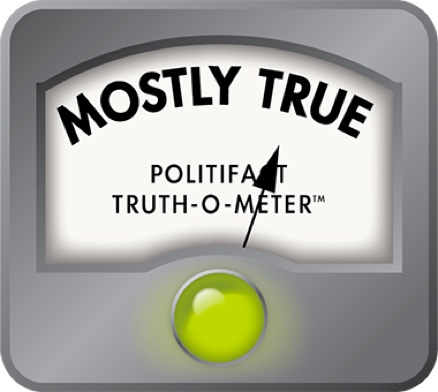
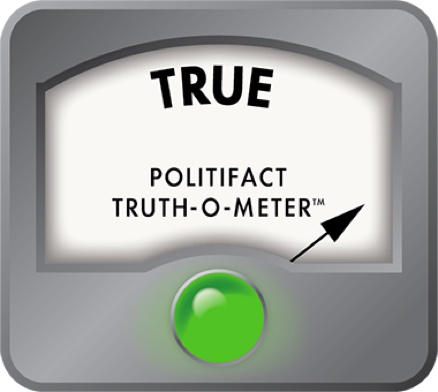
The past three years — 2010 to 2012 — clearly produced the highest percentage since the statistic has been calculated in 1975. While it’s possible the rate was higher prior to 1975, we don’t have statistics to prove that, so there’s no data “on record.” So we rate the claim True.
Our Sources
House Budget Committee, "The War on Poverty: 50 Years Later," March 3, 2014
U.S. Census Bureau, "Table 5: Percent of People by Ratio of Income to Poverty Level," accessed March 3, 2014
U.S. Census Bureau, "Table 2. Poverty Status of People by Family Relationship, Race, and Hispanic Origin," accessed March 3, 2014
Families USA, "2014 Federal Poverty Guidelines," accessed March 3, 2014
Washington Post, "Read: Paul Ryan’s Critique of the ‘War on Poverty,’" March 3, 2014
Email interview with Conor Sweeney, spokesman for the House Budget Committee, March 3, 2014