Says “I’ve authored the first bipartisan tax reform bill in a quarter-century.”
Did Wyden write the ‘first bipartisan tax reform bill’ in 25 years?
U.S. Sen. Ron Wyden, D-Ore.,held a press event in Portland last week to promote a tax reform bill he’s co-authored with a Republican from Indiana. Wyden said that taxpayers now have to go through “bureaucratic water torture” to do their taxes.
The rules are such a complicated mish-mash that many people need professional help to file their returns.
“It simply doesn’t have to be this way. I serve on the Senate Finance Committee. I’ve authored the first bipartisan tax reform bill in a quarter-century. This is with Sen. Dan Coats, the Republican from Indiana,” Wyden said.
The first bipartisan tax reform bill in 25 years? PolitiFact Oregon thought the statement a pretty bold claim to make. Don’t people elected to Congress like to write up laws? We started digging.
The context:
The last time the federal government overhauled the tax code was in 1986, when Republican Ronald Reagan was in office and the parties split control of Congress, much like today. Wyden, who was elected to Congress in 1980 and to the Senate in 1996, has talked often about the need to revisit the bipartisan spirit of that time.
Wyden wants to simplify and streamline the tax code. He says he also wants to lower the burden on families and small businesses. Wyden first proposed an overhaul in 2010, pairing with Sen. Judd Gregg, R-N.H. After Gregg left office, Wyden partnered with Coats in 2011 and plans to introduce the legislation again this year.
The analysis:
We asked Tom Towslee, a Wyden spokesman, to back up the senator’s assertion. Towslee said the office had checked with the Congressional Research Service, the body’s nonpartisan research arm, and was told of a 1995 plan sponsored by Sens. Sam Nunn, D-Ga, and Pete Domenici, R-N.M.
That plan would have replaced the income tax with a consumption tax, which Towslee said is not the same as a comprehensive reform plan. “I think you’ll agree that reforming the current income tax code to make it fairer, simpler and more efficient is very different from replacing it outright with something else,” he said.
We turned to the Tax Foundation, a Washington, D.C., think tank. President Scott Hodge checked with his staff and they also came upon the Domenici-Nunn “USA Tax Act” of 1995. (Tax bills in 1990, 1997, 2001, 2002 and 2003 may have had some crossover appeal, but these were bills to raise and lower tax rates, and not to address the tax code in a comprehensive way.)
“It may be a stretch, but not a big one,” Hodge said of Wyden’s claim. “What Wyden cares about is re-creating the bipartisanship that brought about the 1986 bill. He may not be the first, but he is in small company.”
We checked a database of Congressional bills. We found numerous bills, often introduced over multiple sessions, for a flat tax or for a fair share tax, sponsored by Democrats or Republicans, but not both. We also found several efforts to do away with the Internal Revenue Service, some with a Democrat or two on board with Republicans. For example, H.R. 352, introduced in January, is a four-page document that terminates the IRS Code of 1986 in Section 2 and calls for a new federal tax system in Section 3. It is skimpy on details.
We also caught up with Jane Gravelle, the senior specialist at Congressional Research Service who assisted Wyden’s office. She’s been there 40 years, done tons of research in the area and could not locate legislation similar to the 1986 effort other than Wyden’s. She does not consider the Nunn-Domenici effort a general income tax reform bill on par with Wyden’s bill.
“I would also add that formulating and actually putting a major tax reform bill into legislative language is a major undertaking, not something that can be done easily and quickly,” she said in an email.
Indeed, Wyden’s bill runs 120 pages. Apparently we were mistaken in thinking that lawmakers like to draft lengthy, complicated legislation on the tax code. The bills are rare.
The ruling:
Some politicians call the tinkering of tax rates “tax reform.” We don’t buy that. Some people consider the Nunn-Domenici bill of 1995 a bipartisan tax reform bill. We can see why Wyden’s office, with back-up from the research service, would differentiate his plan from their plan.
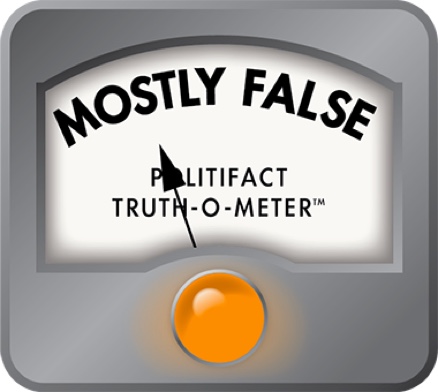
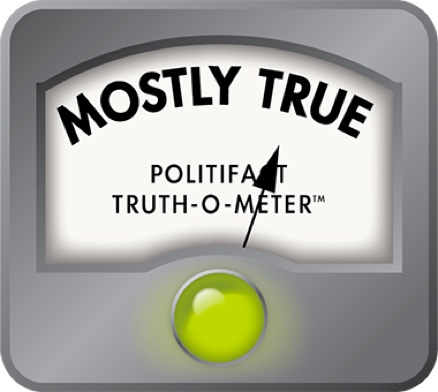
Still, the 1995 effort merits a mention as additional information missing from an otherwise accurate statement. We rule the statement Mostly True.
Our Sources
The Hill, "Wyden, Coats to introduce tax reform legislation," April 4, 2011
Congressional Research Service, "CRS Report for Congress, Prepared for Members and Committees of Congress, Tax Reform: An Overview of Proposals in the 112th Congress," Oct. 26, 2012
Chicago Tribune, "Bipartisan Sponsors Unveil Tax-revamp Plan," April 29, 1995
Washington Post, "Congress begins meetings on tax reform," March 14, 2013
National Public Radio, "Times Have Changed Since Reagan's 1986 Tax Reform," Oct. 17, 2011
PolitiFact, "Obama claims job rate soared after Clinton raised taxes," July 7, 2011
Ron Wyden, press event, April 1, 2013
Emails from and interview with Tom Towslee, Wyden spokesman, April 2-3, 2013
Emails from Scott Hodge, President, Tax Foundation, April 3, 2013
Emails from Jane Gravelle, Congressional Research Service, April 4-5, 2013