Says when Republicans took over the state legislature in 2010, New Hampshire’s tax rate for employers was 50th in the nation, and unemployment had more…
NH Speaker of the House says Democrats are to blame for high businesses taxes and unemployment rates
Eyes and ears for questionable campaign claims are everywhere.
Recently a New Boston reader reached out to PolitiFact New Hampshire with a campaign mailer he received from Speaker of the House Bill O’Brien R-Mont Vernon this summer.
The material was one of many tools incumbents are employing in a tussle for party control of the statehouse in 2013.
“When Republicans took over the legislature in 2010, we inherited a tax rate for employers that was 50th — dead last — in the nation,” O’Brien said. “Add to that one of the most intense regulatory state government structures in the country, and it was no wonder that the unemployment rate had more than doubled since the Democrats took power four years prior.”
Along with this excerpt, our reader had a simple request: “Would you be willing to crunch the numbers here?”
We were happy to oblige.
First, we reached out to O’Brien through his campaign email and phone number, but we heard nothing back.
We broke his claim into two parts, and reached out to The Tax Foundation and the New Hampshire Employment Security for some answers.
The Tax Foundation, a business-backed policy group, offered some guidance for the part of the claim where O’Brien speaks about New Hampshire’s “tax rate for employers” in 2010.
That year New Hampshire ranked 50th on The Tax Foundation’s corporate tax index, according to economist Scott Drenkard.
Every year The Tax Foundation takes an “all-encompassing” look at the entire tax system of a state, Drenkard said, breaking it into five subcategories: corporate, income, sales, unemployment insurance, and property taxes.
“The word ‘rate’ is concerning to me because it’s not exactly what it looks at,” Drenkard said. “The rate is only part of this story.”
Drenkard pointed us to a New Hampshire Watch Dog article that broke down the Tax Foundation’s ranking at the time.
As part of the study, New Hampshire ranked 7th best for overall business tax climate, and had been 7th since 2007. In 2006, the Granite State was 6th.
“New Hampshire’s economic competitiveness was dragged down in the rankings by its worst in the nation corporate tax policy,” according to the article.
“The rate is fairly high,” Drenkard said. “That’s part of the component there. There’s a business profits tax and New Hampshire limits carryforwards, one of the things that’s an important part of the base.”
New Hampshire also got “dinged” in 2010 for offering credits for creating jobs, as well as research and development credits and investment credits, which The Tax Foundation scores as negative in its corporate tax policy, Drenkard added.
“Those, for the most part, mixed with the high rate, ended up putting it in 50th in 2010,” Drenkard said. “In general, the spirit of what he’s trying to say is certainly true. We rank it as one of the worst corporate tax structures in the country.”
State legislatures write the laws that impact tax structure, Drenkard said. But it’s important to note that in 2012 — under a Republican-controlled legislature — the Granite State only hits 46th in its corporate tax rank compared to the rest of the country.
Each Tax Foundation study is considered exclusive to the year in which it is conducted and should not be compared with previous ranks, Drenkard said.
“For the most part, I don’t remember hearing any fantastic corporate tax reforms from New Hampshire at least recently,” Drenkard said. “So the story is it was bad in 2010 and for the most part is still one of our lowest ranked corporate tax codes.”
As for the Granite State’s unemployment statistics, O’Brien is fairly accurate on the numbers by themselves.
“Roughly, you could say it doubled,” Annette Nielsen, an economist for New Hampshire Employment Security said.
Looking at 2006 generally — four years prior to Republicans taking over the state legislature in November 2010 — unemployment was in the 3.4-3.7 percent range, Nielsen said.
It stayed that way through May 2008, she added. In November and December that year, the recession hit, and state unemployment numbers started rising. By December 2008 the unemployment was 4.8 percent. By October 2009 it peaked at 6.7 percent and stayed that way through January 2010. Not quite the “more than doubled” number O’Brien cited, but close.
New Hampshire’s increasing unemployment rate followed nationwide trends, Nielsen said.
“The nation was at a much higher rate, it peaked in October at 10.1 or 10.2 percent,” Nielsen said. “It followed the general trend of the nation.”
Are Democrats to blame for the increased unemployment figures?
“Whether it could be better or worse, that’s kind of a little more individual — what people maybe feel,” Nielsen said. “There are some forces that are national that have an impact. New Hampshire is not an island by itself. It’s part of the nation and there were some greater forces that were taking place at that time.”
Dennis Delay, an economist with the N.H. Center for Public Policy Studies, an independent nonprofit that pursues data-based research on public policy matters, agreed.
Unemployment increased in New Hampshire as a result of the Great Recession, he said.
“States with Republican legislatures also saw unemployment rates rise substantially after 2007, because of the worldwide financial crisis and its impact on local economies,” Delay added.
He provided a graph of job losses in the U.S. and compared it to New Hampshire, which shows the spike in job losses nationwide during that period of time.
“The situation in New Hampshire looks similar, although New Hampshire did not lose as many jobs in percentage terms as the U.S.,” Delay added.
Our ruling:
O’Brien said that when Republicans took over the state legislature in 2010, the state’s tax rate for employers was last in the nation, and unemployment had more than doubled under Democrats.
We find he generalized a 2010 tax study, zeroing in on New Hampshire’s corporate tax rate, when several other factors contribute to The Tax Foundation’s corporate tax index for New Hampshire. And he failed to mention that New Hampshire’s corporate tax rank is still in the same ballpark in 2012.
O’Brien used accurate unemployment figures comparing 2006 to 2010, but the numbers have more to do with the Great Recession than with the people (or the party) running the state.
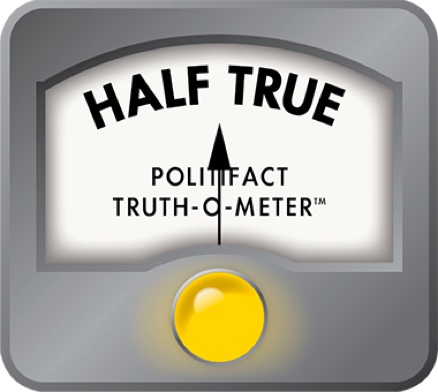
O’Brien was on target with the rank and rates he cited, but there is context missing and misplaced blame. We rate his claim Half True.
Our Sources
Reader submitted campaign mailer, Speaker of the House Bill O’Brien, Sept. 5, 2012.
Interview with Annette Nielsen, economist for N.H. Employment Security, Sept. 17, 2012.
Interview with Scott Drenkard, Tax Foundation economist, Sept. 17, 2012.
Email correspondence with Dennis Delay, economist with the N.H. Center for Public Policy Studies, Sept. 17, 2012.
Calculated Risk, Percent Job Losses in Post WWII Recessions, Sept 7, 2012.
New Hampshire Watch Dog.org, "NH ranks last in corporate tax climate, 7th best for business overall," Oct. 26, 2010.