
Newt Gingrich says students today ‘take more years to get through’ college
Newt Gingrich says too many college students are slackers.
During a campaign event in Stuart, Fla., on Jan. 28, 2012, Newt Gingrich said college students are taking too long to graduate.
“Students take fewer classes per semester. They take more years to get through. Why? Because they have free money,” Gingrich said. “I would tell students: ‘Get through as quick as you can. Borrow as little as you can. Have a part-time job.’ But that’s very different from the culture that has grown up in the last 20 years.”
We wondered whether the statistics showed that students are indeed taking longer to graduate than they did in the past. So we looked into it.
We turned to figures on post-secondary education compiled by the National Center for Education Statistics, a division of the U.S. Department of Education. As it turns out, the trend for four-year colleges is exactly the opposite.
Students starting college in …
Percent graduating in four years
1996
33.7
1997
34.1
1998
34.5
1999
35.3
2000
36.1
2001
36.2
2002
39.3
So the percentage of students completing degrees within four years has actually risen incrementally in recent years. Between the graduating classes of 2000 and 2006, the percentage of students graduating in four years increased by one-sixth.
So where four-year colleges are concerned, Gingrich’s comment is off the mark. But Gingrich has a point in regard to two-year institutions.
Students starting college in …
Percent who graduated in three years
1999
29.3
2000
30.5
2001
30.0
2002
29.3
2003
29.1
2004
27.8
2005
27.5
So for two-year institutions, the rate did fall slightly, though by less than what the rate for four-year institutions rose.
Christopher Swanson, the vice president for research and development at Editorial Projects in Education, the publisher of Education Week, said that in general, education experts haven’t been worried so much that the trendlines for college completion are going in the wrong direction. “The main narrative you hear about (concerns) the low completion rates in general,” he said. On that score, he said, “there doesn’t seem to be a whole lot to write home about.”
Swanson did take issue with the general tenor of Gingrich’s comments — that you should borrow as little as you can and instead get a job if you want to increase the likelihood that you’ll finish college on time.
“That seems to fly in the face of what I think is a pretty well-established finding from the research that working during college or post-secondary education tends to be detrimental in terms of completion (that is, that you’re less likely to complete) and time to completion (that it takes longer),” Swanson said. “There may be any number of issues and problems with excessive student borrowing, but being able to borrow for college does allow students the opportunity to focus more exclusively on their school work than would probably have been the case otherwise. If you follow the don’t borrow/get a job argument and play that out a bit, that sounds a lot like what happens as a matter of course in community colleges. And the completion rates there are extremely low, on the order of one-third completing within an extended timeline.”
Our ruling
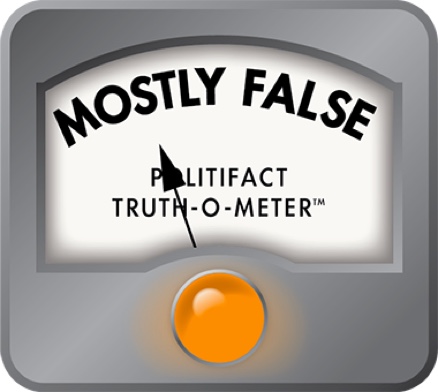
Gingrich said that students today “take more years to get through” college. While graduation rates are lower than experts would like them to be, it’s not true that students are taking longer to graduate from four-year institutions. The percentage graduating on time at four-year colleges has actually risen consistently in recent years. The only exception to this pattern is at two-year colleges, where the percentage of students graduating within three years has fallen slightly. On balance, we rate the statement Mostly False.
https://www.sharethefacts.co/share/670cf7ee-39a3-41a7-9d3a-e6c3459864a0
Our Sources
Washington Post, "Gingrich urges students to get part-time jobs — apparently unlike himself," Jan. 28, 2012
National Center for Education Statistics, "Table 341. Graduation rates of first-time postsecondary students who started as full-time degree-seeking students, by sex, race/ethnicity, time between starting and graduating, and level and control of institution where student started: Selected cohort entry years, 1996 through 2005," accessed Jan. 30, 2012
E-mail interview with Christopher Swanson, vice president for research and development at Editorial Projects in Education, Jan. 30, 2012