“The president’s party always gets shellacked in midterms. It’s only twice, 1934 and 2002, that the president’s party actually gained in both the House and…

Do presidents always get “shellacked” in midterm elections?
As Democrats brace for expected losses in the House and Senate, you can expect to hear a lot more of this in the weeks ahead: The president’s party usually takes a beating in midterm elections.
So when we heard Mary Jordan, a longtime foreign correspondent for the Washington Post, mention this pattern during the roundtable segment of ABC’s This Week with Christiane Amanpour, we decided to check the history.
Jordan said, “Well, the fact that the Republicans are going to do so well, really, it’s just the history. The president’s party always gets shellacked in midterms. It’s only twice, 1934 and 2002, that the president’s party actually gained in both the House and the Senate.”
She’s correct that the president’s party generally loses ground in midterm elections. In midterms since 1862, the president’s party has averaged losses of about 32 seats in the House and more than two seats in the Senate.
She’s also right that the president’s party beat the odds and gained in 1934 and 2002. In 1934 — two years into Franklin D. Roosevelt’s presidency, in the midst of the Great Depression — Roosevelt’s Democratic Party gained nine House seats and 10 Senate seats. And in 2002, roughly a year after the terrorist attacks of Sept. 11, 2001, President George W. Bush’s Republican Party gained eight House seats and two Senate seats.
But the president’s party also avoided getting “shellacked” on other occasions.
We won’t dig back as far as the Lincoln Administration, but in 1962, President John F. Kennedy’s Democrats lost just four seats in the House and gained three seats in the Senate. In 1990, President George H.W. Bush’s Republicans lost eight seats in the House and only one seat in the Senate — a setback, but not a shellacking. And in 1998, President Bill Clinton gained five seats in the House and stayed even in the Senate.
None of these fit the strict definition of the president’s party gaining seats in both chambers during a midterm election — the yardstick Jordan specifically used — but we do think they undermine her claim that presidents “always” get “shellacked” in midterms.
The 1998 election under Clinton is especially notable, since elections six years after a president takes office tend to produce especially harsh results for the party occupying the White House. In fact, the 1998 election — when voters were widely believed to be punishing a Republican overreach in their impeachment of Clinton — represents the only time since the Civil War that a president has survived a sixth-year election with anything close to gains in both chambers.
A final note for political history buffs. We initially thought we’d have to add 1902 to 1934 and 2002 as a year in which the president gained seats in both chambers. On Election Day 1902, Theodore Roosevelt’s Republicans gained two seats in the Senate and seven in the House — but we found the Democrats also gained seats in the House, 25 to be precise. How was that possible? It was because Congress had enlarged the House to account for population growth, from 357 seats before the election to 386 seats after. (The House didn’t reach its current 435 seats until 1913.) So because of this oddity, we’ll leave 1902 out.
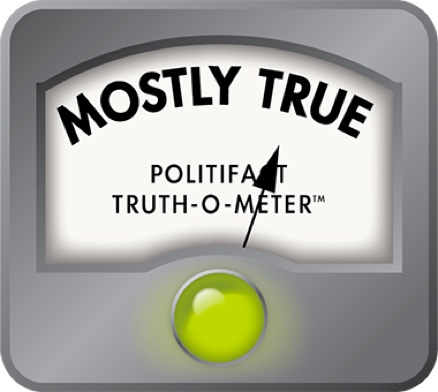
In all, then, Jordan is on target by singling out 1934 and 2002 as the only years in which a president’s party gained seats in both chambers during a midterm election. But she stretched a bit when she said that “the president’s party always gets shellacked in midterms.” If she’d said “usually gets shellacked,” she would have been on safe ground, but the examples of 1962, 1990 and 1998 demonstrate that an incumbent president can in fact lose ground in Congress without being “shellacked.” On balance, we rate Jordan’s statement Mostly True.
Our Sources
Mary Jordan, comments during the roundtable segment of ABC's This Week with Christiane Amanpour, Sep. 5, 2010
Colleen J. Shogan, "The Contemporary Presidency: The Sixth Year Curse" (paper published in Presidential Studies Quarterly), March 2006
U.S. House of Representatives Office of the Clerk, "Party Divisions of the House of Representatives, 1789 to Present" (table), accessed Sept. 7, 2010
Norman J. Ornstein, Thomas E. Mann and Michael J. Malbin, Vital Statistics on Congress, 2001-2002, published 2002