“If we went back to the obesity rates that existed in 1980, that would save the Medicare system a trillion dollars.”

A trillion is too much
A trillion dollars? Really? That’s a lot of money — $1,000,000,000,000, to be exact.
Obama is accurately quoting that number from a report issued by the Center for American Progress, a left-leaning think tank. The report states, “If we were able to reduce obesity to 1980s levels, Medicare would save $1-trillion.” It attributes the number to the Centers for Disease Control and the Commonwealth Fund.
At issue is the increased prevalence of obesity. The percent of the U.S. population considered to be obese has roughly doubled since the 1980s. Researchers have documented that these people need more health care due to complications from obesity-related diseases such as diabetes, cardiovascular disease, certain types of cancers and other illnesses. Researchers have also developed models to calculate costs for obesity-related health care.
We agree that obesity drives up health costs, but getting to $1-trillion just doesn’t add up, according to our estimates. (Factcheck.org, a political fact-checking Web site at the University of Pennsylvania, found the same thing; check out their analysis
here
. ) The Centers for Disease Control cites a study on health spending due to obesity and overweight that shows numbers significantly less than $1-trillion.
We tracked down one of the authors of the study the CDC cited: Eric Finkelstein, a health economist with the research group RTI International who has studied the issue extensively and written several papers on the topic. Finkelstein said obesity accounts for excess health spending of about $90-billion a year. About half of that — about $45-billion — is billed to Medicare and Medicaid together.
Medicare’s share of obesity spending therefore is between $20-billion and $25-billion. If obesity rates rolled back to 1980s levels, Medicare spending would be about half that, or about $12-billion a year.
Now we get to the slipperiness of Obama’s quote. He says if obesity rates rolled back, Medicare would save $1-trillion. But he doesn’t give a time frame, and neither does the report he’s quoting from. Maybe he meant it would have saved $1-trillion since the 1980s.
But that doesn’t make sense either. At the rate of $12-billion of savings per year, it would take more than 80 years to reach $1-trillion. Let’s say our estimate is too conservative and it’s $20-billion per year. It would still take 50 years to reach $1-trillion in savings. Inflation might get you there a bit faster, but not by that much. The number $1-trillion is just so big that increments of $10-billion won’t get you there very quickly.
“I think it’s a stretch,” Finkelstein said.
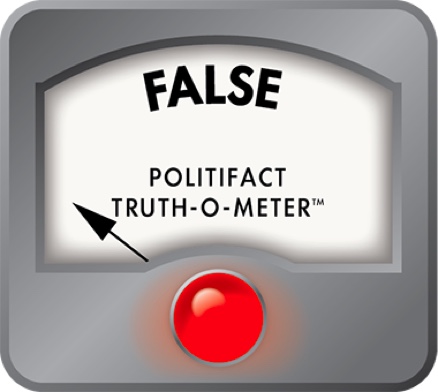
We think so, too, and rate Obama’s obesity claim False.
Our Sources
Interview with Eric Finkelstein of RTI International
Centers for Disease Control and Prevention, Overweight and Obesity, Economic Consequences , May 22, 2007
Health Affairs, The Impact of Obesity on Rising Medical Spending , Dec. 13, 2007