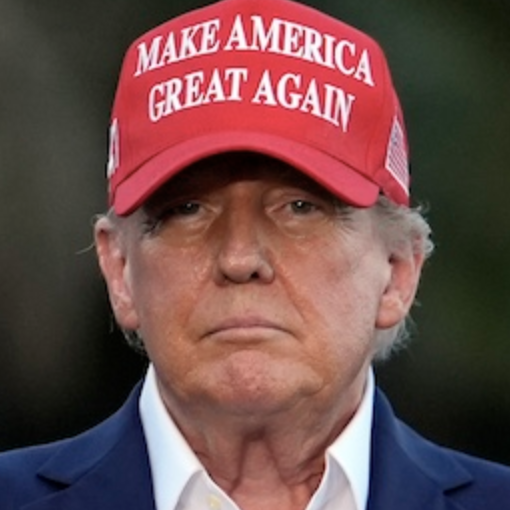
"I will restore the Trump ban on transgender in the military. I had it stopped, totally stopped, and then they approved it."
On March 18, District Court Judge Ana C. Reyes issued a preliminary injunction blocking the Defense Department's new policy to remove transgender service members.
The ruling came in response to a lawsuit several active transgender service members filed over President Donald Trump's executive order declaring that transgender service members "cannot satisfy the rigorous standards necessary for military service," and subsequent Defense Department policies prohibiting from service anyone with a history of gender dysphoria.
Gender dysphoria is psychological distress that results from an incongruence between one's sex assigned at birth and one's gender identity. Medical experts say not all transgender people experience it.
The injunction requires the administration to "maintain the status quo of military policy regarding transgender service that existed immediately before" Trump issued his executive order.
In her opinion, Reyes, described the policy as rushed without careful consideration or the support of evidence.
"The Military Ban is soaked in animus and dripping with pretext," Reyes wrote. "Its language is unabashedly demeaning, its policy stigmatizes transgender persons as inherently unfit, and its conclusions bear no relation to fact. Thus, even if the Court analyzed the Military Ban under rational basis review, it would fail."
Reyes, a Biden administration appointee, called it "highly unlikely" the ban would survive judicial review for other reasons as well.
The order goes into effect the morning of March 21 unless the U.S. Court of Appeals steps in. For now, we are moving the status of this promise to Stalled.
On his first day in office, President Donald Trump repealed a Biden-era executive order that allowed transgender people to serve openly in the military, clearing the path to reinstate restrictions in place under Trump's first administration.
Trump took the next step Jan. 27 by signing an executive order, "Prioritizing Military Excellence and Readiness," which says transgender service members "cannot satisfy the rigorous standards necessary for military service." Identifying as transgender, it says, "conflicts with a soldier's commitment to an honorable, truthful, and disciplined lifestyle," and "is not consistent with the humility and selflessness required of a service member."
The order directed the defense secretary to update military service medical standards within 60 days and, within 30 days, "issue guidance necessary to fully implement this order."
The Pentagon issued a Feb. 26 memo announcing a policy that "individuals who have a current diagnosis or history of, or exhibit symptoms consistent with gender dysphoria are no longer eligible for military service."
Gender dysphoria is psychological distress that results from an incongruence between one's sex assigned at birth and one's gender identity, although medical experts say not all transgender people experience it.
The memo also said that people with gender dysphoria may no longer enlist, and military departments must begin "separation actions" within 30 days for those currently serving.
Waivers will be granted on a case-by-case basis, the memo said, but waiver eligibility requires a person to have "never attempted to transition," and to have lived for 36 months as their sex assigned at birth "without clinically significant distress." Transition refers to the process a person goes through to identify and live as a gender different from the sex assigned to them at birth.
The memo's other policies prohibit the use of pronouns that don't match a person's sex, and mandate that "all service members will only serve in accordance with their sex."
Several transgender active service members, and some seeking to enlist have filed a lawsuit to halt the changes.
Of more than 1.3 million active military service members, it's unclear exactly how many are transgender. A 2018 Defense Department estimate put the number at 8,980, or 1% of the entire force. When including members in the National Guard and military reserves, a 2014 estimate from the University of California, Los Angeles' Williams Institute, a LGBTQ+ policy research center, put the figure around 15,500.
Trump's order directed the Defense Department to restrict the ability of transgender people to serve in the armed forces. The policies released on Feb. 26 prohibit transgender people with gender dysphoria from enlisting and orders the purge of existing transgender service members, with some narrow possible exceptions.
The policy faces a court challenge, but for now we rate this a Promise Kept.
As part of a Day 1 executive order repealing a slew of Biden administration policies, President Donald Trump cleared a path to reinstate a ban on transgender people serving in the military.
Trump's Jan. 20 executive order, "Initial Recissions of Harmful Executive Orders and Actions," revoked several of President Joe Biden's executive orders, including a Jan. 25, 2021, order allowing transgender service members to openly serve.
Trump has yet to institute a new ban, but repealing the Biden executive order clears the path for such a policy to be executed.
"This paves the way for a new ban on military service, but as of today, nothing has changed," said Rachel Branaman, executive director of the Modern Military Association of America, a nonprofit advocating for LGBTQ+ servicemembers and veterans.
Trump's promise to reinstate a ban on transgender people serving in the military harks back to his first-term policy agenda. The promise is one of 75 Trump made that PolitiFact will track on the MAGA-Meter. Over the next four years, we will periodically evaluate the new administration's progress on Trump's 2024 campaign promises, just as we did with Barack Obama, Trump during his first term, and Joe Biden.
In a July 2017 tweet, Trump declared that "the United States Government will not accept or allow transgender individuals to serve in any capacity in the U.S. Military." This policy aimed to reverse a 2016 Obama administration policy allowing trans people to serve openly.
In 2023, Trump claimed that he "banned transgender" people from serving in the military, and we rated it Mostly True. That's because after his policy was announced in a memorandum, it faced numerous legal challenges that delayed its execution. In 2021, Joe Biden signed an executive order reversing Trump's first-term restrictions and allowing transgender service members to serve openly.
Trump's reversal of Biden's order doesn't mean a ban is in force, but his Day 1 actions show his administration is paving the way to attempt to pass such a policy in the future.
We rate this promise In the Works.