A map shows “all the cargo ships backed up by the Suez Canal. Get ready for shortages and prices to skyrocket.”

Map of ship traffic doesn’t show the Suez Canal
If your time is short
- The map in the post shows bodies of water around the Arabian Sea, not the Suez Canal, which connects the Red Sea to the Mediterranean.
- Experts don’t expect the six-day blockage at the canal to have much impact on supplies or prices in the U.S.
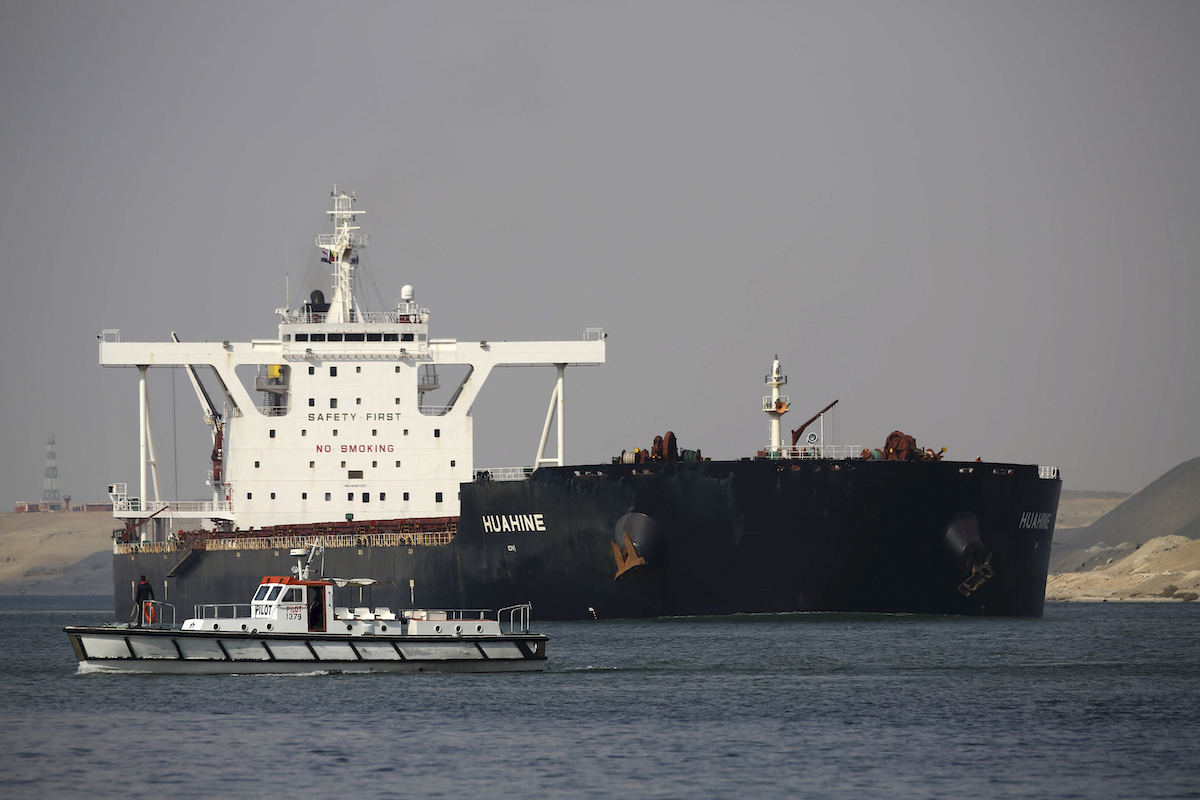
The giant freighter Ever Given has been freed after six days, and other cargo ships are finally moving through the Suez Canal.
But the impact of the maritime traffic jam will be felt for a while, says a Facebook post shared on March 29, the day the ship was refloated.
The post shows a map of a body of water around the Arabian Peninsula and a dense cluster of triangles, circles and other shapes representing ships apparently bottlenecked in one area.
The Facebook caption reads: “These are all the cargo ships backed up by the Suez canal. Get ready for shortages and prices to skyrocket.”
The problem with the image: The water in the map isn’t the Suez Canal.
The post was flagged as part of Facebook’s efforts to combat false news and misinformation on its News Feed. (Read more about our partnership with Facebook.)
We took out our own maps to figure out what the Facebook post was showing, and found that the cluster of ships it depicted was at least a thousand miles away.
The Suez Canal is located in Egypt, and it connects the Red Sea to the Mediterranean. It’s used heavily as a quick shipping route for cargo ships traveling between Europe and Asia.
The map in the Facebook post shows bodies of water flowing from the Arabian Sea. At the top of the map, between Iran and Saudi Arabia, is the Persian Gulf, and to the south is the Gulf of Aden, between Yemen, Djibouti and Eritrea.
Both areas carry a lot of shipping traffic, but the backup from the Suez Canal didn’t stretch to the Persian Gulf.
The posted map was originally created by Marine Traffic, a provider of ship tracking and maritime intelligence.
Georgios Hatzimanolis, media strategist for Marine Traffic, clarified that the map in the Facebook post shows normal traffic in the area, not unusual congestion.
Hatzimanolis also explained what the colored shapes mean: green for cargo ships, red for tankers, and blue for passenger ships.
As for the second half of the Facebook post, will we see product shortages and skyrocketing prices because of the delays at the Suez Canal?
No, says Gary Hufbauer, nonresident senior fellow at the Peterson Institute for International Economics.
“The claim that ‘prices will skyrocket’ is a HUGE exaggeration,” Hufbauer said in an email. “I don’t think any price surge will be noted in the U.S., and only small blips in Europe at most.”
Hufbauer explained that this is because most U.S. imports from Asia come across the Pacific to the West Coast, or through the Panama Canal to the East Coast.
A report from Forbes backs this up, saying that trade with the U.S. will be minimally affected. Additional reports cite a study from analytics companies Dun & Bradstreet and E2open, which says that while industries in the U.S. will be affected, Western Europe will be the region that’s hardest hit.
Our ruling
A Facebook post showing a map of maritime traffic says, “These are all the cargo ships backed up by the Suez Canal. Get ready for shortages and prices to skyrocket.”
The map doesn’t show the Suez Canal. It shows normal traffic in a different area, around the Arabian Sea, the Persian Gulf and the Gulf of Aden.
Experts say the impact of the six-day blockage of the Suez Canal will be minimal in the U.S.
We rate this post False.
Our Sources
Facebook post, March 29, 2021
Google Maps, The Suez Canal, accessed March 30, 2021
Google Maps, The Suez Canal compared to the Arabic Sea, accessed March 30, 2021
Email interview with Georgios Hatzimanolis, Media Strategist for Marine Traffic, March 31, 2021
Email interview with Gary Hufbauer, Nonresident Senior Fellow at Peterson Institute for International Economics, March 31, 2021
Forbes, U.S. Impact from Suez blockage will be minimal, largely on east coast, March 28, 2021