“If you look at the one (hydroxychloroquine) survey, the only bad survey, they were giving it to people that were in very bad shape. They…

Trump wrong that hydroxychloroquine studies only gave drug to dying patients
If your time is short
-
Trump spoke as though there was only one study that found no benefit from hydroxychloroquine, and said it only looked at people "that were in very bad shape," almost dead.
-
There have been three studies, and all found no link between hydroxychloroquine and reduced deaths.
-
All studies filtered out the impact of underlying health problems.
Count President Donald Trump as hydroxychloroquine’s No. 1 fan.
At a press conference, Trump told reporters he’s putting his health where his mouth is.
“Couple of weeks ago I started taking it,” he said May 18. “Because I think it’s good. I’ve heard a lot of good stories. And if it’s not good, I’ll tell you right. I’m not going to get hurt by it.”
To be clear, the Food and Drug Administration cautions that hydroxychloroquine can hurt people. It increases the risk of an irregular heartbeat, which can lead to cardiac arrest.
Trump didn’t mention that. He did, however, dismiss the research that cast doubt on whether the drug does any good against COVID-19.
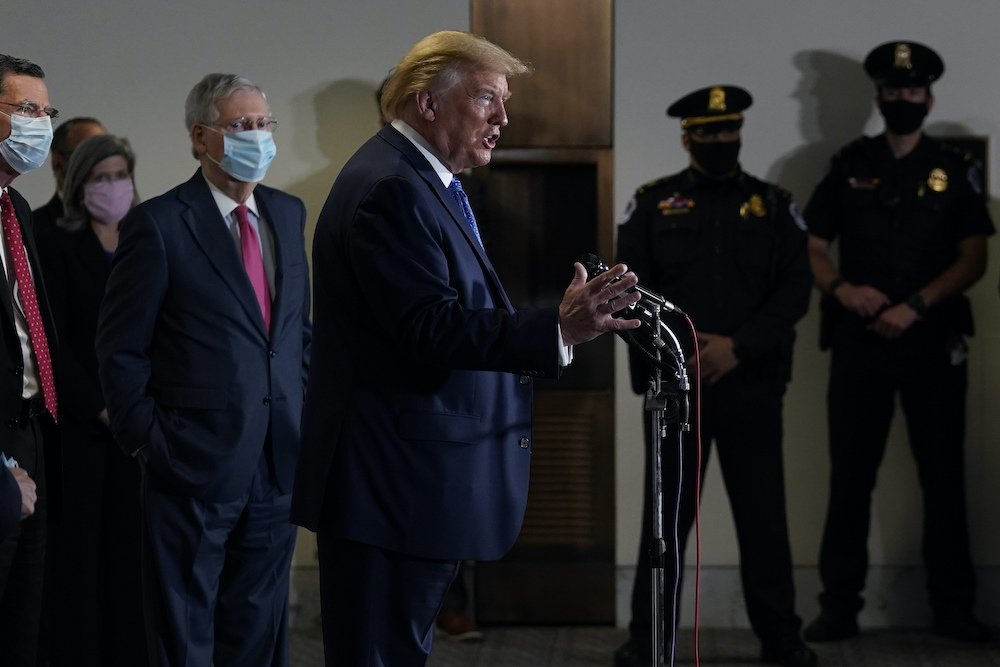
“If you look at the one survey, the only bad survey, they were giving it to people that were in very bad shape,” Trump said at a May 19 press event. “They were very old. Almost dead. It was a Trump enemy statement.”
Later that day, Trump clarified that he was talking about a study of Veterans Administration patients.
Trump spoke as if there were only one negative study. There have been three: the one on VA patients and two larger ones. They all reached the same conclusion that outcomes with hydroxychloroquine were the same as without it.
The studies
The earliest work on hydroxychloroquine was small studies, sometimes with as few as 30 patients, and for each study that showed promise, another study found no benefit. The mixed results spurred more research.
The analysis Trump criticized came in late April, when researchers at the universities of South Carolina and Virginia released their paper on 368 VA patients with COVID-19. They looked at who got hydroxychloroquine, azithromycin or both, and they tracked who ended up on a ventilator or died. The paper was released without peer review.
They found that hydroxychloroquine, with or without the other drug, had no effect on whether someone had to be put on a ventilator. Worse, hydroxychloroquine increased the chances of dying.
The authors cautioned that all of the patients involved in the study, regardless of outcome, were men over 65. And they also factored in a range of underlying conditions, including diabetes, high blood pressure and other health risks. Those issues were found in roughly equal numbers across all groups of patients. Ultimately, about 75% of the patients getting hydroxychloroquine lived. The survival rate was close to 90% for those who didn’t get it.
Trump ignores larger, newer studies
In early May, two studies emerged based on patients treated in the nation’s biggest COVID-19 hotspot, New York City. Both investigations were much larger than the study of VA patients.
The study that appeared May 7 in the New England Journal of Medicine looked at the medical records of 1,376 people who tested positive for COVID-19 and were admitted to the hospital. Their results echoed the first study on hydroxychloroquine.
“There was no association between administration of the drug and a lower chance of dying or winding up on a respirator,” said co-author Neil Schluger, the head of Pulmonary, Allergy, and Critical Care Medicine at Columbia University Irving Medical Center.
Now, it’s fair to say that the patients who got the drug were, as a group, a bit worse off than those who didn’t. In particular, their blood oxygen levels were lower when they were first admitted. Schluger said that didn’t matter.
“The difference in oxygen levels between the two groups we compared were fairly small and not clinically important,” Schluger said.
These patients were not close to death, Schluger said.
“Overall, about 83% of the patients in our cohort survived, and that survival had no association with hydroxychloroquine administration,” he said.
On May 11, the JAMA Network of the Journal of the American Medical Association published a study of 1,438 randomly selected COVID-19 patients treated at 25 New York area hospitals. That group of researchers tracked whether they died in the hospital. They, too, found no connection between outcomes and use of hydroxychloroquine. They also found no impact from the use of another drug, azithromycin. About 75% of patients getting hydroxychloroquine survived, compared with about 87% who were not given the drug.
Like the other study, this one found that patients who got the drug were in worse health at admission than those who didn’t. They might have lower oxygen levels, or some other condition such as diabetes or obesity.
But by examining patients’ full medical records, both teams were able to use stronger analytic tools to filter out the impact of differences in underlying health. Once that was done, they could make apples-to-apples comparisons of the effect of hydroxychloroquine on people who got the drug and those who didn’t.
The authors of all studies acknowledged that working with patient records after the fact isn’t the final answer, and they called for more research.
We reached out to the White House and did not hear back.
Our ruling
Trump spoke about “the one survey,” a study of VA patients and hydroxychloroquine, and said it was “bad” because “they were giving it to people that were in very bad shape. They were very old. Almost dead.”
There have been three studies, not just one. None of them found that the drug reduced the death toll.
As a group, the patients getting the drug were not on the verge of death. Across three studies, about 75% to 80% of the patients receiving the drug survived.
To say they were in very bad shape is also off the mark. Health issues were found in members of both the treatment and non-treatment groups. That allowed researchers to tease out the impact, and make informed comparisons that took these health differences into account.
We rate this claim False.
Our Sources
White House, Remarks by President Trump After Senate GOP Policy Lunch, May 19, 2020
Rev.com, Donald Trump Says He’s Taking Hydroxychloroquine to Prevent Coronavirus in Press Conference, May 18, 2020
MedRxIV, Outcomes of hydroxychloroquine usage in United States veterans hospitalized with Covid-19, April 23, 2020
New England Journal of Medicine, Observational Study of Hydroxychloroquine in Hospitalized Patients with Covid-19, May 7, 2020
JAMA Network, Association of Treatment With Hydroxychloroquine or Azithromycin With In-Hospital Mortality in Patients With COVID-19 in New York State, May 11, 2020
Email exchange, Neil Schluger, chief, Division of Pulmonary, Allergy, and Critical Care Medicine, Columbia University Irving Medical Center, May 19,, 2020