An optional microchip for COVID-19 vaccines “would give officials information on who has and has not been vaccinated” and “tracks the location of the patient.”

No, chip on COVID-19 vaccine syringes would not be injected or track people
If your time is short
-
COVID-19 vaccines do not include microchips for tracking patients.
-
A medical technology company has been producing prefilled syringes for coronavirus vaccines. The syringes can include an optional chip on the label — not inside the injected dose itself — that would show if a particular dose is expired or counterfeit.
-
The chips would not be injected with the vaccine, nor would they gather information on patients or allow their locations to be tracked.
A video circulating on social media wrongly claims that some COVID-19 vaccines could include microchips to let government officials track patients. That’s inaccurate.
The Dec. 9 video spread on Facebook and Instagram as the U.S. distributed its first doses of the Pfizer-BioNTech vaccine. It was flagged as part of Facebook’s efforts to combat false news and misinformation on its News Feed. (Read more about our partnership with Facebook.)
The video pulls from a May interview with Jay Walker, executive chairman of ApiJect Systems Corp., a medical technology company. In the interview, Walker described how ApiJect’s prefilled syringes could include optional chips to show when a vaccine dose is expired or counterfeit.
The video uses selective editing and misleading text overlays to give the impression that the ApiJect’s radio-frequency identification technology would enable government officials to track the vaccinated population.
“The chip would give officials information on who has and has not been vaccinated, as well as when doses expire,” the text over the video says. “The chip tracks the location of the patient.”

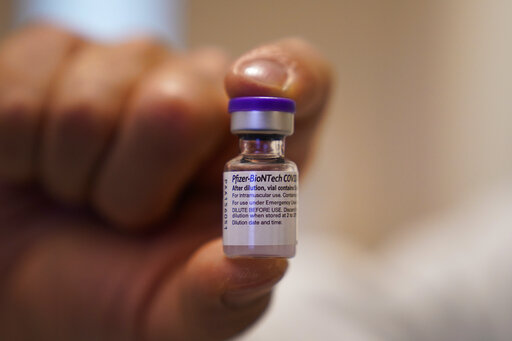
A pair of screenshots from a social media video falsely claiming some COVID-19 vaccines could include microchips to track patients.
But in reality, the optional chip would be on the syringe label, spokespersons for ApiJect and the Department of Health and Human Services told PolitiFact. It would not be injected into patients with the vaccine, nor would it allow those patients to be tracked in any way.
Fact-checkers from Reuters and Lead Stories previously debunked the video’s claims. Elizabeth Johnston, who describes herself as a blogger, author and activist, posted the video with a watermark from her website. We reached out to her, but she did not immediately respond to a request for comment.
Patients won’t be tracked or have chip injected with vaccine
In his May interview with CBN News, Walker described ApiJect’s partnership with the U.S. government to expand production of injection devices for a future COVID-19 vaccine. The company had recently entered into a $138 million contract with the Pentagon and HHS. (In the interview, Walker is misidentified as ApiJect’s CEO.)
The interviewer asked Walker about “the optional RFID chip” on the prefilled syringes that could help health workers tell if a vaccine dose was expired or counterfeit.
“What that chip does is it has the unique serial number for each dose,” Walker said. “It is designed so that there is no counterfeiting. It is designed so that we’ll know exactly that the right dose hasn’t expired.”
Walker went on to explain that the chip “only refers to the dose” of the vaccine in the prefilled syringe. “There’s no personal information, no patient information,” he said. “It’s simply like a barcode. Only we know instantaneously where and when that dose has been used.”
But the video circulating on social media omits that section of the interview. It mutes Walker’s words and, in a text overlay on the screen, says the chip “would give officials information on who has and has not been vaccinated” and “tracks the location of the patient.”
Steven Hofman, a spokesperson for ApiJect, rejected the video’s claims. “No chip is vaccinated into anyone,” he said in an email to PolitiFact.
The technology is optional for purchasers of the syringes and “would go on the label on the outside of the container holding the vaccine,” Hofman said. So far, it hasn’t been requested by any government or private company, he said. And if it were, it wouldn’t be able to track people.
“The chip does not and will not collect any personal information on who is vaccinated,” Hofman said. The chips could record where each shot was administered, but they “would not and could not record information on who has been vaccinated.”
The chips could also help keep tabs on the devices as they ship to pharmacies and other locations for vaccine administration, an HHS spokesperson said in a statement.
“The video is inaccurate,” the statement said. “ApiJect technology doesn’t inject a microchip into a person receiving the vaccine.”
PolitiFact has debunked numerous false claims about tracking devices in vaccines. Experts previously said microchips are too large to be injected when patients are vaccinated.
“Even the smallest version of RFID chips are rather large, such that none would ever fit into a vaccine needle,” Dr. Wilbur Chen, an infectious-disease scientist at the University of Maryland’s Center for Vaccine Development and Global Health, told PolitiFact in April.
Our ruling
A Facebook video said an optional microchip for COVID-19 vaccines “would give officials information on who has and has not been vaccinated” and “tracks the location of the patient.”
The chips are part of the label for ApiJect’s prefilled syringes, and they help identify the vaccine doses, not patients. They would not be injected into patients seeking the vaccine, nor would they be used to track information and locations.
We rate this Facebook post False.
Our Sources
Facebook and Instagram posts (archived), Dec. 9, 2020
Reuters, "Fact check: COVID-19 vaccine labels would not microchip or track individuals, but serve logistical purpose," Dec. 14, 2020
Lead Stories, "Fact Check: ID Chip In Some COVID-19 Vaccine Syringes Would NOT Be Injected Into Patients; It Signals Vaccine Expiration Date," Dec. 13, 2020
USA Today, "Fact check: Feds buy syringes that may have RFID chips, but no evidence COVID-19 vaccination required," June 4, 2020
CBS News on YouTube, "How Gov Could Use RFID Chips When Millions of Americans Inject COVID-19 Vaccine," May 22, 2020
U.S. Department of Defense, "DOD Awards $138 Million Contract Enabling Prefilled Syringes for Future COVID-19 Vaccine," May 12, 2020
PolitiFact, "No, the US isn’t developing a vaccine or ‘antivirus’ with a chip to track people," April 3, 2020
Email interview with Steven Hofman, spokesperson for ApiJect, Dec. 14, 2020
Statement from the Department of Health and Human Services, Dec. 14, 2020