Says “$3 trillion in offshore money… is coming back into the economy” because of the GOP tax bills.


GOP tax bill and overseas profits: Beware the hype
The House and Senate tax bills are a boon to American multinational companies that have booked trillions of dollars in profits overseas. Funds claimed by the companies would see tax rates well below even the much-reduced 20 percent corporate rate in the proposed bills.
On the Senate side, companies would face a 14.5 percent tax on money they had been holding as cash or securities, and for money invested in hard assets, the rate could be as low as 7.5 percent.
Chris Ruddy, CEO of the conservative website Newsmax, cast this as a flood of money “three times the Obama stimulus” that would “drive the economy for the next 10 years.”
“I think after this tax bill, it’s actually going to be a watershed, because $3 trillion in offshore money, forget about the individual and corporate tax rates, $3 trillion of all that Apple money is coming back into the economy,” Ruddy said on ABC’s This Week with George Stephanopoulos on Dec. 3. (Apple and Google are the poster children of overseas cash, but there are many others, from General Electric to Pfizer to Coca-Cola.)
We took a closer look at Ruddy’s claim that “$3 trillion in offshore money … is coming into the economy.”
Ruddy’s statement is part prediction — the money will juice the economy — and part statement of fact — there’s $3 trillion out there waiting to come into the American economy.
Recent history gives reasons to doubt whether the first part will come true, but we don’t fact-check predictions. We can, however, look at whether that money is outside the American economy, as Ruddy said.
Ruddy told us that he got his $3 trillion figure from a New York Times article, which said the Senate and House plans would “allow companies to bring nearly $3 trillion in profits home.”
Where things get tricky is where that money is today.
There’s considerable evidence that a large chunk of it, a bit under one-half, already is in the U.S. economy.
When a Senate committee’s Permanent Subcommittee on Investigations surveyed 27 American multinational corporations in 2011, it found that about 46 percent of tax-deferred foreign earnings were in “in U.S. bank accounts or invested in U.S. assets such as U.S. Treasuries, U.S. stocks other than their own, U.S. bonds, or U.S. mutual funds.”
The investment research firm Moody’s calculated that in 2017, foreign subsidiaries of American multinationals held about $1.4 trillion in cash or marketable securities. With estimates of total overseas profits ranging from $2.6 trillion to $3.1 trillion, tax lawyer Steven Rosenthal at the Urban-Brookings Tax Policy Center said “40 percent or so is about right” for the share of profits in the United States.
In an October tax note, Goldman Sachs economists wrote that thanks to those holdings, offshore profits are “largely available for domestic activities.”
There’s no dispute that “companies can invest offshore funds in U.S. markets,” said Kimberly Clausing, an economist at Reed College.
Under American law, any money made on those investments is taxable, but the underlying cash remains outside the reach of the IRS.
Ruddy told us “even if it’s in a U.S. bank account, they can’t use it for U.S. operations, as far as I understand.”
Ruddy has a point, but nothing keeps the money on the other side of the border. And once it’s put into the economy, it moves around as loans or equity investments in companies that seek to expand.
That’s how the U.S. Treasury Department saw it just before President Donald Trump took office.
In making the case for tax reform, the department’s Office of Tax Policy said that it is “a common misconception” offshore profits must remain outside the United States.
“While there are limitations on how those funds may be used by the corporation, in general those assets are held for investment at U.S. financial institutions, and thus contribute to investment and capital formation in the United States,” they wrote.
American multinationals can also use this to effectively bring home money virtually tax-free, according to Edward Kleinbard, professor of tax law at the University of Southern California’s Gould School of Law and former chief of staff of the congressional Joint Committee on Taxation
Kleinbard described to lawmakers on the House Ways and Means Committee Feb. 24, 2016, how Apple floated a $12 billion bond in 2016: “The interest expense will be fully deductible by Apple, and its enormous hoard of foreign earnings will continue to grow.”
In fact, Kleinbard said the tax deduction on the interest paid on the bond could largely offset the interest earned by Apple’s offshore cash invested in America.
“In that case, the principal of the bond offering will be the economic equivalent of a tax-free repatriation – in this case of $12 billion,” Kleinbard said.
Kleinbard also told us that some of the overseas profits have already ended up in foreign brick-and-mortar projects.
“Those investments aren’t picking up and moving to the U.S.,” he said. “If you are a global business, of course you need at least some real investments throughout the world.”
Kleinbard’s rough estimate is that about half of the offshore profits are in cash and other liquid assets, and the other half are in “real investments in non-U.S. businesses.”
Our ruling
Ruddy said that $3 trillion in offshore money could come into the American economy under the Republican tax bills. That assumes that all of that money is overseas and readily available. Neither assumption is accurate.
A 2011 Senate study found that a bit under half of offshore profits are already in the United States in the form of bank accounts or investments in bonds or stocks. Investment firms and independent researchers generally agree that the fraction hovers around 40 to 45 percent of all overseas profits. The consensus is that a change in tax law would not inject a flood of new money into the economy because it is already here.
A large portion of the other half is tied up in actual projects in businesses overseas.
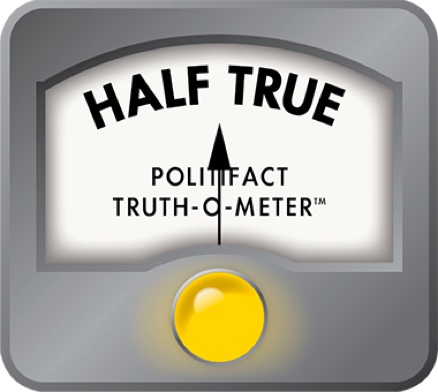
Ruddy’s notion that $3 trillion is sitting there available for use falls wide of the facts. Some portion would be freed up, but not more than that. We rate this claim Half True.

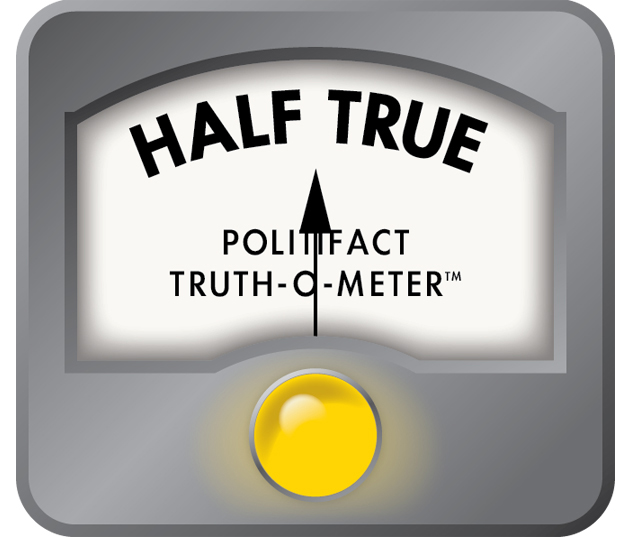 PolitiFact Rating:
Our Sources
ABC News, This Week with George Stephanopoulos, Dec. 3, 2017
Stephen Shay, U.S. Senate testimony: Directions for International Tax Reform, Oct. 3, 2017
U.S. Senate Homeland Security and Governmental Affairs Permanent Subcommittee on Investigations, Offshore funds located onshore. Dec. 14, 2011
Financial Times, Moody’s: Corporate cash pile to balloon to $1.9 trillion in 2017, Nov. 20, 2017
U.S.Treasury Department, The Case for Responsible Business Tax Reform, January 2017
Congressional Research Service, Tax Cuts on Repatriation Earnings as Economic Stimulus: An Economic Analysis, May 27, 2011
U.S. Joint Committee on Taxation, Letter: Estimate of offshore earnings, Aug. 31, 2016
U.S. Congress, Tax Cuts and Jobs Act, Nov. 28, 2017
Tax Foundation, Key Changes in Senate Tax Reform Bill Heading into the Vote-a-Rama, Dec. 1, 2017
New York Times, How Tax Bills Would Reward Companies That Moved Money Offshore, Nov. 29, 2017
MSN Money, Here's What Tax Reform Could Mean for International Investment in the U.S., Oct. 26, 2017
National Bureau of Economic Research, Watch what I do, not what I say: The unintended consequences of the Homeland Investment Act , June 2009
Email interview, Chris Ruddy, CEO, Newsmax, Dec. 4, 2017
Email interview, Edward Kleinbard, professor of law and business, USC Gould School of Law, Dec. 4, 2017
Email interview, Steven Rosenthal, senior fellow - tax policy, Urban-Brookings Tax Policy Center, Dec. 5, 2017
Email interview, Kimberly Clausing, professor of economics, Reed College, Dec. 4, 2017