In the past decade, K-12 funding has grown six times faster than the rate of enrollment.
Gov. Bob McDonnell says education funding grew six times faster than enrollment
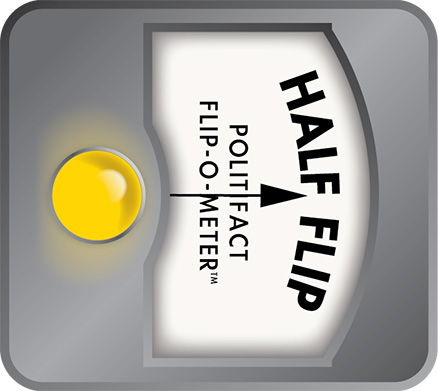
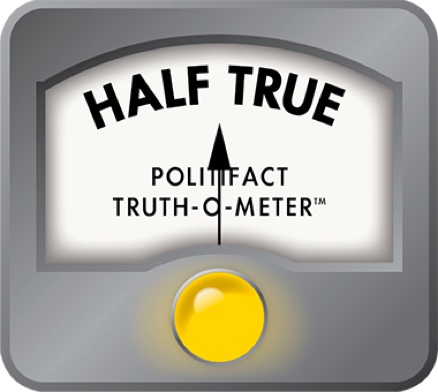
On Feb. 24, PolitiFact Virginia rated as True a statement by Gov. Bob McDonnell that public education funding over the last decade grew six times faster than enrollment. We based that ruling on raw state budget and K-12 enrollment numbers. Subsequently, several readers pointed out that we did not factor in inflation. They were right, inflation accounted for most of the imbalance between increases in education and gains in enrollment. So we are changing our rating to Half True because there is some validity to McDonnell’s claim but his numbers are out of context. And we are providing a new analysis, which appears below.
In the closing days of this winter’s General Assembly session, Gov. Bob McDonnell unsuccessfully tried to build support for a $50 million cut in public education funding.
The governor told the Richmond Times-Dispatch, in a story that ran Feb. 20, that K-12 education funding has grown six times faster than enrollment over the last decade.
We graded McDonnell’s math.
His data was compiled by Dan Timberlake, Director of Virginia’s Department of Planning and Budget. Timberlake told us he decided to compare budget levels from the 2002 fiscal year with those currently allocated for the 2012 fiscal year, which will begin July 1.
Timberlake said he measured three major, state-generated sources of education dollars: Virginia’s general fund, lottery proceeds and the Literary Fund. His figures did not include federal money and a few very small funding sources.
General fund revenue primarily comes from income taxes on individuals, though it also includes some sales tax revenue, contract fees, and profits from the state-run liquor stores. The money pays for general services such as schools, public safety and health.
Lottery funds, which were pulled from the general fund fund in 2007 and siphoned directly to education, provided $430.2 million to education last school year.
The Literary Fund gets revenue from criminal fines, fees, and forfeitures, unclaimed property; unclaimed lottery winnings and interest on low-cost loans that are used for school construction projects.
State funding from these three sources was $4.01 billion in the 2002 fiscal year and is slated to be $5.47 billion in the 2012 fiscal year. That’s an increase of 36.2 percent.
Next Timberlake tracked student enrollment in the state’s public schools, and so did we. Enrollment grew from 1,147,673 in the fall of 2001 (which is in the 2002 fiscal year) to a projected level of 1,220,523 in the fall of 2011. That’s an increase of 6.3 percent.
So education spending grew 36.2 percent while student numbers grew 6.3 percent. That would make the spending increase just shy of six times larger than the enrollment increase.
But there’s a catch to these numbers: inflation accounted for most of the increase and McDonnell did not factor it into his equation.
When your stir in the 22.5 percent rise in the national consumer price index over the last decade, you end up with a 13.7 percent inflation-adjusted increase to education spending. That’s slightly more than double the rate of enrollment growth.
You get a similar result when consider the 23 percent inflation rate over the decade in Southern states, where the Bureau of Labor Statistics includes Virginia in its regional calculations. Unfortunately, BLS does not measure inflation in individual states.
Why did new funding outpace enrollment over the last decade?
Charles Pyle, director of communications for the Virginia Department of Education, said much of the money was needed to pay for Standards of Learning mandates the state set for public schools, including an algebra readiness initiative and early-reading program.
Pyle said funding has also increased for pre-school initiatives that serve children not covered by the Head Start program. And he said major investments have been made to upgrade technology in schools. Additional funding has also been directed towards resource teachers in elementary schools and English-proficiency instructors.
A closing note: The General Assembly ended up approving a $75 million increase for public schools before adjourning on Feb. 27.
Let’s review. The governor claimed state K-12 funding grew six times faster than student enrollment during the past decade.
According to the Virginia Department of Planning and Budget, education spending from state sources has climbed 36.2 percent in the past 10 years. During that period, the number of K-12 students in Virginia has climbed 6.3 percent. So McDonnell is technically right, but his claim is misleading.
When you consider inflation over the last decade — which the governor did not — new spending slightly more doubled growth in enrollment. Much of that increase came from new Standards of Learning requirements that McDonnell strongly supported as a legislator.
We rate his claim Half True.
Our Sources
Virginia Department of Education, Fall Membership, accessed Feb. 23, 2011.
Virginia Department of Education, Literary Fund, accessed Feb. 23, 2011.
Virginia Department of Planning and Budget, Past budgets, accessed Feb. 23, 2011.
Virginia Department of Planning and Budget, Frequently Asked Questions, accessed Feb. 23, 2011.
Virginia Lottery, Where money goes, accessed Feb. 23, 2011.
Richmond Times-Dispatch, House, Senate budgets far apart on K-12 funding, Feb. 20, 2011.
Interview with Tucker Martin, Director of Communications for Gov. Bob McDonnell, Feb. 23, 2011.
Interview with Dan Timberlake, Director, Virginia Department of Planning and Budget, Feb. 23, 2011.
Interview with Charles Pyle, Director of Communications, Virginia Department of Education, Feb. 23, 2011.
Bureau of Labor Statistics, consumer price index 1913-2011.