The federal government “now tells us which light bulbs to buy.”

Michele Bachmann says the government tells us what light bulbs to buy
Rep. Michele Bachmann said we’ve spent a lot of money over the past few years, but we don’t have much to show for it. Bachmann gave a response to President Barack Obama’s State of the Union address on behalf of two tea party groups.
“Instead of a leaner, smarter government, we bought a bureaucracy that now tells us which light bulbs to buy and which may put 16,500 IRS agents in charge of policing President Obama’s health care bill,” Bachmann said in her January 25, 2010 response to the State of the Union, delivered at the request of the Tea Party Express and Tea Party HD. Bachmann is a Republican member of the U.S. House of Representatives from Minnesota.
Her statement caught our attention, so we decided to check it out. Here, we’ll look at her claim about light bulbs. We’ll look at her statement about IRS agents in a separate item.
We’ve looked into light bulbs before, when PolitiFact Texas examined a similar statement by Texas Gov. Rick Perry.
What our Texas colleagues found: In 2007, Congress voted to improve the efficiency of light bulbs. President George W. Bush signed the Energy Independence and Security Act, which set energy efficiency standards for incandescent lamps (light bulbs), incandescent reflector lamps (like track lighting in your kitchen) and fluorescent lamps, according to a 2007 report from the Congressional Research Service.
In June 2009, Obama announced more changes for lighting standards. Starting in August 2012, fluorescent tube lamps (most commonly found in offices and stores) and conventional incandescent reflector lamps must become more efficient. The government said such fluorescent and incandescent lamps represented approximately 38 percent and 7 percent, respectively, of total lighting energy use.
PolitiFact Texas also found a June 2010 editorial in the Washington Times objecting to Federal Trade Commission-issued regulations of light-bulb labels. The editorial said the regs were ordered by Congress as part of its 2007 decision to force the more efficient, curlicue-shaped compact fluorescent light bulb “on a public that so far has refused to embrace it willingly.” Beginning Jan. 1, 2012, the editorial says, “bureaucratic rules will phase in,” and conventional 100-watt bulbs “will be first on the contraband list.”
Jen Stutsman, spokeswoman for the U.S. Department of Energy, told PolitiFact Texas in November that conventional incandescent bulbs as currently manufactured are not expected to meet the efficiency standards Congress set. However, the government expects manufacturers to improve incandescent technologies to meet the higher standards, or consumers will move to compact fluorescent light bulbs, LED technologies or halogens. She said new standards for 100-watt bulbs take effect in January 2012. New standards for 75-watt bulbs start in 2013, and standards for 60- and 40-watt bulbs start in 2014.
Stutsman said the expected shifts aren’t equivalent to the government telling Americans which light bulbs to use. “Under no circumstances does it say that a consumer must purchase a specific type of light bulb,” Stutsman said.
Finally, PolitiFact Texas talked with the Dallas-based American Lighting Association, a trade group whose director of engineering and technology, Terry McGowan, said in an e-mail that it’s a stretch to say federal laws are telling us what light bulbs to buy. “Federal law is requiring that household light bulbs be made more efficient in steps over time as a nationwide energy-saving measure. It’s like saying that new cars will have to deliver more miles/gallon. Maybe some people would say that’s mandating what kind of car to buy, but that’s an interpretation — especially if many cars on the market can meet the miles/gallon requirement,” McGowan said.
“There will still be household light bulbs available,” McGowan’s e-mail said, noting later that special-purpose bulbs used in appliances or for decorative purposes are exempted. “One thing is for sure, what we use for lighting our homes will take some thought — and maybe we’ll be changing what we decide to do.”
So, is Washington telling us what kind of bulb to use?
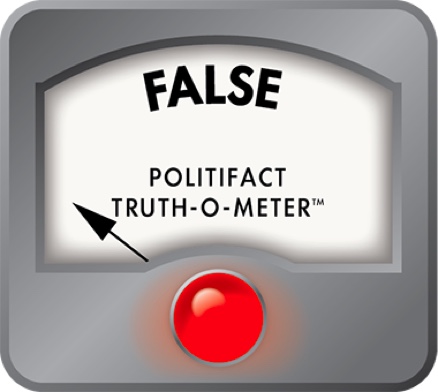
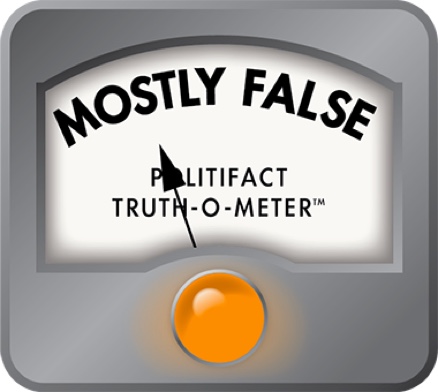
Not yet, though the 2007 law steps up efficiency requirements, and that’s expected to result in consumers purchasing and using different bulbs. These factors give Bachmann’s statement an element of truth — but not much more. We rate it Barely True.
Editor’s note: This statement was rated Barely True when it was published. On July 27, 2011, we changed the name for the rating to Mostly False.
Our Sources
PolitiFact Texas, Rick Perry says Washington's reach extends to telling us which light bulb to use, Nov. 8, 2010
Congressional Research Service, CRS Report for Congress, "Energy Independence and Security Act of 2007: A Summary of Major Provisions," Dec. 21, 2007 (accessed Nov. 4, 2010)
E-mail, response to PolitiFact Texas, Terry McGowan, director of engineering and technology, American Lighting Association, Dallas, Nov. 5, 2010
Interview, Jen Stutsman, deputy press secretary, U.S. Department of Energy, Washington, Nov. 4, 2010
Rick Perry, governor of Texas, in "Fed Up! Our Fight to Save America from Washington," Little, Brown and Company, New York, 2010, p. 37.
PolitiFact, "Obama makes light bulbs more energy efficient," July 21, 2009 (accessed Nov. 4, 2010)
U.S. Department of Energy, announcement on new efficiency standards , accessed Nov. 4, 2010