“In this bill that I’ve just signed, we don’t cut anybody’s salary. We don’t take away their pension. And we don’t destroy their health care.”

Gov. John Kasich says new state labor law doesn’t cut worker pay, pension or health care
Opponents and supporters of Ohio’s new collective bargaining law are preparing for a possible referendum in November that would decide whether the controversial measure stays on the books.
So it’s no surprise Republican Gov. John Kasich, a proponent of Senate Bill 5, immediately began defending the law after he signed it on the last day of March.
The law will sharply reduce public workers’ collective bargaining rights.
Unions have declared the law an attack on Ohio’s middle class. Kasich rejects the argument that it will damage public workers’ livelihoods.
“In this bill that I’ve just signed, we don’t cut anybody’s salary. We don’t take away their pension. And we don’t destroy their health care,” Kasich said March 31 in a interview with Sean Hannity on the Fox News Network.
Campaigns for and against SB 5 are expected to spend tens of millions of dollars to sway voters should opponents of the new law collect enough signatures to put the referendum on the ballot. Kasich himself sent an e-mail to supporters promoting passage of SB 5 and seeking campaign donations.
With such a passionate debate on the horizon, PolitiFact Ohio decided to check out Kasich’s characterization of SB 5.
Before we get into the specifics of Kasich’s claim, it is important to remember a few things:
- SB 5 does not alter any existing contracts.
- The law will not take effect until after the fall election if enough signatures are gathered by a June 30 deadline to put the referendum on the ballot.
- If that deadline passes and signatures are short of the required 231,147, the law takes effect in July.
Now let’s begin.
We’ll break this down into thirds, examining how SB 5 affects pensions, health care and worker salaries. We relied on interviews and an analysis of the 444-page bill by the nonpartisan Ohio Legislative Service Commission to reach our conclusions.
Impact on pensions
Kasich was correct when he said the bill does not take away worker pensions. The new law could affect amount employees contribute toward their pension plans. It does not change pension benefits in any way, nor does it grant management new authority to do so.
Many public workers contribute 10 percent of their salary toward their pension while the employer contributes 14 percent of the a worker’s salary. Some unions, however, have negotiated deals where the employer pays a portion of the employee contribution. If an employer agreed to pay 2 percent of the worker share, for example, it would pay 16 percent of the worker’s salary and the worker would pay 8 percent.
Senate Bill 5 prohibits the practice, known as a “pension pick-up.” So Kasich is correct to say the bill does not “take away” any worker’s pension. Some workers who benefited from pension pick-ups, however, would have to pay more of their pension contributions under SB 5.
Impact on health care
Kasich says the bill does not “destroy” workers’ health care. The governor is correct here too because the bill does not change health care benefits. It limits the share of the premiums that the public employer can pay toward those benefits.
The new law bars public employers from paying more than 85 percent of health care coverage costs. That leaves at least 15 percent to employees. State workers currently pay 15 percent of their health care costs, but many other public workers pay less. While SB 5 will shift health care costs onto some workers, it does not “destroy” benefits.
Impact on wages
The shifts in pension and health care contributions could have a direct effect on wages. If the new law shifts a bigger share of retirement and health care costs onto workers, they’ll want higher wages to make up the difference so their take home pay remains intact.
Kasich said “we don’t cut anybody’s salary.”
In a literal sense, he is correct. SB 5 does not set new salaries for public workers. But the new law effectively wipes out salary schedules in past labor contracts and directs cities and unions to agree to new salary structures that assign pay raises based on job performance.
Kasich other supporters often tout the leverage the new law provides local governments to control labor costs. Management gains a new edge under SB 5 through the reduction of public workers’ collective bargaining rights, a ban on striking and a new system to resolve labor disputes that favors employers.
So while Kasich has said the bill does not cut workers’ pay, he also has promoted SB 5 as a tool to control labor costs.
Which is it? Critics say the answer is obvious.
“Something has to give somewhere,” said Dennis Willard, a spokesman for We Are Ohio, an anti-SB 5 group collecting signatures to put the bill on the fall ballot. “The only possible way for these local governments to save money is to eliminate jobs or reduce wages. There’s no other way.”
Kasich spokesman Rob Nichols insisted the bill “doesn’t prescribe wages,” so it is inaccurate to conclude SB 5 cuts workers pay. But reduced pay is a near certainty in some communities.
Kasich says the bill “didn’t cut anybody’s wages,” but some key points are missing from that statement:
- Workers who have to pick up an increased portion of their health care and pension premiums will see less take-home pay in their checks unless their public employer raises wages to cover the heightened premiums — a doubtful proposition if the new law is truely a tool to control labor costs.
- Cities across the state are looking to cut costs – and SB 5 gives mayors and school boards the leverage to cut pay as they negotiate with their workers in the future.
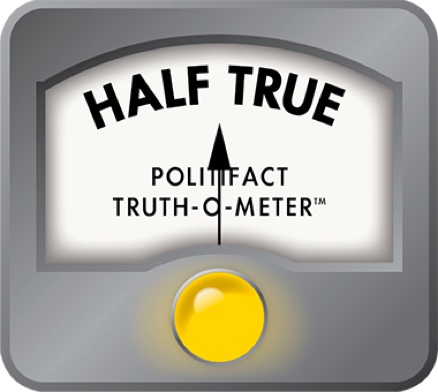
Those are important pieces of information needed to put Kasich’s statement in proper context. On the Truth-O-Meter, that rates as Half True.
Our Sources
Interview with Kasich spokesman Rob Nichols
Interview with We Are Ohio spokesman Dennis Willard
Ohio Legislative Service Commission analysis of Senate Bill 5
CQ Transcription, Gov. Kasich Interviewed on Fox News, March 31, 2011