“(John) Kasich was the architect who balanced the budget, cut spending, created a surplus, igniting record job creation.”

John Kasich touts role in balancing budget, creating surplus, boosting jobs
Jobs are the central theme of this fall’s election campaigns, and John Kasich’s TV ad “Busted” neatly delivers the Republican candidate’s two-pronged message about the state’s economy: The policies of Democratic Gov. Ted Strickland have failed, and Kasich can do better.
“Kasich,” the ad says, “was the architect who balanced the budget, cut spending, created a surplus, igniting record job creation.”
It’s a sweeping claim that begs for explanation and context. The ad doesn’t provide it. Neither does the posting about the ad on the campaign’s blog, though it more helpfully calls Kasich “chief architect of the 1997 Balanced Budget.”
PolitiFact Ohio looked into the record for more.
We started with “Balanced Budget.” That refers to the federal Balanced Budget Act of 1997, H.R. 2015, a bipartisan agreement to balance the federal budget by the year 2002. The 537-page bill was sponsored by Kasich, a U.S. House member representing a suburban Columbus district from 1983 through 2000 and chairman of the House Budget Committee.
The legislation also promised the first major tax cuts in 16 years, and it reduced Medicare and Medicaid payments to health care providers.
Kasich was widely recognized as the its chief architect and a key player in negotiating its passage. When President Clinton signed the agreement into law, Kasich stood beside him in the Rose Garden.
Failure is an orphan, but success has a thousand fathers — or custody-seekers.
Newt Gingrich, Kasich’s mentor and then-speaker of the House, called him “a historic figure. More than any single man, he is responsible for balancing the budget.”
Clinton, appearing in Cleveland for Strickland in September, said Kasich “always tells people that he brokered for the Republicans the balanced-budget bill that I signed. That is true but misleading” — because, Clinton said, Kasich earlier was among congressional Republicans who shut down the government because the president refused to slash federal agencies and programs.
Regardless, conditions were comparatively favorable for the budget agreement. It came amid a booming economy and increased tax revenues that already had driven down the deficit, ultimately leading to a surplus. (The increase in tax revenues is credited to the improved economy and to tax increases that were part of the Omnibus Budget Reconciliation Act of 1993.)
Clinton announced that surplus in September 1998, a year after the agreement was signed. It was the first U.S. budget surplus in 29 years. Federal budgets were balanced in both fiscal 1999 and fiscal 2000.
Republicans claimed credit, saying they had pressured Clinton to adopt their balanced-budget commitment.
Clinton said he and congressional Democrats deserved the credit for passing the 1993 budget bill, which did not win a single Republican vote in the House and which Cinton has said “led to an enormous flowering of the economy in America.” (PolitiFact examined that claim in detail last April and rated it Half True. The economy did improve after the 1993 budget bill became law, but economists say many factors played a role.)
Unemployment was one key indicator of the economy’s health. It fell from 4.9 percent in 1997 to 3.9 percent in 2000, continuing a steady decrease that started in 1993.
But the impressive amount of job creation does not mean that a record number of jobs were added.
According to the Bureau of Labor Statistics, the economy added 3,154,000 jobs in 1998 — about 100,000 more than were created in 1997 — and another 3,063,000 in 1999. But neither year reaches the peak of 3,447,000 jobs in 1994. (Job creation began to slow in 2000.)
Kasich deserves credit for conceiving, sponsoring and negotiating passage of the Balanced Budget Act of 1997.
But the ad overstates his role by saying he balanced the budget. And it exaggerates by giving Kasich, or the the budget agreement, credit for a surplus or “record” job creation.
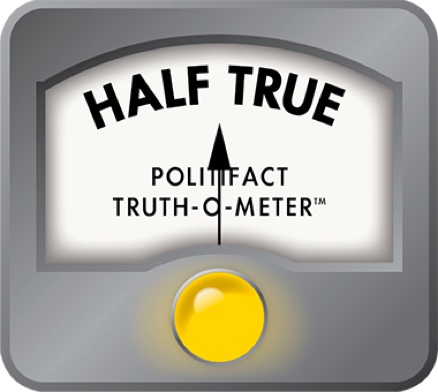
We rate Kasich’s statement as Half True.
Our Sources
John Kasich 2010, "Busted," posted to YouTube Oct. 14, 2010
105th Congress, H.R. 2015, Library of Congress Bill Summary
PBS NewsHour, "Analyzing the budget deal," July 29 1997
Plain Dealer, "Kasich sets sights on ultimate prize," Feb. 22, 1998
Plain Dealer, "Kasich at the crossroads," June 7, 1998
Columbus Dispatch, "Kasich big on budget balancing," Feb. 14, 2010
Plain Dealer, "Bill Clinton headlines rally for Gov. Ted Strickland at Tri-C in Cleveland," Sept. 14, 2010
Plain Dealer, "Clinton announces $70 billion surplus," Oct. 1, 1998
CNN, "President Clinton announces another record budget surplus," Sept. 27, 2000
PolitiFact, "Bill Clinton takes credit for 'flowering' of economy in 1990s," April 19, 2010
Bureau of Labor Statistics Data
InfoPlease, U.S. unemployment rate
FactCheck.org, "During the Clinton administration was the federal budget balanced?," Feb. 3, 2008