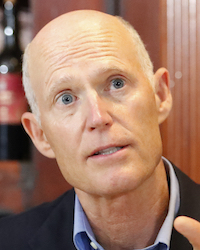
Regulations are an “endemic weakness in government — so old that Thomas Jefferson listed this problem among his charges against the King of England in…
Rick Scott says Thomas Jefferson called regulations an “endemic weakness”
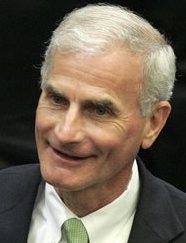
As part of his push to spur job growth, Gov.-elect Rick Scott has put a target on many government regulations. For example, Scott told business leaders at the Florida Council of 100 on Nov. 18, 2010, that he will freeze all regulations currently being formulated by state agencies so he can evaluate their impact.
“Regulations grow and spread like weeds — if we aren’t actively working to cut them back, they choke off every productive effort,” he told the group, according to prepared remarks. (The event was closed to the public, so we can’t verify the quote.)
He added: “This is an endemic weakness in government — so old that Thomas Jefferson listed this problem among his charges against the King of England in the Declaration of Independence. Jefferson wrote, ‘He (King George III) has erected a multitude of new offices, and sent hither swarms of officers to harass our people, and eat out their substance.’ “
Scott quotes Jefferson correctly. But we wondered, what did Jefferson mean when he wrote that line? Did he think regulations are an endemic weakness in government?
The “swarms of officers” Jefferson referenced were about 50 officials in the British Customs Service whose job was to stop colonists from smuggling goods to circumvent various taxes imposed by the Crown, including the Stamp Act of 1765 and the Townshend Acts of 1767.
Colonists were “particularly adroit smugglers,” said Stephen Lucas, a University of Wisconsin communications professor. The officials “certainly were harassing to the merchants and the smugglers who were trying to evade the laws.” Lucas studies rhetoric and wrote the 1989 article “The Stylistic Artistry of the Declaration of Independence.”
Lucas adds: “He uses the term ‘swarms,’ which makes it sound like there are thousands of these officials. The point was to make them sound as onerous as possible.”
Jefferson was, of course, a politician. And the Declaration of Independence was a revolutionary document used to discredit King George III. “What would you expect a guy to say?” said Peter Onuf, an American history professor and Jefferson scholar at the University of Virginia.
Onuf, however, pointed out that the document was a critique of King George — not of government in general. “It’s designed to depict the government of George III as absolutely illegitimate,” he said. “The important thing is that it’s an argument against a particular government.”
He added: “To take these phrases out of context and suggest they’re eternally valid under all circumstances, it just gets tedious after a while.”
Lucas said the Declaration’s famous preamble (“We hold these truths to be self-evident…”) includes principles that apply to any government. The 28 charges against King George are just that — specific accusations against the king.
“In fact, the colonists tended to see these grievances they had against England as growing out of a conspiracy to choke off the colonies,” Lucas said. “They’re not necessarily an inherent part of government.”
Let’s circle back to modern times. Scott is clearly trying to bolster his anti-regulation argument with the gravitas of the Declaration of Independence. He calls regulation an “endemic weakness in government” and then says Jefferson listed “this problem” in the Declaration.
But Jefferson didn’t complain about regulation as an “endemic weakness.” He leveled a specific charge against King George that, as Lucas points out, involved just about 50 officials to combat smuggling among the colonial population of 3 million.
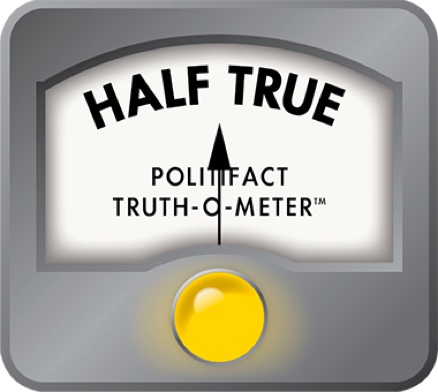
Scott accurately quoted Jefferson, but he took the line out of context to advance his own argument against government regulation. Jefferson was no big-government liberal (He once lauded the “suppression of unnecessary offices (and) useless establishments and expenses.”). But in this case he was more upset about King George than he was about government intervention. We rate Scott’s statement Half True.
Our Sources
Gov.-elect Rick Scott, prepared remarks of Council of 100 speech, Nov. 18, 2010.
Declaration of Independence, July 4, 1776.
University of Wisconsin professor Stephen Lucas, "The Stylistic Artistry of the Declaration of Independence," 1989.
Interview with University of Virginia professor Peter Onuf, Nov. 19, 2010.
Interview with Stephen Lucas, Nov. 21, 2010.
Thomas Jefferson, Second Inaugural address, March 4, 1805.