
Romney won’t mention a date
On the weekend before the Florida Republican primary, John McCain attacked Mitt Romney on Iraq, bringing one of McCain’s signature issues back to the forefront of the campaign.
“Now, one of my opponents wanted to set a date for withdrawal that would have meant disaster,” McCain said.
Later, in remarks to reporters, McCain linked Romney’s position with that of Democratic candidate Hillary Clinton.
“If we surrender and wave a white flag, like Senator Clinton wants to do, and withdraw, as Governor Romney wanted to do, then there will be chaos, genocide, and the cost of American blood and treasure would be dramatically higher,” McCain said.
(We previously examined McCain’s “white flag” attack on Hillary Clinton
here
.)
Romney immediately disputed the accuracy of McCain’s remarks.
“That’s dishonest, to say that I have a specific date. That’s simply wrong,” Romney said. “That is not the case. I’ve never said that.”
So did he?
As a source, the McCain campaign points to an interview Romney gave to
Good Morning America
in April 2007. Interviewer Robin Roberts asked Romney, “Do you believe that there should be a timetable in withdrawing the troops?”
Romney: “Well, there’s no question but that the president and Prime Minister al-Maliki have to have a series of timetables and milestones that they speak about. But those shouldn’t be for public pronouncement. You don’t want the enemy to understand how long they have to wait in the weeds until you’re going to be gone. You want to have a series of things you want to see accomplished in terms of the strength of the Iraqi military and the Iraqi police and the leadership of the Iraqi government.”
Roberts: “So, private? You wouldn’t do it publicly because — the president has said flat-out that he will veto anything the Congress passes about a timetable for troop withdrawals. As president, would you do the same?”
Romney: “Well, could you, yeah — well, of course. Could you imagine the setting where during the Second World War we said to the Germans, gee, if we haven’t reached the Rhine by this date, we’ll go home, or if we haven’t gotten this accomplished, we’ll pull up and leave? You don’t publish that to your enemy, or they just simply lie and wait until that time. So, of course, you have to work together to create timetables and milestones, but you don’t do that with the opposition.”
So is a withdrawal date a withdrawal date if you don’t tell anyone about it?
On the Democratic side of the presidential campaign, where primary voters are generally opposed to the Iraq war, the candidates regularly discuss timelines for withdrawal. Their emphasis has been on when to begin withdrawal, with front-runners Clinton and Barack Obama resisting deadlines for complete withdrawal. It’s worth noting that Romney hasn’t come close to talking about the kind of withdrawal parameters the Democrats have mentioned.
On the other hand, he’s said in debates that he does not envision a permanent presence for the United States in Iraq. In a September debate, Romney said:
“If the surge is working, then we’re going to be able to start bringing back our troop levels, slowly but surely, and play more of a support role over time. Ultimately, down the road, I would anticipate that we’re not going to have a permanent presence in Iraq.”
McCain has said that while high casualty levels over the long term in Iraq are unacceptable to the American public, troops should stay in Iraq as long as needed, comparing the situation with American troops in Japan and Germany. (We checked an attack on McCain about that statement
here
.)
So McCain and Romney do seem to have genuine policy differences when it comes to withdrawal.
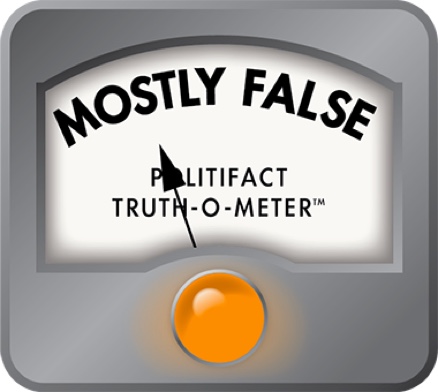
But McCain paraphrases Romney’s statements in a way that leaves voters with the impression that Romney advocates a specific date for withdrawal from Iraq, which he does not. When Romney spoke about setting timetables for troop withdrawal it was within the context of meeting benchmarks or goals for progress there. For that reason, we come down on the more negative side of the Truth-O-Meter’s dial. We rate McCain’s statement Barely True.
Editor’s note: This statement was rated Barely True when it was published. On July 27, 2011, we changed the name for the rating to Mostly False.
Our Sources
Associated Press, McCain: Romney favored Iraq withdrawal , Jan. 27, 2007
Good Morning America, Interview with Mitt Romney , video and transcript, April 3, 2007
PolitiFact.com, Democrats race to oppose Iraq most , Oct. 1, 2007
CNN, Democratic debate transcript , Jan. 21, 2008
Fox News, Republican debate transcript , Sept. 5, 2007
PolitiFact.com, That's no typo, 100 years , Jan. 15, 2007