Can Joe Biden’s agenda really cost zero dollars? A guide to the bills and the numbers

If your time is short
-
There are two big bills in play: The bipartisan infrastructure bill and the reconciliation bill, also called the Build Back Better Act.
-
The reconciliation bill is a work in progress, with no firm numbers on spending or offsetting revenues.
-
The Congressional Budget Office says the infrastructure bill will add about $250 billion to the debt.
-
The Build Back Better Act could add zero to the national debt if it balances new spending with new revenues.
It’s crunch time for President Joe Biden and the Democrats. On top of keeping the government funded past September, and raising the federal debt limit so Washington can pay its bills, Democrats are confronting two pieces of legislation that will define them as they head into the 2022 midterms.
There is the bipartisan infrastructure bill, and there is the multi-trillion dollar reconciliation bill, often called the Build Back Better Act. The latter funds a number of Democratic priorities, including universal preschool for 3- and 4-year-olds, a national paid family and medical leave program and investments to address climate change.
The reconciliation bill is a work-in-progress and lacks a final price tag, but we can reasonably say that the combined spending in both measures — if they pass — will be in the neighborhood of $2 trillion to $3 trillion.
Biden raised eyebrows and drew a lot of questions when he said the cost of the Build Back Better Act would be zero. How could something so expensive cost nothing?
The answer is, Biden was talking about the impact of the reconciliation bill on the federal debt, that new taxes and other revenues would balance out news spending. Because the final bill isn’t yet written, we can’t fact-check how it will or will not affect the debt. But we can look at the numbers and get a sense of how challenging it will be to balance the spending with new revenues to keep things debt-neutral.
Biden speaks
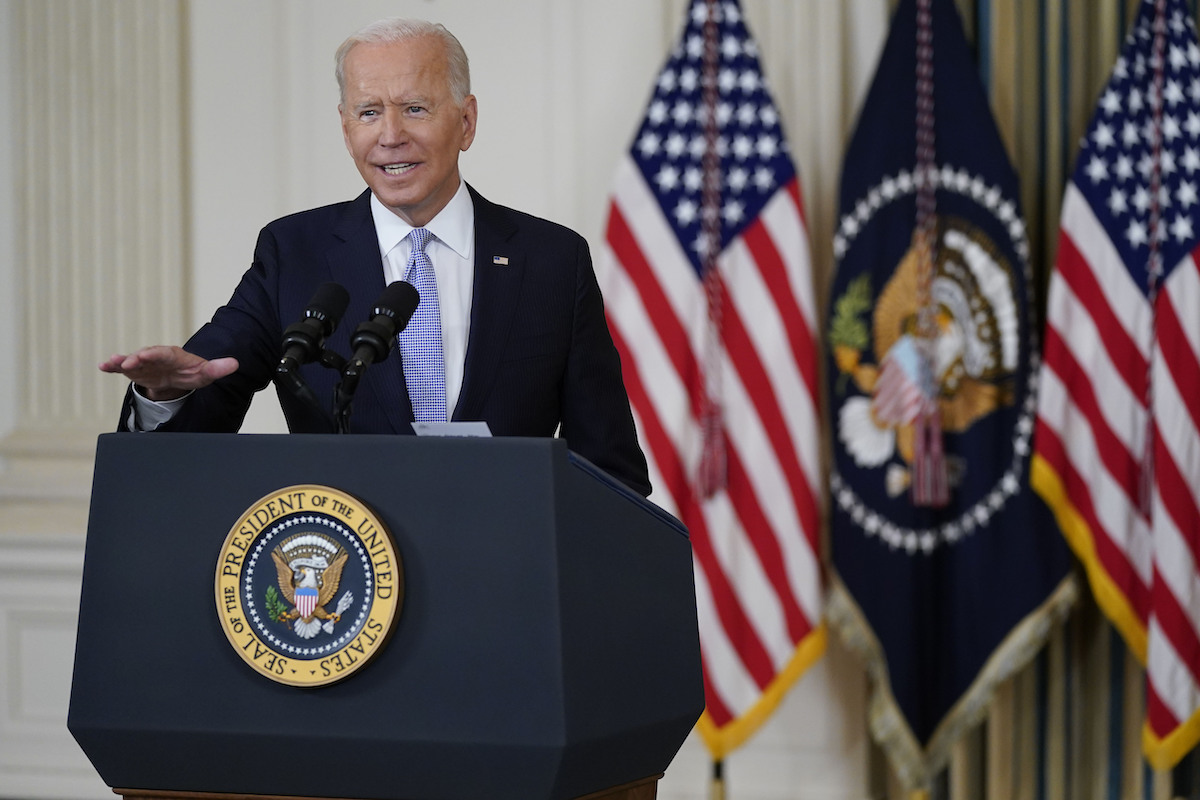
At a Sept. 24 White House news conference, Biden took a broad question about delivering on his campaign promises and dove into the massive reconciliation bill that has divided the members of his party. We know he was talking about that bill because of the dollar amounts he described. The latest number for the bill is $3.5 trillion. (The infrastructure bill has about half a trillion dollars in new spending.)
“We talk about price tags,” Biden said. “It is zero price tag on the debt. We’re going to pay for everything we spend. …‘Well, you know, it started off at $6 trillion, now it’s $3.5 trillion. Now is it going to be $2.9?’ It’s going to be zero.”
In theory, the bill could live up to that promise. If the trillions of dollars in spending is offset by trillions of dollars in tax hikes on corporations and the wealthy, as Biden said, the bill could be debt neutral.
“I’ll believe it when I see it,” said Marc Goldwein, senior policy director with the Committee for a Responsible Budget, a group that advocates for deficit reductions. “The House version does not appear to be fully paid for at present. Not even close.”
Democrats are arguing among themselves over the size of the package and the level of tax hikes needed to cover those costs. Once those disagreements are settled, the Congressional Budget Office and the Joint Committee on Taxation will estimate how much it will cost and whether it will pay for itself.
“It all comes down to how CBO and JCT score it,” said Steve Ellis, president of Taxpayers for Common Sense, a group that advocates for efficient government spending.
But, Ellis added, some costs and revenues might slip through the cracks.
“Even then, there will be items they point to that would offset some or all of the cost outside the 10-year scoring window or that don’t get credit because of scoring rules,” Ellis said.
The point is, it’s too early to know whether the Build Back Better Act will be deficit neutral.
Biden tweets
Biden created more confusion the day after the press conference. He tweeted, “My Build Back Better Agenda costs zero dollars.”
He ended the tweet with “it adds zero dollars to the national debt.”
Again, Biden is talking about the balance between spending and revenues, but this time he talked about his “agenda.” That is a much broader term, and it goes beyond the reconciliation bill, the Build Back Better Act.
Both Goldwein and Ellis said they couldn’t say for sure what Biden meant. The press office for the White House National Economic Council told us that the tweet echoed Biden’s point from the news conference, and referred only to the reconciliation measure.
But taken literally, Biden’s agenda could include the bipartisan infrastructure bill. The Congressional Budget Office estimated that the infrastructure plan would add $256 billion to the debt. Goldwein’s group thinks the increase could be nearly $400 billion.
That would refute Biden’s assertion that his agenda has no effect on national debt.
In fairness, Ohio Republican Sen. Rob Portman, a prime architect of the bill, posted numbers that he says show the bill is more than paid for, and would turn a $100 billion surplus over 10 years.
Still, assuming the infrastructure measure boosts deficits by $256 billion, Biden’s “agenda” could still come in deficit neutral if the Build Back Better Act not only paid for itself, but covered the fiscal gap from the infrastructure bill, too.
Our Sources
White House, Remarks by President Biden on the COVID-19 Response and the Vaccination Program, Sept. 24, 2021
Joe Biden, tweet, Sept. 25, 2021
Congressional Budget Office, Estimated Budgetary Effects of H.R. 1319, American Rescue Plan Act of 2021, March 10, 2021
Congressional Budget Office, Senate Amendment 2137 to H.R. 3684, the Infrastructure Investment and Jobs Act, as Proposed on August 1, 2021
Committee for a Responsible Federal Budget, Infrastructure Plan Will Add $400 Billion to the Deficit, CBO Finds, Aug. 5, 2021
Washington Post The Fact Checker, Biden’s claim that his spending plan ‘costs zero dollars’ Sept. 28, 2021
Office of Sen. Rob Portman, Portman, Sinema Statement on CBO Score for Bipartisan Infrastructure Investment and Jobs Act, Aug. 5, 2021
Moody’s Analytics, Macroeconomic Consequences of the Infrastructure and Budget Reconciliation Plans, July 21, 2021
Interview, Marc Goldwein, senior vice president, Committee for a Responsible Federal Budget, Sept. 28, 2021
Email exchange, Steve Ellis, president, Taxpayers for Common Sense, Sept. 28, 2021
Interview, Jesse Lee, senior communications adviser, White House National Economic Council, Sept. 28, 2021