Six questions answered about this year’s state budget deal
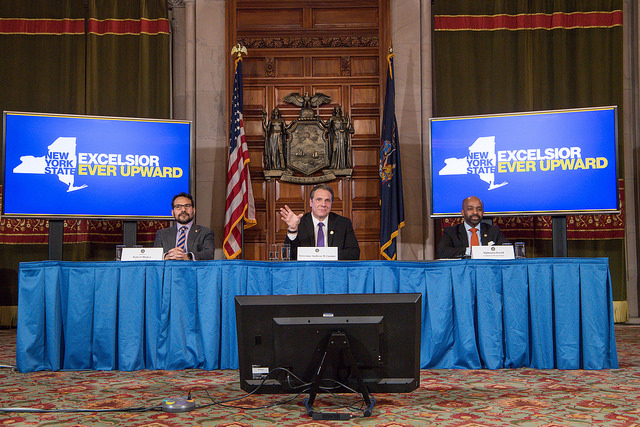
Gov. Andrew M. Cuomo and the New York State Legislature have agreed to a budget for the state’s fiscal year. It came nine days after the fiscal year began on April 1.
The budget, comprised of 10 bills, runs more than 3,300 pages. It outlines state spending and major policy changes. The legislation will fund state government, schools, social services and more.
New York State has one of the largest state budgets in the country, coming in this year at $163 billion. Lawmakers like to tie policy to the state’s spending plan each year. A statewide paid family leave program was included in last year’s budget.
This year’s budget covers different issues, like criminal justice reforms and a progressive tax structure.
Here are answers to six questions about this year’s state budget deal.
When will ride-hailing services like Uber and Lyft be allowed upstate?
Upstate residents will be able to order a ride on their smartphone through ride-hailing services like Uber and Lyft as soon as early July. Each ride, paid through a mobile app, will also have a 4 percent fee charged on the total fare.
Counties are allowed to opt out of ride-hailing, but cities with more than 100,000 residents can override that decision. Buffalo, for example, could allow ride-hailing if Erie County decided to ban it.
Who’s eligible for the Excelsior Scholarship, or ‘free’ college tuition?
The state will now supplement tuition costs for students attending public two-year and four-year colleges. There are strings attached.
-
• Income: Students from families earning $100,000 or less will be eligible this fall. That increases to $110,000 or less next year and $125,000 or less by fall of 2019.
-
• College credits: Students must complete at least 30 academic credits each year to maintain the scholarship.
-
• Academic: Students have to finish each year in good academic standing, though there is no specified grade point average requirement.
-
• Residency: Students have to stay and work in New York State after they graduate for the number of years they received the award. If they skip out on that requirement, the award turns into a loan that must be paid back.
The maximum award is $5,500 to cover the full amount of tuition, but it’s applied after aid from the state’s Tuition Assistance Program and federal Pell Grants. Students can receive the award for up to four years.
What about private college students?
Students at private colleges are not eligible for the same scholarship, but may be offered additional aid through the state’s Tuition Assistance Program.
The income, credit, academic, and residency requirements are the same for the award.
Participating private schools have to match the student’s expanded award amount toward tuition costs. Schools are also blocked from increasing the student’s tuition while they receive the award. Private schools are allowed to opt out of the program.
Raise the Age: Can 16- and 17-year-olds still be prosecuted as adults in criminal court?
North Carolina is now the only state in the country that prosecutes 16- and 17-year-olds as adults in criminal court.
Lower-level crimes, like violations and misdemeanors, will now be handled in family court or a local court instead of criminal court.
Felony cases will start in a new youth section of criminal court where a family court judge will preside. Violent felonies will remain in criminal court unless the judge determines otherwise. Non-violent felonies would be transferred to family court unless the judge is convinced to keep the case in criminal court.
Criminals under the age of 18 will serve time in separate facilities from adults. Offenders can apply to have their records sealed after a ten-year waiting period.
Are there tax cuts in this budget?
Middle-class earners will still see their state income tax rates drop to the lowest level in 70 years.
The tax cuts, already passed last year, were up for debate in this year’s budget. Lawmakers agreed to extend a tax on high-income earners for another two years to preserve those cuts.
The cuts affect middle-class earners making between about $27,000 and $323,000 for married couples, and $13,000 and $215,000 for single filers. Their tax rates will drop from between 5.9 percent and 6.65 percent currently to either 5.5 percent or six percent by 2025.
Is there a plan to reduce property taxes?
Local governments will attempt to reduce property taxes by sharing services and equipment throughout their county.
Each county will have a panel of representatives from local governments and school districts. That panel will be responsible for coming up with a plan for shared services in the county. The county’s government will also issue recommendations on the plan before it’s approved by the panel. If all works as planned, savings will be passed on to taxpayers.
Local officials will have to explain, in writing, why they voted in favor or against the plan.
Other spending:
-
• The budget increases aid to schools by $1.1 billion, with $700 million for foundation aid.
-
• Lawmakers set aside $2.5 billion for water infrastructure over five years.
-
• Child care tax credits will double from $169 per household on average to $376.
-
• Another $200 million is included to combat opioid addiction through support, treatment, and recovery services.
Our Sources
S2009/A3009, NYS Budget Revenue Bill, Passed Apr. 9, 2017 (Contains legislation on all major issues)
S2004/A3004, NYS Capital Projects Bill, Passed Apr. 9, 2017 (Includes funding for water infrastructure)
Press release: New York Raises the Age of Adult Criminal Responsibility, Assembly Speaker Carl Heastie, Issued April 7, 2017
"Senate gives final passage to controversial state budget", The Buffalo News, April 9, 2017