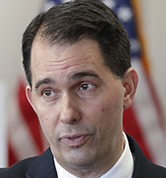
“For our next two years in my state, we will end with a structural surplus of $499 million.”

Scott Walker says $499 million ‘structural surplus’ is ahead
The education funding cuts in Gov. Scott Walker’s proposed 2015-’17 budget rankled critics because at one point a nearly $1 billion surplus was projected for the start of that budget.
Walker and fellow Republicans returned much of the surplus to taxpayers in 2014, and then slower-than-predicted growth in tax collections further boxed in the GOP entering the new budget cycle.
Now, while campaigning for president, Walker eagerly touts his budget as fiscally responsible.
He is even using the “S” word again — surplus.
“At the end of the budget we’re debating right now for our next two years in my state, we will end with a structural surplus of $499 million — nearly a half-a-billion dollars on the structural side of things,” Walker said in a May 9, 2015 speech at the South Carolina Freedom Summit in Greenville.
Wait, his budget cuts education but it ends up in a surplus?
All the claims and counterclaims about deficits and surpluses can get confusing. Let’s look more closely at this one.
First, note the modifier “structural” in front of “surplus.”
That’s important. Walker is talking about a particular measure of a budget’s fiscal responsibility, one published regularly by the nonpartisan Legislative Fiscal Bureau.
It’s usually called the “structural deficit” or “structural surplus,” but even that name is misleading.
The measure is not a prediction of whether the next budget will be in balance. By law it has to be.
Rather, it is a tally of the size of the budget challenge lawmakers will face in the following budget (2017-’19) based on the spending and taxing decisions they are making in the upcoming one. Think of it as a rough projection of the amount of tax-collection growth the Legislature and governor will need to balance that 2017-’19 budget.
It’s rough because the Fiscal Bureau doesn’t try to guess how much tax collections might rise or fall, or factor in demand for Medicaid health programs.
But it gives lawmakers an idea of how decisions they are making might affect state finances going forward.
The Fiscal Bureau examined Walker’s 2015-’17 budget plan and said it would create a positive balance of $300 million in year one of that 2017-19 budget and another $199 million in year two. This is the report that Walker spokeswoman Laurel Patrick cited to back up his claim.
That adds up to $499 million, as Walker said. His own budget document published a similar number.
Behind the numbers
Much of the “structural surplus” traces to Walker’s proposed cut in aid for local school districts and to timing factors in the way Walker funds school tax credits, said Dale Knapp, research director at the Wisconsin Taxpayers Alliance.
“You generally run into structural problems when, in the second year of the budget, spending is greater than ongoing revenues,” Knapp said. “That is not the case in the governor’s proposal.”
Another expert agreed with the numbers, but found fault with how Walker phrased the deficit number as a done deal, when it’s not through the Legislature yet.
“He assumes that the budget will pass exactly as he proposed it, and we all know that won’t happen,” said Jon Peacock, head of the Wisconsin Council on Children and Families’ Wisconsin Budget Project. “Even the governor has been urging changes to the budget.”
That’s a fair point; the budget is still in the sausage-making stage.
Peacock raised a larger criticism of using the structural imbalance number as a measure of the state’s fiscal condition.
Lawmakers and governors have learned how to game a once-useful tool, he said. For instance, Peacock said, Walker’s budget unrealistically assumes a popular form of school aids will disappear in the following two-year budget.
Knapp, too, called the school aid change “a bit of an accounting trick” that seems designed only to inflate the size of the structural surplus.
Our rating
Walker said a sign of his restoring fiscal responsibility was that “For our next two years in my state, we will end with a structural surplus of $499 million.”
A reliable, independent source made that estimate, so the figure is solid. Walker, though, makes it sound like a done deal when the budget is still undergoing legislative review.
We rate his claim Mostly True.
Our Sources
Emails with Dale Knapp, research director, Wisconsin Taxpayers Alliance, May 19, 2015
Emails with Jon Peacock, director, Wisconsin Budget Project, May 20, 2015
Emails with Laurel Patrick, Gov. Scott Walker’s press secretary, May 20, 2015
Interview with Bob Lang, director, Wisconsin Legislative Fiscal Bureau, May 20, 2015
Legislative Fiscal Bureau, 2015-17 and 2017-19 General Fund Budget, March 16, 2015
Department of Administration, Budget in Brief, page 33, General Fund Condition Balance, February 2015
The Wisconsin Budget Project, The Wisconsin Budget Process, undated
PolitiFact Wisconsin, Truth-O-Meter item, Nov. 19, 2013
PolitiFact Wisconsin, Truth-O-Meter item, Oct. 22, 2014
Milwaukee Journal Sentinel, "State budget shortfall projected at nearly $1.8 billion," Sept. 8, 2014