“One-third of our college grads leave Ohio within three years.”

Gov. John Kasich says one-third of Ohio’s college grads leave the state within 3 years
Ohio Gov. John Kasich has been giving a lot of speeches lately to a variety of groups but the message is typically the same: that, in his opinion, the state was on life-support when he took office in January and is slowly recovering thanks to his initiatives.
To drive his point that Ohioans have become increasingly disenchanted with the Buckeye state, the Republican leader suggests that many college graduates are giving up hope of ever making a career here and instead are choosing to leave to pursue life elsewhere.
“One-third of our college grads leave Ohio within three years,” Kasich said at a highway engineers conference in Columbus on Oct. 25. “We lose our best and brightest.”
Losing 1 in every 3 Ohio college graduates would be a classic example of what academia has come to refer as the “brain drain.” PolitiFact Ohio wanted to know whether the governor accurately captured the girth of the problem.
To start, the statement seems to overlook the fact that not all college graduates are Ohioans to begin with.
The Ohio State University, for example, is one of the largest universities in the country with more than 56,000 undergraduate and graduate students on its main campus. About 22 percent of them are not Ohio natives. It stands to reason that some would return to their home state or be recruited for work outside of Ohio.
That point aside, we decided to look at Kasich’s point of reference.
His information comes from the Ohio Board of Regents, which in 2008, under a previous administration, said that just 66 percent of Ohio public college grads were still in the state three years after graduation. Then-Chancellor Eric Fingerhut aimed to raise that figure to 70 percent by 2017.
The Regents said that figure still holds today. Regents spokeswoman Kim Norris said 66 percent of Ohio’s Spring 2008 public college graduates were employed in Ohio during the fourth quarter of 2010.
To put it in numerical terms, Ohio had 39,736 graduates — associate, Bachelor’s, graduate and professional degrees and certificates combined — in Spring 2008 and 26,082 of them were working in Ohio late last year.
Norris said the Regents came up with the figure by cross-matching college graduates with employment data from the Ohio Department of Job & Family Services.
But there is a catch.
The Regents figures only count people who are employed. It assumes the other 33-percent left the state. That would support the governor’s statement, but isn’t it possible that many of those 14,000 people earning degrees in 2008 are still in Ohio and unemployed?
Norris conceded that also could be the case.
Ohio’s unemployment rate in September was 9.1 percent, matching the national rate. There were more than 530,000 Ohioans out of work and actively looking for a job, according to data from the Ohio Department of Job & Family Services.
The Board of Regents did not have a figure of 2008 college grads who were still in Ohio three years later that includes those that might be unemployed. PolitiFact Ohio thinks it is safe to say that there are not just two options at play here for those college graduates: that either they found a job here or that they left Ohio. Unfortunately, given the state and nation’s economy, some are likely unemployed and looking to put their college degrees to work.
If the 9.1 percent unemployment rate is applied to the 14,000 people who earned degrees but are not employed in Ohio, it accounts for 1,274 people. That would amount to slightly more than 3 percent of the people who got degrees in 2008.
The governor is making a salient point, that as the economy limps along, bright, young minds might be encouraged to look for their opportunities elsewhere and that should worry anyone concerned for Ohio’s future.
The Board of Regents figure does not account for the possibility some of those grads didn’t leave, but are unemployed. That’s information that provides clarification.
And even if the unemployment rate is taken into consideration, the figure the governor used is still in the ballpark.
And the message behind his statement, that Ohio is losing some of its youngest talent, is a accurate.
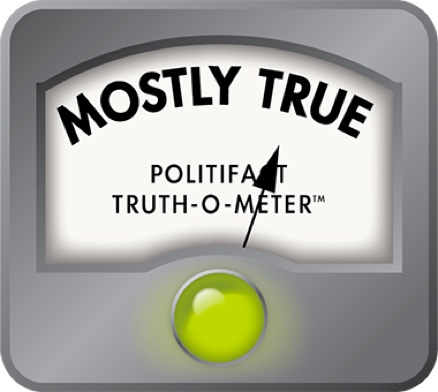
On the Truth-O-Meter, we rate the governor’s statement Mostly True.
Our Sources
John Kasich comments at the Ohio Transportation Engineering Conference, Columbus, Oct. 25, 2011
Phone interview with Kim Norris, spokeswoman, deputy chancellor, Ohio Board of Regents, Nov. 15, 2011
Ohio Board of Regents chart: "In-state retention of Spring 2008 graduates by degree level"
The Plain Dealer, "Study: 60 percent of Ohio's college grads expect to leave the state," June 15, 2009
Ohio Department of Job & Family Services, September unemployment
The Ohio State University, statistical summary