Allen says China owns more U.S. bonds than Americans
Republican Senate candidate George Allen said recently that the U.S. is indebted to China, and not in a good way.
“China owns more of our bonds than do Americans,” Allen said in a July 2 interview with the NBC 29 television station in Charlottesville. “That’s not a good position to be in.”
Are China’s holdings of U.S. government debt larger than the amount Americans own? We checked to see if that was true.
The national debt stands at $14.3 trillion. Nearly $6 trillion of that is held by the Federal Reserve and U.S. government agencies in various funds such as the Social Security Trust Fund.
The rest of the amount, about $8.3 trillion, is “privately-held” debt owed to mutual funds, pension funds, foreign investors and other bond holders.
There’s no doubt China holds a lot of U.S. government debt. In fact, it’s the largest foreign owner of U.S. Treasury securities.
As of March 2011, China owned about $1.2 trillion of U.S. debt – more than a quarter of the total $4.5 trillion in U.S. treasuries held by foreign investors, according to statistics from the U.S. Treasury Department. But the rest of the roughly $3.8 trillion of privately held debt was owned by United States investors such as banks, pension funds and mutual funds.
So there’s no way that China owns more U.S. debt than domestic investors.
But Bill Riggs, an Allen campaign spokesman, told us that when the former governor said China held more bonds than Americans, he was referring to debt held by ordinary American investors.
To support that narrower contention, the Allen campaign sent us a couple of reports from the U.S. Treasury to argue that regular American investors’ U.S. debt holdings were less than China’s.
Allen’s campaign pointed to an April 2011 Treasury report showing the June 2010 amount of foreign holdings of U.S. securities, which includes treasury securities as well as other investments including stocks and debt owed by U.S. agencies.According to the report, China had $1.6 trillion of U.S. securities.
Riggs then sent us a Treasury Department table showing the breakdown of how much U.S. Treasuries are held by various classes of investors.
That chart breaks out holders of U.S. treasuries into about 10 groups such as U.S. banks, savings bonds, pension funds, insurance companies, mutual funds, foreign investors, state and local governments and a miscellaneous “other investors” category.
Riggs said the campaign tallied up the total debt held by what Allen termed American investors. Allen’s campaign included debt tied up in U.S.savings bonds, private pension funds, state and local government pensions and mutual funds.
Investors in those funds held a total of $1.5 trillion of debt in June 2010, Riggs said. The Allen campaign did not include in its calculations U.S. Treasury debt held by banks, insurance companies, state and local governments outside their pension funds or tallies from the “other investors” category.
That $1.5 trillion tally that Allen attributes to American investors is less than the $1.6 trillion attributed to China in Treasury’s April report.
But there are serious flaws with the Allen campaign’s reasoning.
First of all, Allen’s rationale is an apples-to-oranges comparison.
The smaller $1.5 trillion tally for so-called American investors only includes U.S. Treasury securities. But the larger $1.6 trillion tally linked to China includes not just Treasury debt, but other investments a well — such as stocks and corporate debt.
Derek Scissors, an economist who specializes in Asian affairs at the conservative Heritage Foundation, said the two numbers are not measuring the same thing.
“It’s not a comparable number,” Scissors said. “They’re trying to build a skewed case.”
Scissors was also skeptical of how the Allen campaign defined debt held by regular American investors. If the Allen campaign was going to count debt held by mutual funds, Scissors wondered why they didn’t include debts held by U.S. banks.
Scissors also said some portion of the “other investors” category, which held $1.2 trillion of U.S. treasury debt in June 2010, would certainly include some debt owned by Americans.
But Allen’s calculations for American-held debt doesn’t count a penny of debt held in that category, which includes debt held by individuals, government-sponsored enterprise and businesses.
For the record, we checked a pair of Treasury Department charts to get the latest official tally of how much U.S. treasury securities were owned by China. As of December 2010 — the most recent month for which we could find comparable data — mainland China and Hong Kong (which are reported separately) together held nearly $1.3 trillion in U.S. Treasury securities. In that same month, the investor categories comprising Allen’s definition of regular investors held $1.6 trillion in U.S. securities.
To sum up:
Allen said China owns more U.S. bonds than Americans. That statement is wrong on its face, but the Allen campaign offers a qualifier — his spokesman said Allen’s statement is a reference to regular American investors.
But the reports Allen cites are not comparable and don’t even prove that narrower assertion.
Official debt tallies, even using Allen’s definition of ordinary American investors, show U.S. citizens held more government debt than China.
As an added defense, Allen’s campaign said Federal Reserve Chairman Ben Bernanke in February testified before Congress that he thinks China owns more than $2 trillion of U.S. government bonds. That still doesn’t prove Allen’s point.
The bottom line is that Allen’s methodology of including some U.S. investors and ignoring others is highly questionable, and his evidence doesn’t add up to his conclusion.
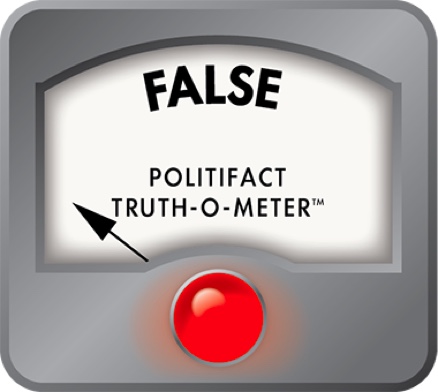
We rate the claim False.
Our Sources
NBC 29 WVIR-TV story, "Allen and Kaine campaign in Crozet on foot and horseback,", July 2, 2011.
E-mail from Bill Riggs, Allen campaign spokesman, July 7, 2011.
Interviews with Bill Riggs, July 7, 2011.
E-mail from Barry Bosworth, senior fellow at the Brookings Institution, July 6, 2011.
Interviews with Derek Scissors, an Asia economist at the Hertitage Foundation, July 6, 2011 and July 7, 2011.
U.S. Treasury, "Ownership of federal securities,"June 2011.
U.S. Treasury, "Major foreign holders of treasury securities,"accessed July 7, 2011.
Heritage Foundation report, "Chinese investment in the U.S., $2 trillion and counting,"March 1, 2011.
Bloomberg, "U.S. investors regain majority holding of treasuries,"Aug. 9, 2010.
U.S. Treasury, "Report on foreign portfolio holdings of U.S. securities,"April 2011.
CNN Money, "Our dollar, China’s $2 trillion problem,"February 9, 2011.
Congressional Research Service, "China-U.S. trade issues,"June 2, 2011.
PolitiFact, "Herman Cain says China holds 26 percent of U.S. Debt,"April 22, 2011.
PolitiFact, "Rep. Allen West says China holds 29 percent of U.S. debt,"June 14, 2011.