“Six institutions in our country now control two thirds of the capital.”

Rep. Marcy Kaptur critical of power in hands of a few banks
Whether she’s blasting Wall Street greed in Michael Moore’s 2009 movie “Capitalism, a Love Story,” or urging homeowners who face foreclosure to squat in their own homes, Rep. Marcy Kaptur has emerged as one of Congress’ most vocal critics of large financial institutions.
The Toledo Democrat repeated many of her criticisms in an interview on MSNBC’S Dylan Ratigan show, where she criticized the nation’s biggest banks for “reckless” conduct that led to the nation’s foreclosure crisis.
“Six institutions in our country now control two thirds of the capital,” Kaptur said, who contends financial power should be returned to community banks and credit unions with ties to the areas where they do business. “That’s too much. It’s too much power in too few hands.”
The statistic Kaptur cited sounded like a big chunk of change for a few institutions to control, so we asked where her numbers came from.
Her office cited a book called “13 Bankers” by MIT economist Simon Johnson and James Kwak which contains a table that examines the growth of the nation’s six biggest banks: Morgan Stanley, Goldman Sachs, Wells Fargo, Citigroup, JPMorgan Chase, and Bank of America.
According to the chart, the assets of those banks grew from less than 20 percent of the nation’s Gross Domestic Product in 1995, to roughly 60 percent today. The book argues that these “too big to fail” institutions harm the economy because they stifle competition and take excessive risks because they know the government will bail them out of a disaster. Federal Reserve data backs up Johnson’s contention that the six large banks control assets that are roughly 60 percent of the nation’s gross domestic product.
The statistic that inspired Kaptur’s remarks checks out, but there’s a problem with her statement. The chart refers to bank assets, not bank capital, as Kaptur said. And there’s a big difference between the two.
Assets encompass everything a bank owns, including buildings and loans to customers. Capital is what’s left on a bank’s balance sheet after its liabilities – like customer deposits that can be withdrawn at any time – are subtracted from assets. The federal reserve considers banks to be adequately capitalized if their capital is more than eight percent of its assets, says Emre Ergungor, a senior research economist at the Federal Reserve Bank of Cleveland.
Johnson said Kaptur’s underlying point about the concentration of power in the hands of a few banks was correct.
“My overall assessment – Rep. Kaptur should have said ‘six institutions in our country now have assets worth over 60 percent of GDP’ (or less technical words to that effect),” Johnson said in an e-mail. “But she is right that (a) the size of assets controlled by our largest institutions has gone up a lot in recent years, including after the financial crisis, and (b) this is an economic problem of first order importance for the United States — this is the point of 13 Bankers.”
We agree with Johnson. And had Kaptur said something like that, she would have rated higher on the Truth-O-Meter.
A basic tenet PolitiFact uses to evaluate statements is that words matter. In this case, by using the word “capital,” rather than “assets,” she turned the accuracy of her statement upside down.
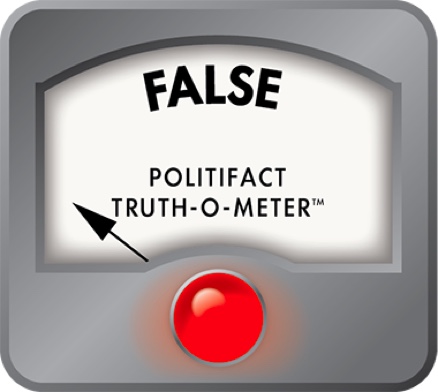
That’s why we rate her statement as False.
Our Sources
MSNBC, Marcy Kaptur interview on the "Dylan Ratigan Show," Nov. 23, 2010
Simon Johnson and James Kwak, "13 Bankers," 2010
Federal Reserve bank data on assets of the 50 largest banks.
Interview with Federal Reserve Bank of Cleveland economist Emre Ergungor, Dec. 16, 2010
Email from MIT economics professor Simon Johnson, Dec. 17, 2010