U.S. deficits and the debt in 5 charts: A 2018 midterm report
As the midterm election campaign approaches its climax, the federal deficit has pushed its way back into the political discussion.
Just a week before the midterm elections, President Donald Trump emphasized his hard-line stance on restricting immigration. In an interview, he not only took aim at birthright citizenship -- the longstanding policy that virtually anyone born on U.S. soil has citizenship -- but also said he could use an executive order to do it.
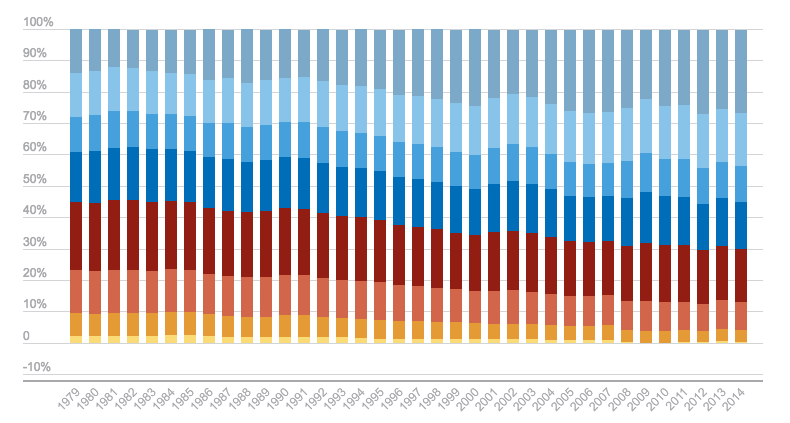
The Tax Cuts and Jobs Act of 2017 -- the large tax bill passed by the Republican Congress and signed by President Donald Trump -- is not getting mentioned much on the midterm campaign trail, perhaps because the public seems to be lukewarm on whether it was a good idea. But taxes, like death, are among the few certainties in life. So we decided to take a graphical look at both the new tax law and the broader landscape of taxation in the United States.
Sen. Elizabeth Warren, D-Mass., punched back at President Donald Trump on Oct. 15 when she released DNA test results showing that she has a Native American ancestor. Trump and Warren had sparred ever since Trump began calling her "Pocahontas" for saying on law school faculty forms that she had Native American ancestry, citing family lore from Oklahoma.
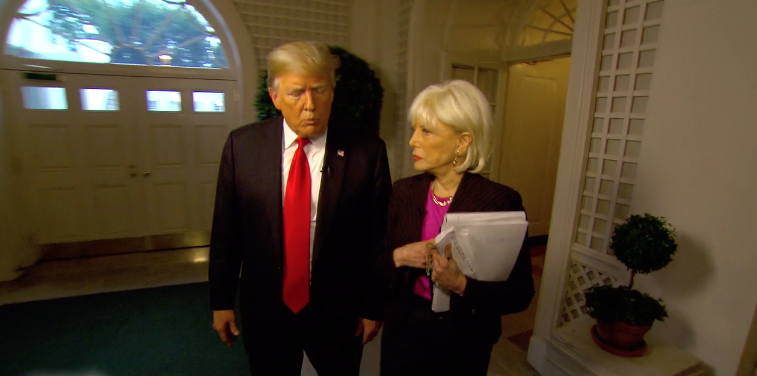
In an Oct. 14, 2018, interview on CBS’ 60 Minutes, President Donald Trump addressed a wide range of topics. Here’s a rundown of some of the assertions Trump made during the interview with Lesley Stahl.
President Donald Trump brought his battle with Democrats onto politically sacred ground, accusing them of forcing the death of Medicare. Trump moved from 280-character tweets to a 4,900 character op-ed in USA Today to paint a doomsday picture if Medicare for All became the law of the land. With the help of experts, we fact-checked some of his claims.
In his historic testimony before the Senate Judiciary Committee, Supreme Court nominee Brett Kavanaugh defiantly accused Democrats and the Clintons of orchestrating a political "hit" to keep Kavanaugh off the country’s highest court. The statement was controversial enough. But some heard Kavanaugh go even further, saying that if confirmed to bench, "what goes around comes around."
In our politically polarized era, few issues are as polarized as gun policy. As part of our effort to analyze key issues in the 2018 midterm elections through a handful of graphics, here are some of the factors shaping the gun policy debate today.
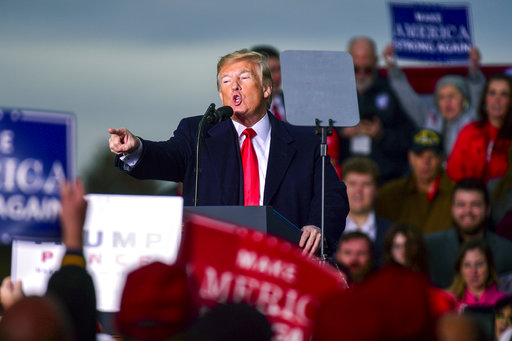
For the second time in two months, President Donald Trump traveled to friendly territory in West Virginia to hold one of his signature campaign rallies. At the rally, in Wheeling, W.Va., Trump boosted the candidacy of Patrick Morrisey, who is challenging U.S. Sen. Joe Manchin, a Democrat. Trump repeated many of his favorite applause lines from previous rallies, including praise for the state of the economy and shots at Democrats over immigration policy, gun control, and his tax law. Here are some of the lines from his speech, fact-checked.
In the course of four hours, Ford talked about an assault in a bedroom some 36 years ago before the Senate Judiciary Committee. It’s an account that Supreme Court nominee Brett Kavanaugh later vehemently denied.
Trump defended his Supreme Court nominee as a good man of the highest caliber hours after a third woman accused Brett Kavanaugh of sexual misconduct.
As senators weigh the Supreme Court nomination of Brett Kavanaugh amid allegations of sexual misconduct, many Americans are thinking back to a previous example of accusations against a Supreme Court nominee.