The Promise
"Joe Biden will direct the CDC to provide specific evidence-based guidance for how to turn the dial up or down relative to the level of risk and degree of viral spread in a community, including when to open or close certain businesses, bars, restaurants, and other spaces; when to open or close schools, and what steps they need to take to make classrooms and facilities safe; appropriate restrictions on size of gatherings; when to issue stay-at-home restrictions."
Promiser:
Joe BidenPromise Group:
Current Status
Updates
Biden used evidence for COVID-19 guidance, but experts say other factors likely influenced decisions
When Joe Biden took office in January 2021, Americans were fed up with government officials closing schools, recreational facilities and businesses because of COVID-19.
Biden promised that his administration would use scientific evidence to evaluate risk of viral spread in the community to advise the public on when to open or close businesses, schools and other common spaces. Biden also promised that the Centers for Disease Control and Prevention would recommend steps to make facilities safe.
Biden's promises were rooted in criticism of President Donald Trump's handling of the pandemic. Trump gets credit for Operation Warp Speed, which quickly led to the development of vaccines. But Trump also was part of the downplay and denial about COVID-19.
In rating Biden's progress on our Biden Promise Tracker, we are not evaluating whether Biden should have sought closures to protect public health. There has been a lot of research and news reports about the negative effects of closures on workers, businesses, the economy and schoolchildren. Our task in evaluating this promise is to determine whether Biden achieved his pledge to use evidence to determine COVID-19 openings and closings. We rate promises not on the president's intentions or effort, but on verifiable outcomes.
But there was a challenge with Biden's promise from the outset: The federal government lacked the power to enact most of these closures. State and local officials decided whether to close schools, beaches, restaurants and bars.
"By 2021 and certainly by 2022, the public simply would not accept compulsory school or business closures," said Lawrence Gostin, director of Georgetown University's O'Neill Institute for National and Global Health Law.
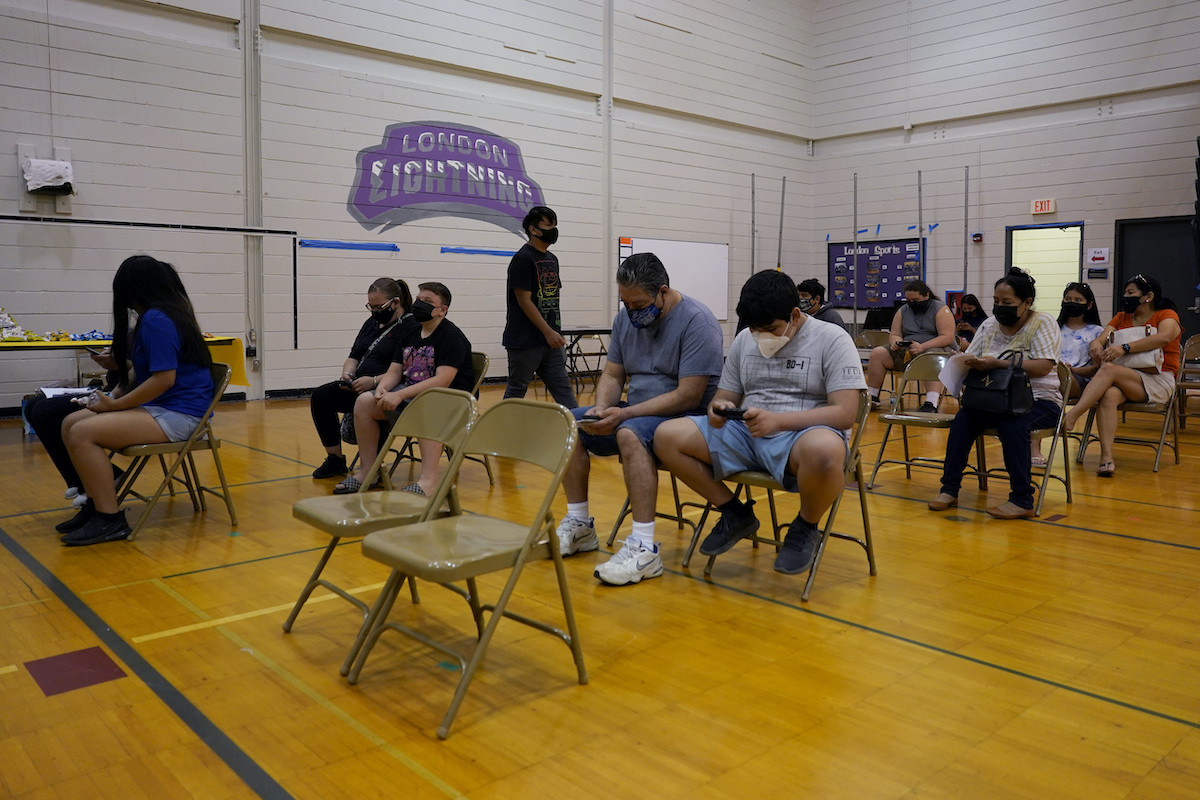
Students and parents sit and wait June 11, 2021, after being administered their second dose of the Pfizer COVID-19 vaccine at a clinic at London Middle School in Wheeling, Ill. (AP)
Weeks into Biden's presidency, the Centers for Disease Control and Prevention published color-coded charts showing the amount of community viral spread and recommended that schools use data to decide whether to reopen.
The CDC issued the "test to stay" guidance in December 2021 to reduce the number of children sent home to quarantine. The administration sent COVID-19 tests to schools and replaced the CDC guidance that had said exposed children should quarantine for 10 days.
Beyond schools, the Biden administration generally assumed that other buildings such as restaurants, offices or stores would remain open.
The CDC issued masking and testing recommendations. Some states followed them; others did not.
"President Biden has had significant success in doing one thing that is most important in the midst of a pandemic," Gostin said. "He charged CDC with the task of evaluating the science regarding the risk of school and business closures. Throughout the pandemic, I cannot think of a single time when the White House interfered with CDC's research or censored its findings."
However, the CDC could not definitively determine how much school and business closures reduced COVID-19 risk, Gostin said.
By 2022, the CDC began to significantly relax containment measures.
"That was directly the result of considerable pandemic fatigue and a widespread resistance of the public to complying with strict measures," Gostin said. The "CDC and the White House were being realistic and tempering their recommendations."
The Biden administration considered science, but also appeared to take into account other factors, said Wendy Parmet, a Northeastern University law professor.
"If we read Biden's 'promise' to mean that the Administration would consider science and not traffic in misinformation, I think it largely kept its word. But almost surely politics, economics, and law affected some of the policies," Parmet said.
In spring 2023, the Biden administration ended the COVID-19 public health emergency, which meant there was no longer a uniform federal requirement for states and counties to track COVID-19's spread.
As of December 2024, the CDC's website page about how to protect yourself and others from COVID-19 doesn't mention closures. It recommends staying up to date with vaccines, washing your hands and staying home if you're sick.
Joe Antos, a health policy expert at the conservative American Enterprise Institute, said the Biden administration or the CDC could have done more to update recommendations when it was clear that young people were least at risk. Failing to do so meant that most schools were closed "well after the facts were known," he said.
"This resulted in major learning losses that have proven to be difficult to overcome," Antos said.
"By one measure, he was successful because he trusted our nation's scientists to do their work and to make evidence based recommendations," Gostin said. "But by another measure, it was an abysmal failure because it fomented distrust in science and public health, and caused a pushback against vaccinations."
Experts say that the federal government used science-based evidence to issue COVID-19 lockdown guidance, consistent with Biden's original promise. But experts said scientific evidence was not the only factor and that the federal government did not update its guidance quickly enough as new evidence emerged.
We rate this promise Compromise.
RELATED: Four years after shelter-in-place, COVID-19 misinformation persists
RELATED: How did Biden progress on 99 campaign promises? A look at our Biden Promise Tracker
CDC issued guidance throughout Biden’s first year on school openings, but did it matter?
By the time Joe Biden took office several months after the pandemic began, Americans were tired of dealing with closures of K-12 schools, businesses and public spaces. During the start of his tenure, one of the main challenges Biden faced was how to proceed on his promise to use evidence to guide openings and closings.
As president, Biden has power to set rules for federal facilities and for transportation, such as mask mandates for airports and airplanes. But he doesn't have the power to open or close schools or businesses.
School openings have been closely watched by parents across the country. But state leaders usually set policies for schools, with some schools also setting their own rules, said Christine Pitts, a resident policy fellow at the Center on Reinventing Public Education.
"In reality, the feds have almost no oversight in what happens at the state level," Pitts said.
When Biden took office, about half of students were attending virtual-only schools, according to Burbio, a website that tracks school opening data nationwide.
In February 2021, the Centers for Disease Control and Prevention recommended that schools use universal masking, keep everyone 6 feet apart, clean regularly, and prioritize the vaccination of teachers and quarantines. Some health experts criticized parts of the guidance, saying it overemphasized cleaning and would have led to too many schools shutting down. By that point, millions of students were already back at in person school at least some days each week.
The CDC issued multiple updates on schools throughout 2021 including the "test to stay" guidance in December that aimed to reduce the number of children sent home to quarantine.
Beyond schools, the Biden administration generally operated under the assumption that businesses and facilities would be open. The CDC guidance focused on best practices to safely operate — such as guidance for workplaces about masks, ventilation and COVID-19 testing, and mandating vaccines for federal workers. The Biden administration's vaccine mandate for large businesses and health care workers has been tied up in litigation with rulings expected soon by the U.S. Supreme Court.
Some experts called on the Biden administration and the CDC to improve how it communicated about the guidance.
Glen Nowak, co-director of Center for Health & Risk Communication at the University of Georgia, said the Biden administration has "deferred to the CDC for advice and direction and what to tell schools and states."
But the "problem with COVID as we have seen is the science, data and evidence are all dynamic and keep changing," Nowak said.
At the end of 2021 as the omicron variant was surging, the CDC shortened the recommended isolation period from 10 to five days for people who are asymptomatic or their symptoms are lessening. Some public health experts criticized the new guidance because it didn't include a testing requirement. At the start of the new year, there was a shortage of at-home tests and in-person appointments were hard to come by as people in some cities waited in long lines.
"To me, this feels honestly more about economics than about the science," Yonatan Grad, an associate professor of immunology and infectious diseases at the Harvard T.H. Chan School of Public Health, told the New York Times.
The CDC said that the change was motivated by science demonstrating that the majority of transmission occurs early in the course of illness. That new guidance also came at a time when some industries were struggling with staff shortages in part due to employees having to quarantine.
Overall, the Biden administration has been using science-based guidance in most cases, but its decisions have also been met at times with criticism and controversy.
We will continue to monitor the Biden administration's guidance on openings and closings. For now we continue to rate his progress In the Works.
RELATED: Events within and beyond Joe Biden's control stymied progress on COVID-19 in his first year
CDC issues guidance on school reopenings amid COVID-19
Millions of parents are watching President Joe Biden's efforts to safely reopen schools closed by the COVID-19 pandemic. But it remains to be seen whether new guidance from his administration will influence decisions by local school districts or state officials.
The school safety guidelines issued Feb. 12 by the Centers for Disease Control and Prevention recommended universal masking, keeping everyone 6 feet apart, regular cleaning, quarantines and contract tracing for new cases.
The CDC says schools should be the last settings to close and the first to reopen, making them a higher priority than businesses such as restaurants, bars and gyms.
The guidance says teachers should be a high priority for vaccines, although states set the rules for eligibility. (Teachers are eligible to get the vaccine in more than half of U.S. states, the New York Times found.)
The CDC developed a color-coded tool to guide decisions based on transmission levels — positive tests and new cases — each week.
If it were strictly followed, many schools would be closed. In communities with high transmission, the CDC recommends that elementary schools use hybrid instruction while middle and schools hold virtual classes.
Dr. Rochelle Walensky, CDC director, said on CNN Feb. 14 that 90% of communities had a high rate of transmission. (She lowered it to 75% on Feb. 17.)
"We really don't want to bring community disease into the classroom," she said.
With the recommendations out, it's not clear what comes next. The CDC guidance may not lead to any changes in states such as Florida, where schools have been open for months. Many school boards have already made their plan for virtual, hybrid or in-person learning.
During a CNN town hall in Milwaukee, Biden reiterated his goal to open the majority of K-8 schools by the end of the first 100 days. "The goal will be five days a week," he said Feb. 16. (K-8 schools are considered to pose less risk than high schools because younger children seem to transmit the virus less.)
As of mid-February, the majority of K-12 students attend schools that offer in-person learning, either every day or some days of the week, according to Burbio, which aggregates school data nationwide.
While public health experts for months have been in agreement about the need for strategies such as mask wearing, some experts criticized parts of the CDC guidance. For example, two public health experts wrote that the guidance about when to close based on community transmission levels is unnecessary and will keep millions out of school.
In a Washington Post op-ed, Joseph G. Allen, an associate professor of exposure assessment science at Harvard University, and Helen Jenkins, an associate professor of biostatistics at Boston University, pointed to the CDC's own conclusions that "there has been little evidence that schools have contributed meaningfully to increased community transmission."
The professors also said the guidance overemphasizes cleaning.
"There isn't a single documented case of COVID-19 transmission through surfaces, so why is the CDC emphasizing things such as cleaning outdoor playground equipment that have no bearing on exposure or risk? Shared air is the problem, not shared surfaces," they wrote.
At this point in the school year, districts across the country have generally set their policies on school operations amid COVID-19, although some are considering or negotiating over bringing back students.
School officials have said that some CDC recommendations are a challenge to meet, such as keeping students 6 feet apart.
"Our population in the school is much larger than it was in August. So, 6 feet is almost impossible to achieve within the classrooms," Pinellas Classroom Teachers Association President Nancy Velardi told Bay News 9. "They do use it for meetings and other things, but it's more like between 3 and 4 feet in the classroom now."
During a CNN town hall in Milwaukee, Biden reiterated his goal to open the majority of K-8 schools by the end of the first 100 days. He said "the goal will be five days a week."
The CDC's guidance to schools is a step toward Biden's promise to use evidence to determine school openings and closing. We will be watching to see if Biden makes progress toward his goal. For now we rate this promise In the Works.
Biden issues order on safely reopening schools
President Joe Biden issued an executive order to support the opening and continued operation of schools.
"It is the policy of my administration to provide support to help create the conditions for safe, in‑person learning as quickly as possible," Biden wrote in his Jan. 21 order.
Biden's order directs the Secretary of Education and the Secretary of Health and Human Services to provide evidence-based guidance to assist states and elementary and secondary schools. The decisions on whether and how to reopen for in-person learning should include implementing measures such as cleaning, masking, proper ventilation and testing.
During the campaign, Biden promised to direct the U.S. Centers for Disease Control and Prevention to provide evidence-based guidance on whether to open or close businesses and schools. This is one of 100 promises we are tracking on our Biden Promise Tracker.
Before he took office, Biden spoke about his goal to "safely reopen the majority of our K-8 schools by the end of the first 100 days." Biden likely left high schools out of that statement because teenagers are more likely to catch COVID-19 than younger students, and younger students may struggle to learn remotely.
We could not find federal data on the proportion of schools that are open, but many are, experts said. As of Jan. 20, just under half of K-12 students in the U.S. were attending virtual-only schools, according to an analysis by Burbio that aggregates school data nationwide. Just over one-third of students were attending school in person every day, while about 22% were attending hybrid schools, meaning students attend in person some days of the week.
"Many districts that were in-person at some point in the fall and took breaks due to rising COVID rates are planning returns during January and early February, so we expect the number of K-12 students in-person, either every day or hybrid, to rise regardless of federal activity in the coming weeks," said Burbio president Dennis Roche.
But just over one-third of K-12 students have not been in a classroom this year, with absences most concentrated in west coast and mid-Atlantic states, plus many urban areas, Roche said.
"Existing plans to return in-person are focused on K-5 students in these areas. When you think about 'opening schools,' the immediate area of concern is focused in these regions," he said.
While Biden's promise is about the number of schools reopening, looking at the number of students in classrooms provides a more complete picture, because there could be many small schools open while some of the largest urban schools are closed, experts said.
"The real challenge is getting the majority of students back to school, which will be harder, because the largest schools serving the most kids are in the poorest, most-COVID impacted areas, with low levels of health care access and social/government trust (justified, certainly), and high levels of COVID spread and co-morbidity," said Justin Reich, an educational researcher and director of the MIT Teaching Systems Lab.
Days before he took office, Biden announced a $1.9 trillion COVID-19 proposal, including $130 billion to help schools reopen. Biden's proposal states that schools could use the $130 billion in a variety of ways, including to reduce class sizes and modify spaces, improve ventilation, hire more janitors, and buy masks. The money can also go toward summer school or supporting students who fell behind.
Biden's plan requires buy-in from lawmakers who have formally approved $54 billion for K-12 schools in December. Biden faces a slim majority in Congress, and it's unclear how lawmakers will prioritize various aspects of Biden's $1.9 trillion proposal.
Biden's order is a first step toward his promise to use evidence to determine COVID-19 openings and closings, including schools. We will be watching to see if Biden makes progress toward his goal but for now we rate this promise In the Works.