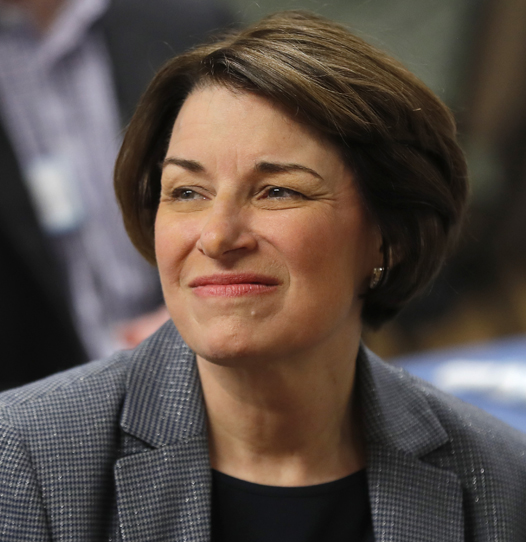
Amy Klobuchar said hate crimes are increasing. That’s right for reported incidents in the U.S.
Sen. Amy Klobuchar, D-Minn., took issue with President Trump’s response to the New Zealand mosque shooting. In an interview with CNN’s Jake Tapper, Klobuchar criticized Trump’s rhetoric for dividing people and noted that the Christchurch shooter said Trump was “a symbol of renewed white identity and common purpose.”
Tapper cited the upward trend of hate crimes in many parts of the world and highlighted the rise of white nationalism in the United States. He then asked the Democratic presidential candidate how she would fight this problem as president.
“There has been an increase in hate crimes,” Klobuchar said. “There has been an increase in very negative rhetoric at groups.”
Is Klobuchar painting a real picture of the status quo of hate crimes?
We found that several pieces of research back her up for the United States. (Klobuchar’s campaign team did not respond to PolitiFact’s request for comments.) Looking at reported hate crimes in general, the upward trend holds true.
Data has shown recent uptick of total hate crimes
Hate crimes are defined as “crimes that manifest evidence of prejudice based on race, gender or gender identity, religion, disability, sexual orientation, or ethnicity,” according to the Hate Crime Statistics Act passed by Congress in 1990.
Hate crimes can be committed against people, property or society, and can include violent attacks, robbery, as well as arson and vandalism.
The FBI reported 7,175 incidents of hate crimes in 2017 (the most recent data available). The number of offenses presents a 17 percent increase from 2016, and an uptick for three consecutive years from 5,479 incidents in 2014.
FBI’s Uniform Crime Reporting program aggregates voluntary reporting data from law enforcement agencies nationwide and identifies those offenses that constitute hate crimes. The growth of hate crimes coincide with the drop in overall violent crimes, robbery and property crimes from 2016 to 2017, meaning that the crimes resulted from biases account for a more significant percentage of crimes overall.
Crime researcher Brian Levin surveyed official local police data from 30 large American cities in 2018 and found that “this is the first time in this decade that collection of cities has hit 2,000… and has its steepest increase since 2015.”
Levin, director of Center for the Study of Hate & Extremism at California State University, San Bernardino told PolitiFact that Klobuchar’s contention is correct, after examining several data sets.
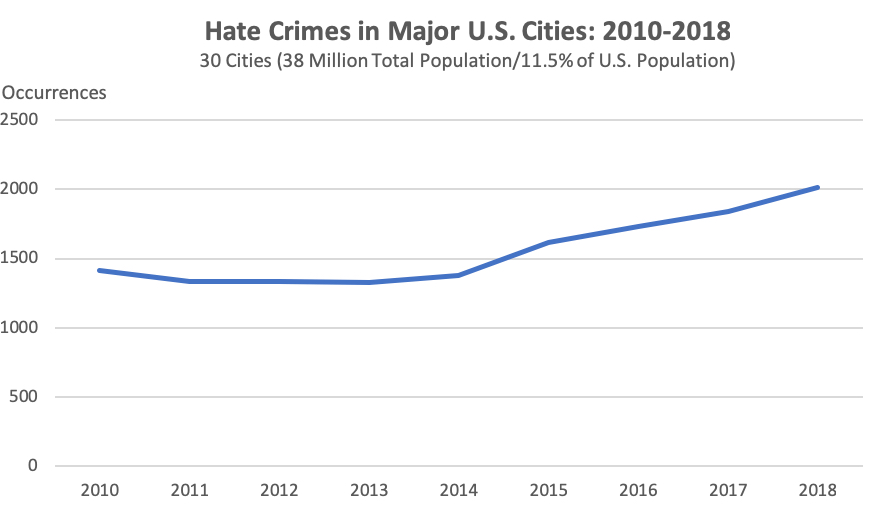
Source: Kevin Grisham and Brian Levin of the Center for the Study of Hate & Extremism-California State University, San Bernardino
Looking at cities individually, 70 percent of the cities reported an increase from 2017 to 2018, and slightly less than half hit a decade high, Levin said. The cities that recorded decade-high hate crimes include Los Angeles, Chicago, Houston, Philadelphia, Dallas, Austin, San Francisco, Fort Worth, Seattle, Washington, D.C., Louisville, Sacramento, Miami, New Orleans, and Cleveland.
However, Levin does recognize that some of the increase, especially in cities with very low numbers before, was the result of the more rigorous reporting. Emeritus professor at Carnegie Mellon University Alfred Blumstein said with the increasing national attention, people could be more ready to report hate crimes to the police and are better equipped to decide if an offense is a hate crime when targeted to members of a special group.
Both data collected by Levin and FBI has a caveat — they contain the reported crimes only. The Bureau of Justice Statistics, however, reports a much larger number of hate crimes, typically over 20,000 from 2009 to 2017. Instead of using police data, the agency conducted the National Crime Victimization Survey and counted unreported offenses where hate languages and symbols were present.
Data from the newest BJS hate crimes statistics briefing — different from the FBI data — shows that there’s a significant decrease of total hate crimes from 2014 to 2017 (the annual total is calculated with a three-year-average for each year). The analyses of victimization numbers done by Barbara Oudekerk, a statistician at BJS, indicate that reported incidents, which are often reflected in the FBI data, have increased, while unreported incidents almost decreased by half. More recently, the total numbers from 2015 to 2017 didn’t change much.
This set of data has the limitation that it does not include crimes against organizations and relies on sampling.
Finally, there is also some truth to Klobuchar’s statement about the adverse effects of negative rhetoric. After studying the pattern and seasonality in the FBI data, the Center for the Study of Hate & Extremism found that “hate crimes have increased in every presidential election year since national FBI recordkeeping began in the early 1990s.” In 2016, the spike also corresponded with the election month of November.
Levin said that hate crimes fluctuate more than usual around “catalytic, emotionally-charged events, terrorist attacks, and conflictual elections.”
“We’ve seen that hate crimes have increased not only around all elections, but Brexit as well in the UK. That’s a lesson for all of us to maybe tone down the rhetoric,” Levin said.
Our ruling
Klobuchar said that “there’s been an increase in hate crimes.” She is generally right, especially for reported hate crimes in the United States. Available FBI data shows that documented hate crime has gone up in recent years, especially since 2016—the number of incidents, offenses, and victims generally grew.
However, experts say this rise can be attributed to increased reporting, and the statistics drawn from the National Crime Victimization Survey suggest that while reported hate crimes have gone up, unreported hate crimes have not. These estimates have not seen a statistically significant increase over the past three years.
We rate this statement Mostly True.
Our Sources
CNN, Klobuchar on NZ: Trump’s rhetoric “doesn’t help”, March 17, 2019
The New York Times, Massacre Suspect Traveled the World but Lived on the Internet, March 15, 2019
FBI: UCR, 2017 Hate Crime Statistics, 2016 Hate Crime Statistics, 2015 Hate Crime Statistics, 2014 Hate Crime Statistics, 2013 Hate Crime Statistics 2012 Hate Crime Statistics, About Hate Crime Statistics, Accessed March 20, 2019
Bureau of Justice Statistics, Hate Crime Statistics, 2009-2017, March 29, 2017
The Hill, Tweet about Amy Klobuchar’s speech at the Human Rights Campaign, March 15, 2019
Email interview with Brian Levin, director of Center for the Study of Hate & Extremism-California State University, San Bernardino, March 21, 2019
Email interview with Tannyr Watkins, Public Affairs Specialist at Department of Justice, April 1, 2019
Phone interview with Brian Levin, director of Center for the Study of Hate & Extremism-California State University, San Bernardino, March 20, 2019
Email interview with Alfred Blumstein, emeritus professor of urban systems and operations research at Carnegie Mellon University, March 21, 2019
ADL, Murder and Extremism in the United States in 2018, Accessed March 20, 2019
National Police Foundation, Releasing Open Data on Hate Crimes: A Best Practices Guide for Law Enforcement Agencies, Accessed March 26, 2019
The Washington Post, “Trump says white nationalism is not a rising threat after New Zealand attacks: ‘It’s a small group of people’ “, March 15, 2019
Center for the Study of Hate & Extremism, Hate Crimes Rise In U.S. Cities And Counties In Time Of Division & Foreign Interference, May 2018
OSCE, “ODIHR Hate Crime Reporting, United States” Accessed March 19, 2019
PolitiFact, Donald Trump doesn’t think white nationalism is on the rise. Data show otherwise, March 20, 2019